A Bad Day In Duckford, One Year LaterOne year ago today, a series of severe thunderstorms rolled through the Duckford area, knocking down trees and electrical power all over the city. The third storm of the day dumped four inches of rain the space of about an hour, a deluge that caused flooding in low-lying areas (and some high-lying areas, too, come to think of it).
It also caused this:
In case you can't tell what's going on in that video, that's taken from a police cruiser's dashboard camera, and it's filming water flowing unimpeded underneath a set of railroad tracks that had had its roadbed washed away. Twenty minutes after that video was shot, a Canadian National train pulling 110 cars, including 70 tanker cars full of ethanol, rolled over that crossing. Eyewitnesses reported that the train was actually bouncing up and down as the track deflected under its weight. 12 cars derailed and exploded.
This accident, which occurred about a half-mile from Pond Central claimed the life of one motorist, injured a few others, and forced the evacuation of around 600 homes. If Pond Central had been much closer to the accident site, I would have been evac'd, too.
One year later, the site of the accident is much improved. The roadbed for the crossing has been strengthened, the pavement for the street replaced and relaid, and much of the terrain was replanted with grass. The local fire department now trains with a few of the derailed cars, practicing for the next big fire and hoping it never comes.
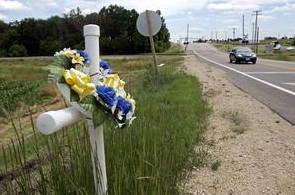
But many of the trees near the derailment site still show signs of having being burned by the blaze. And just off the tracks is a small cross, in memory of the woman who was killed in the incident, Zolia Tellez. I drive by the site once or twice a day, and imagine what it must have been like... and count myself lucky that I wasn't there when it happened. I could have been, and on a normal Friday I would have missed the incident by only an hour or so.
The NTSB is still investigating the accident, and their report isn't expected for another six months or so. A rash of train crashes, including one bad one in Washington DC a few days after the one here in Duckford, has 10 NTSB train specialists working 16 cases. The EPA has found traces of ethanol byproducts in the local drinking water, but far below any amounts that they declare to be dangerous. The massive fish die-off that occurred a month or so after the accident in a nearby river is still completely unexplained. And every now and again, a train comes through on the new rails.
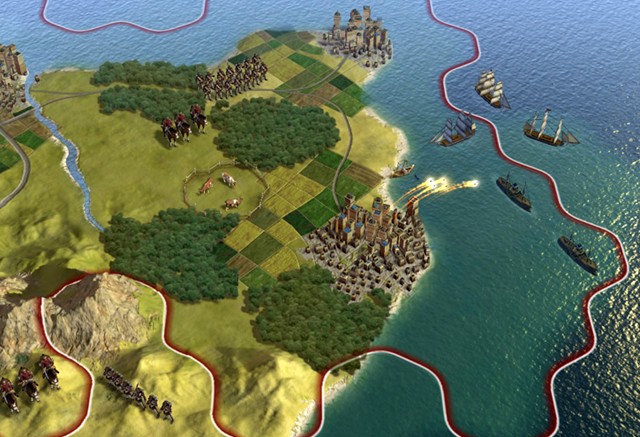
That One GameCiv 5 is scheduled to come out in the Fall, and any self-respecting strategy gamer has already written off any productivity they may have had. The release of new screenshots for the game has done nothing to alleviate that.
Oh, baby...
Any of us who have spent too much time playing for "just one more turn", no matter if it was Civ, MOO, SimCity, whatever, have That One Game. That One Game is the one where everything that happened led to an amazing climax... maybe it was a tense struggle against overwhelming odds, or an incredible occurrence. Maybe it was just a well-played blowout, who knows? But oh, it was memorable... it became That One Game.
Mine was in Civ 3, a huge map and continents. I was playing the English, started on what I wound up calling Australia: big island, green at the coasts but arid desert in the center... and practically no resources to speak of. After a while I learned sailing and found, just off to the west, a very big continent filled with all the luxuries and resources a civ could need. I also found the remains of another civ... three razed cities in the worst starting locations I've ever seen (after the game ended, I discovered it was the French. Ces't la Guerre.). Other than the home of the French, though, what I saw looked ripe for the picking... until I found what killed Napoleon. The Zulus... and they weren't happy I was there, declaring war on me and quickly overwhelming the exploring archer I had sent over. I put them out of my mind, as I had a tech lead on them, and vowed to revisit Africa soon.
Some long while later, I packed up two musketmen, a settler and a worker and sent them off to found a home base on Africa. Once I got there, though, I found that the Zulus had expanded, taking most of the good territory. So instead of colonization, I decided to make life hell for Shaka. I dumped the musketmen and worker off on what appeared to be the only road between northern and southern Africa, fortified one of them, and had the worker build a fortress. The other musketman began tearing up the any roads I could find around the fortress. Within a few turns, Shaka had had enough... and the Impi began to move. I brought the raider back to the fortress and waited. And waited. Eventually, I got a cannon over to the fortress as well.
Just in time, as it turned out. Not one, but two Stacks of Doom converged on my little fortress, one from the north, one from the west... each of them composed of nothing but Impi. Wincing, I immediately gave the fortress the name "Rorke's Drift" and crossed my fingers. By the end of the first SOD's defeat, one of my musketmen had been promoted from "regular" to "veteran," and the other was about to. Both were damaged, however, and the second stack was even larger than the first.
They held the line. One of them died, and the other had one hit point left, but they held the line. From there, the conquest of Africa was easy... almost everything Shaka had, he had thrown at Rorke's Drift, and most of them had died (some retreated).
I left that one musketman and the cannon stationed at Rorke's Drift for the rest of the game, even after I could have promoted them to other, better things. They remained untouched, even through the later nuclear war against the Germans. At the end of the little fracas that they started, the three cities closest to Rorke's Drift had been turned to radioactive rubbish, along with a few others on my side, but any German city over the size of 5 took an missile. But there they stayed.
And when the spaceship to Alpha Centauri finally arrived at its destination, I knew I had just finished playing That One Game. From then on, I have never neglected building fortifications, and I have always had a lone outpost somewhere far away from the main action... in honor of the musketmen of Rorke's Drift.
Posted by: Wonderduck at June 19, 2010 05:56 PM (iJfPN)
3
Hmm. Trying to think. There are some games I've only run through once, like X-Com, so that automatically qualifies as "That One Game" for that game. The final mission on Mars was made of pure awesome and sheer terror, like when one of my two guys carrying the heavy rocket launchers got mind-wiped and took out his entire squad.
Posted by: Pixy Misa at June 20, 2010 09:28 AM (2yngH)
4
I don't really remember specific game sessions that way. I do vaguely remember the first time I tried to assault an enemy base (on Earth) in X-Com and how utterly terrified I was, but I don't remember anything else about that particular session.
5
The 'one game' that comes to mind for me was a session of Warlord (II, I think). I had gotten a pretty good start, had one of my borders well fortified and was busy pounding on the AI on two other fronts. I'd scouted far enough ahead of my "stacks of doom" that I was fairly confident of carrying through to wipe out the two AI players I was actually engaged against. Unfortunately I hadn't scouted far enough forward to notice that Lord Bane was punching through one of them from the other direction. When our offensive forces met in the lands of our unfortunate mutual foe, I lost two major hero stacks, and shortly after that I lost most of the newly captured cities.
I quickly realized that I had nothing in the immediate rear of that campaign that was going to stop the marauding Lord Bane stacks, and at the same time I was reaching the last heavily fortified cities on the other front, where that AI was rallying for a last stand. It was pretty obvious that if I pulled those forces back, I'd end up losing a ton of ground on that front, but it was equally obvious that if I didn't come up with something really nasty to throw in front of Lord Bane quick I was going to lose a lot of key unit building territory.
What turned the looming disaster into an epic game is that I still had some scouts out on the third side of the map, just keeping an eye on the two AI players over there, and I discovered that they had never expanded onto one island, which I quickly claimed, grabbing a couple good cities, and more importantly exploring some ruins that yielded up an excellent weapon for my reserve hero, as well as a stack of dragons. I pulled together a stack of supporting units from various places that could all move quickly and rushed that hero/dragon stack down to finish off the lesser threat while I moved everything else I could free up toward a choke point facing Lord Bane. I lost maybe six or seven more cities to Lord Bane while I was finishing off the other opponent, but then I was able to pull everything back from that side of the map and send them off to the front, at which point I smashed two of Lord Bane's stacks o' doom and stopped his offense.
From that point it was just a bit of back and forth as we fought over the border cities and assembled our armies. Eventually I had three hero-led stacks o' doom ready, as well as a few support stacks to follow along and fortify cities as I took them, so I started pushing forward. Lord Bane had built up enough that I lost on stack, and the other got whittled down so far that it had to retreat, but the last stack with that one hero and his dragons took everything he could throw at it and just kept getting stronger, eventually carrying through to conquer pretty much the whole map.
And now I will go see if GoG has Warlords II in their product line...
Posted by: David at June 21, 2010 11:02 AM (oyblT)
Tech Assistance Needed, Save Squishy!
Okay, here's the story. As you may remember, my boss went on maternity leave about a year-and-a-half ago after giving birth to a ridiculously cute baby girl, whom I call "Squishy." Squishy's mom is an inveterate record-keeper, and has diligently chronicled Squishy's life via the art of digital photography, amassing a huge amount of pictures in the process.
Last night, their main computer coughed up a hairball and died. The husband of my boss has some skill with computers, so he ran some BIOS checks on the system and everything reported that the hard drive and grabbed its chest and died. Of course, this hard drive is the one that has the gazillions of Squishy photos on it, photos that they cannot replace (they have some saved in other places, but just a mere fraction of the total). Here's the thing: the HD gave no indication there was a problem, no weird sounds, nothing. It just stopped functioning. A two-hour call to tech support caused nothing but frustration, of course... frustration and a deep, deep desire to cause an immense amount of physical harm to the techie on the other end of the telephone.
When my boss came in to the Duck U Bookstore today, she told me of the situation. A quick phone call to her husband convinced me that the HD wasn't actually dead (merely pining for the fjords). I suggested that they take it out of the computer, put it into an external enclosure, hook it up to one of their other computers and see what happens. If it doesn't show up, then they know that the offending drive is dead enough that they'd need to take it somewhere to recover the pictures. If it did show up, then they know that the problem may not be the drive, but the computer itself... and they'd be able to copy the drive to the laptop.
I just got a call from them. They did put it into an enclosure, and sure enough, it appeared... well, actually, two drives appeared, at which point I slapped my forehead: of course two drives appeared, it was the boot drive from the dead system! What they were seeing was the C drive and the drive partition where the recovery stuff was kept... which is where the unexpected problem has reared its ugly head.
Y'see, when they look at what was the C drive, there's only a few folders visible, and they don't have anything in them... at least, that's what the laptop is reporting. What I think is happening, and please correct me if you think I'm wrong, is that the drive isn't showing anything because the copy of Windows that's on it obviously isn't booting, and thus the file system on the drive isn't functional (I may have the technical details wrong, but that's the net result). Further, the laptop is XP and the version of Windows on the drive is Vista, which probably causes problems too.
They're copying the drive to the laptop, and I've suggested that they go to their other desktop system (which they retired), rip out that hard drive, and plug the problem drive into it. If everything goes well, the stars align, and a choir of angelic ducks quack out paeans to the heavens, it'll boot up. At worst, they'll be in the same boat they're in now.
The tech question I have for you, the myriad readers of The Pond, is there some way to access the data from the problem drive if dropping it into a different computer system doesn't work? If the data was replaceable, I'd just suggest they find Windows on it, delete it, and see if that turns it into a normally-read drive, but I'm just WAGging there, and the chance that it'll turn the drive into a brick seems not insignificant. Can they pull the data off without the "boot Windows" running?
Another related question: is there some way to boot a laptop from an external hard drive that has Windows on it, sort of a half-arsed version of dual-booting? If they can do that, then they can save the pics to a different external drive, or burn them to DVD, or something.
Let's brainstorm, my friends. Hopefully they'll be monitoring this thread, if not tonight then tomorrow, so they'll be able to provide specific details (what folders are showing up, for example) that I don't have, but in the meantime, let me hear your best suggestions.
Squishy
You wouldn't want to disappoint Squishy, would you? How could you disappoint that face?
There are companies which are in the business of recovering data off of drives that have died. In the most extreme case they take the drive apart and move the spindle into an equivalent drive which is not dead.
But it ain't cheap. You're talking at least a thousand bucks.
2
Also, there are bootable CDs which contain a flavor of Linux which are capable of reading and understanding NTSC and FAT32 which may be able to access the drive even if Windows refuses to do so.
One last point: given that they tried and failed to access the drive using Windows, they should probably not try again. The possibility exists that Windows may damage the data that's on the drive by trying to fix the file structure, making recovery impossible.
4
They know about the data recovery places; there's one in the Rockford area. For easy "eh, it's just mostly dead" stuff, they might be able to recover data for about $200. If it's more complex, then it shoots up to $1500+.
The Linux option is one that I thought about, but I have no clue beyond just thinking about it. I know so little about what it can do that I can't help them past the point of bringing it up.
Hopefully, they'll be able to copy the drive so we don't have to worry about Windows breaking the data. I'm hopeful that a drive-swap into a different computer will work...
Posted by: Wonderduck at June 16, 2010 10:10 PM (iJfPN)
5
When my laptop drive began to fail a year or two back, I used ddrescue
to image it first. You can find it as part of a bootable CD here:
http://ubuntu-rescue-remix.org/ (warning, I've never actually used
that). Of course I was dealing with hardware failure, and not just
corruption. The advantage of running ddrescue, though, is that it makes a
complete image of the drive. You can then do whatever you need to on
the drive image (or better yet, a copy of the drive image). If you mess
that image up, use another copy (this requires a lot of spare disk
space, mind you...).
After that, I used a file catalog rebuilding
and file searching program. I'm on a Mac, so I used Data Rescue II, but
there should be some equivalent for Windows. The Ubuntu Rescue Remix CD
seems to include some open source tools as well, but I've never tried
them. Some basic instructions are here: https://help.ubuntu.com/community/DataRecovery
Posted by: benzeen at June 16, 2010 10:32 PM (WE8c2)
6
If the drive is functioning but the filesystem is scrambled, a recovery utility might do the trick. The only one I've used is Stellar Phoenix, and that was years ago, but it worked flawlessly. Very slowly, but flawlessly.
Posted by: Pixy Misa at June 16, 2010 10:49 PM (PiXy!)
7
1. Make an image of the drive, just in case. I have a sector-to-sector
USB tool to do it that also works as an external drive reader, from
Aleratec (aleratec.com). Using something like Ghost to image the drive
can also work, but I like a hardware drive to drive transfer the best.
2.
Run SpinRite, from Gibson Research (grc.com) which will do a complete
low level scan of the drive, restoring data from damaged sectors. Very
good program, inexpensive, saved my a$$ on multiple occasions.
3.
R-Studio, from R-Studio.com -- i have used it many times in the past,
and it does good work recovering broken file structures.
I know
that none of these options are free, and there are other programs that
do the same things, but if I had your problem in my office these are
the steps I'd take regardless of the program being used.
Posted by: denebola at June 16, 2010 11:24 PM (LDyD6)
image that drive asap, then run spinrite on it, if its recoverable this will work.
another options is if you can find another drive with the same exact firmwear/revision number you could swap out the green logic boards, i have done this in the past, but if they are not identical fw/rv # it may not work.
Posted by: dagamore at June 17, 2010 01:11 AM (vdcdn)
9
All the tools mentioned earlier work wonderfully in the hands of someone who is fully aware of what they're doing. But you can do unrecoverable damage if you do not fully grasp what you're doing. I get the impression that the latter is currently the case. So take the drive to a recovery place.
Posted by: Quentin at June 17, 2010 01:32 AM (KSyKn)
10
Everybody seems to be concentrating on the wrong problem, I think... they have evidence that the drive is fine, but the information isn't immediately accessible, possibly because it's no longer the "boot disc", if you get what I mean.
Is that thinking incorrect? Is there some way to circumvent the version of Windows that's on the drive? Is there some way to boot a laptop from the drive? Or "dual-boot" from an external?
Posted by: Wonderduck at June 17, 2010 06:26 AM (iJfPN)
I'm going to preface this with "I know just enough to be dangerous"
But no, the fact that it's the "boot drive" from another computer shouldn't matter when it's placed in an external enclosure. (Make sure that the master/slave settings are correct) If everything was kosher, you'd just see another drive with a "Windows" directory in it. The boot drive just means it has a master boot record in the drive's sector zero that starts the booting process. When a computer starts, it looks at the drive it's been told to boot from and does what the MBR says, which here is "start Windows". The laptop has it's own boot drive, and it's starting from that one. Any other drive attached to the system, whether or not it has an MBR is just a secondary drive.
The fact that nothing appears says to me that the drive is screwed up somehow. If you didn't care overmuch about the data on the drive, like "It'd be nice to have, but I wouldn't cry over losing it," then play with all of the tools people have listed above. However, Quentin is almost certainly right...take it to someone who knows what the hell they're doing.
Posted by: CatCube at June 17, 2010 07:19 AM (Te0W1)
CatCube is right: the fact that it's a boot partition is irrelevant. I have access to two of those right now attached to the computer I'm using: one is in an external USB enclosure, and the other is a second internal drive attached to the IDE controller. In either case the drive appears fine. If you can't see the files, there's filesystem damage. An undelete utility of some kind might fix the problem, as might a filesystem repair tool...but it might also hose the system beyond repair. Your safest bet is as others have suggested: optionally image it and then take it to a recovery service. They're far cheaper than they used to be: as you already know, it's not exactly expensive any more.
Then tell the boss to start making regular backups.
Posted by: rickc at June 17, 2010 07:49 AM (85Ro5)
13
If the drive is actually visible on another computer, and I'm not entirely sure from your description that's the case, a partition scanning utility may help. I've used find and mount in the past with success, and it's fairly straightforward to use.
http://findandmount.com/
Posted by: jml at June 17, 2010 12:22 PM (Lti64)
14
Everybody, they've decided to take your collective advice: "Take it to someone who knows what the hell they're doing." Fortunately, my boss's husband works in the IT field (though he's on the networking side, not hardware), and there's someone at his place of employ with the tools and the know-how to make it happen.
Assuming, of course, that it can be saved without the drive without being handed to people in bunny suits and taken into a clean room. We'll know soon enough. Advice is still being taken, however! Collectively, you all know more than one person...
Posted by: Wonderduck at June 17, 2010 04:30 PM (iJfPN)
I didn't mean that it takes all my readers to know more than one random person... I meant that a group is always better pooling their knowledge than one person is.
Posted by: Wonderduck at June 17, 2010 04:31 PM (iJfPN)
Further, the laptop is XP and the version of Windows on the drive is Vista, which probably causes problems too.
Try plugging the now external hard drive into a machine running Vista. I think that MS tweaked NTFS in Vista because I've formatted drives on my Vista machine that I couldn't properly read on an XP machine.
Posted by: Kae Arby at June 17, 2010 09:33 PM (jzP7W)
4The Chicago Blackhawks have won Lord Stanley's Cup, for the first time in 49 years!
And now that the Blackhawks have ended their drought, the NHL team that now holds the record for most seasons without winning the Cup is...my Toronto Maple Leafs. But I'm not bitter...
Posted by: Peter the Not-so-Great at June 10, 2010 04:06 PM (c62wM)
5
Steven, they won six championships, the last in 1998. Since then, there's been nothing but mediocrity or worse. I think it's fair to say "what have you done for me lately?"
Posted by: Wonderduck at June 10, 2010 09:28 PM (iJfPN)
Motivation
For the past few weeks, I've been realizing that I don't have much need to write. The F1 Update!s are becoming a chore. Nothing in this season of anime has grabbed me and said "hey, mention me, will ya?" I couldn't even have a topic for this year's Battle of Midway Day, despite trying for days to come up with something.
Part of it is, I'm sure, just "one of those phases" all bloggers seem to go through (or at least "thinkers" go through; I'm not sure "linkers" even need to use their brains for their blogs). Part of it is a nascent fear that I'm on the wrong side of Sturgeon's Law.
And part of it is frustration, a particular type of frustration that again every blogger goes through at one time or another. It's the frustration of seeing a post (or a series of posts) that you've put relatively large amounts of time and effort into... is being ignored completely. I'm thinking of my episodic series review of Ga-Rei Zero here, but it could apply to just about anything on The Pond (with a couple of exceptions). Nearly 26000 words and lord knows how many screencaps over 12 posts, at four hours minimum per post, and there's only 30 comments between them... and at least 10 of those are my own.
Wonderduck's Pond isn't one of the big hitters like Steven or Shamus, never will be, and I'm fine with that. I didn't start writing here because I cared if people read it, but because I wanted to write. But everybody with a comments section wants a little recognition for their efforts; me, you, the blogger who writes about plastic daffodils, everybody. Maybe the stuff here isn't worth commenting on... again, the fear of being on the wrong side of Sturgeon's Law... or maybe nobody sees it, or maybe nobody gives a rat's asterisk about commenting anymore. And The Pond's five-year anniversary is coming up...
1
I enjoyed your posts on Gai-Rei... A problem though: some of those posts refused to completely load in my browser. This is actually a general problem with your blog--some of your posts simply don't load completely. It doesn't seem to happen to any other mu.nu blogs. I think it happens more often on some of the longer image-heavy posts, but not really sure. It also happens for some of the F1 Updates.
Anyway, unless someone is paying you to blog, don't feel compelled to post if its a drag, though I'd be sad if you dropped out...
Posted by: Kayle at June 05, 2010 03:08 PM (dmU/A)
2
Just refresh the post in question, that usually loads everything in.
Posted by: Wonderduck at June 05, 2010 03:43 PM (iJfPN)
3
I really enjoyed your Gai-Rei posts, and started checking your site daily at that point. I also enjoy your history posts. However, I usually don't having anything intelligent to say in response (not that I always let that stop me). I'd be disappointed if you stopped posting, but I won't be selfish enough to request that you keep posting if you no longer enjoy it.
Posted by: Siergen at June 05, 2010 05:30 PM (jMQcx)
I think that concerns about traffic are also one of those phases people go through.
In the end, the writing itself is the reward. I don't write because I expect huge numbers of people to read (although my current traffic levels are quite comfortable, so this sounds a bit like Misaka Mikoto's "power doesn't matter" comments: that's easy for you to say, Railgun!). I write because I'm compelled to write. Or because the act of writing is fun.
In the end, the question is this: what's in this for you? What do you want? Why are you doing it?
If you want traffic, post porn. If you want to write, well, write!
And if there's nothing in it for you, then quit. (I'd be very sorry if you did, though.)
Do you have a traffic tracker? You might be surprised by the amount of traffic you get. Sitemeter is free; try adding one to the template so that it shows up in all your pages. (That's what I did.)
It's dangerous to gauge reader interest by the number of comments your posts draw.
6
I do read (or at least skim) most of what you post here, and it's generally good stuff, but I can't comment if I've got nothing to say, and that's almost always the case with your WWII and F1 posts. I don't know nearly enough about either subject to believe I can add to the discussion. Anime is different, of course, but even then there's a lot that I'm just not interested in, or that I am interested in but haven't seen yet and don't want to get spoiled on (Ga-Rei Zero being an example of the latter). Plus I'm currently in a bit of an anime slump myself.
As for what you should do... if you aren't getting anything out of anime and WWII history, and F1 is becoming a chore, why not write about something else? If you want more comments, actively soliciting them (like you did in this post) might help... I don't have any meaningful blogging experience, but I'm always more inclined to comment when a blogger expresses interest in what I think.
Posted by: Andrew F. at June 05, 2010 06:03 PM (f9X3G)
7
Refreshing helps only on most of the posts, not all of them. Also, I usually have to strip out the hash part of the URL (the behavior of linking to a landmark is weird on your blog, but I haven't been motivated enough to look into the code to find out why...)
Posted by: Kayle at June 05, 2010 09:49 PM (dmU/A)
8
I read your blog regularly, although I don't comment - exactly like all the other blogs I read.
I really appreciate the F1 posts - it's nice learning about a subject I'd be abjectly ignorant on.
I came for the anime (followed a link from Steven's blog I don't know how long ago) but stayed for the eclectic well-written posts.
Posted by: Andy at June 06, 2010 12:51 AM (MXy5A)
9
Kayle, that happens with his posts which extend past the length of his side bar. And it only happens with IE. Firefox handles the long ones fine.
10
Comments are a drug that can cause bad trip easily. Weirdly enough it happens at all levels of traffic. From LGF to AoMM comments contributed to the collapse of the blog.
Posted by: Pete Zaitcev at June 06, 2010 01:20 AM (/ppBw)
11
Not everyone who loves and reads is able to write... I read Chizumatic and Pond everyday, but I won't comment.
Posted by: ari at June 06, 2010 12:31 PM (1wHyJ)
12
I don't check a whole lot of blogs every day, but this one's on that list. Everything I know about F1, I learned from the Pond! ;p
Personally I have a bad habit of not posting. Sometimes I genuinely don't have anything to report. Sometimes I -do- but I don't write anyway. I mean, I could go make a rant-post about Minoru Shiraishi (who is, curse his hide, back in my life again)... but I probably won't, because it'd just depress me when I ought to be timing.
Posted by: Avatar_exADV at June 06, 2010 12:44 PM (mRjOr)
I would remove my comments section, if I was feeling self conscious about it enough that It might make me quit doing something I enjoy.
Posted by: Felblood at June 06, 2010 06:36 PM (Q6asm)
14
I'm a long time reader, but only an infrequent commenter; often I hold back from commenting because I think my comment might be frivolous and asinine. Perhaps I should comment more often, if it would make you feel better about blogging.
Along with the other commenters here, I do enjoy your blog and appreciate your commentary, particularly on the topics of Formula One and WWII history. I enjoy your anime posts, too, even though I pretty much gave up on Japanese animation quite a while ago; some of your anime posts tempt me into getting back into it, at least in a small way.
Posted by: Peter the Not-so-Great at June 06, 2010 08:10 PM (c62wM)
Posted by: Pixy Misa at June 07, 2010 11:21 AM (PiXy!)
16
I'll echo Andy and avatar... I cared nothing about racing until you started posting F1 updates. Now I look forward to your mooooooove of the day. I even watched a few minutes of F1 a while back, just out of interest.
So... stop posting if it is too much of a chore for you, of course. You don't owe me (or us) anything. Nevertheless, I kind of think you would miss doing it after a while. And I enjoy your various slice-of-life posts, and mourned with you on your recent loss.
There is a loose coalition of friends here, and it is made possible primarily by the blog, which is after all, a collection of posts which you felt it worthwhile, to create.
Your choice, in the end, but there are a lot of us out here who read; more than you think, I suspect.
Posted by: dkAllen at June 07, 2010 12:58 PM (1PFDl)
17
I'm just a mere long-time lurker, but I have to throw in here. I enjoy the F1 Updates - because they're fun to read!
And your Pacific War posts are great. Most of those have ended up bookmarked in my "WWII" folder to re-read later.
What Steven said up above is the key - if you don't enjoy it, don't do it.
But we enjoy what you're doing!
Posted by: UtahMan at June 07, 2010 02:45 PM (p1tb6)
Posted by: Wonderduck at June 07, 2010 08:37 PM (iJfPN)
19
It means you've had, at current count, just under 18,000 page views so far this month.
That doesn't break out web spiders from actual visitors, though, so the number is a bit inflated.
Posted by: Pixy Misa at June 07, 2010 11:09 PM (PiXy!)
20
For a comparison in the same units, my blog at meenuvia gets 1521 (10 times less). And Ani-nouto was pulling about 3000 to 4000 non-uniques in the best days.
Posted by: Pete Zaitcev at June 07, 2010 11:46 PM (/ppBw)
June 3, 1942: The Battle Begins
Conventional wisdom says that the Battle of Midway began on June 4th, 1942. Just as the conventional wisdom that says that the Japanese carriers were five minutes from launching a devastating attack on the US carriers is incorrect, this too is wrong. The Battle of Midway actually began on June 3rd. To be sure, all the dramatic parts of the fight occurred the following day, but the two opponents started throwing armament at each other on the third day of June.
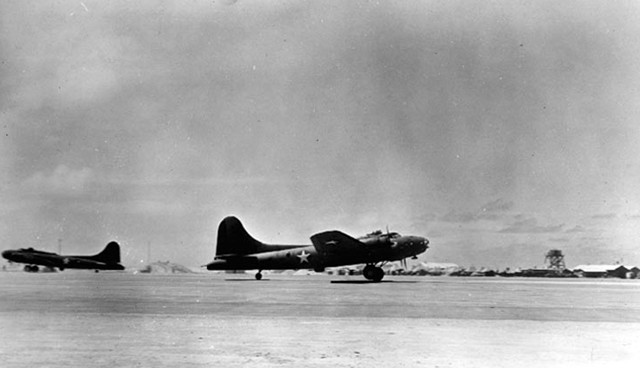
Nine B-17s took off from the runways of Midway's Eastern Island around 1230pm on June 3rd. After a flight of about three hours, they found the transports of the Imperial Japanese Navy's Midway Occupation Force, tasked to effect the actual invasion of the atoll, approximately 500 miles to the west. The B-17s claimed multiple hits on the lumbering transports, though managed none whatsoever, despite a total absence of CAP and effective antiaircraft fire.
Meanwhile, a thousand miles or more to the northeast of Midway, two light carriers of the IJN (the Ryujo and the Junyo) launched an attack on Dutch Harbor, Alaska. 12 Zero fighters, 10 Val dive bombers and 10 Kate torpedo bombers (operating in horizontal bombing mode) lifted off from the tiny flight decks in miserable weather. This attack caused minor damage to oil storage tanks and the local radio station, while some bombs hit the barracks of Ft Mears, killing 25 soldiers.
The attack on the Aleutian Islands has often been called a diversionary assault, intended to draw out the American fleet from Pearl Harbor. It turns out that that is not the case. Both the attack on Midway and the attack on the Aleutians were supposed to begin on June 3rd, but the carrier fleet tasked for the Midway part of the attack were delayed by a day by refueling problems.
Late in the night of June 3rd, four PBY flying boats of Patrol Squadron 44 took off from the seaplane base at Midway, headed for the Occupation Force. Early the next morning, one of them put a torpedo into the bows of the fleet oiler Akebono Maru. Damage was relatively light, and the ship continued underway with little delay. This was the only successful torpedo attack by the Americans for the entire battle.
The opening volleys of the most decisive naval victory in history had been fired; the next day would belong to the carriers.
During WWII most American fighter planes were armed with M2 Browning HMG. Because the Japanese planes were firetraps, the American planes were armed with 50% armor piercing rounds and 50% incendiary, alternating on the feed belts.
Against the Japanese that made a lot of sense. You needed the AP in order to do damage to engines if you hit them. But the incendiary rounds were just the ticket if you were hitting fuel tanks on wings.
Did the US use the same 50/50 belts in Europe against the Germans? Or did they use 100% AP?
2
Good question, Steven. I'll have to research that one. Fortunately, I've got just the books I'll need to get an answer, but it'll take some digging.
Posted by: Wonderduck at June 04, 2010 10:07 PM (iJfPN)
3
What kind of altitude would B-17s bomb a fleet from in the Pacific? Getting as high as possible makes sense in the ETO, but I would suspect that even a slow lumbering transport could dodge a stick of bomb dropped from 20,000 feet by a B-17 leaving contrails across the horizon for all to see.
5
Will, the B-17s attacked the transports at altitudes ranging from 8000 to 12000 feet, which was considered "medium" altitude. The transports didn't even notice the Bs until after they had dropped their bombs, and jinked very late... and there were still no hits.
When the Flying Fortresses attacked Kido Butai the next day, they came in at 20000+ feet. They were spotted early, and they again scored no hits, though Hiryu was bracketed by near misses that landed within her own length away.
Posted by: Wonderduck at June 06, 2010 11:16 PM (iJfPN)
Wolverine!
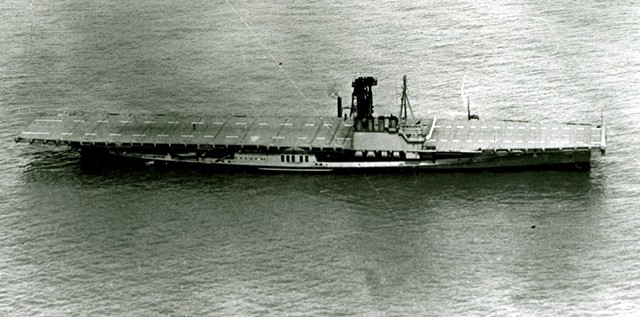
War. War never changes. In 1942, war was raging and the US Navy had a problem. It was obvious that the aircraft carrier was going to be the deciding factor in the Pacific, and a major player in the battle for the Atlantic. A gazillion carriers were going to be coming out of the shipyards, and they would need squadrons upon squadrons of planes and pilots to fill their hangars. While there wouldn't be a problem building the planes, the pilots would be another thing altogether. There would be hordes of men wearing the wings, certainly, and they would have plenty of training in how to fly their planes, but naval aviation is a different type of beast... because of the aircraft carrier.
When the Army Air Forces taught a man how to fly, they were able to assure their pilots that, at the end of a mission, they would have a nice long runway (or a well-manicured meadow) to come home to. On the other hand, most Navy pilots would be in training for carrier aviation. This meant they'd have to put their plane down on a small (at least in comparison to AAF runways) flight deck somewhere in the middle of an ocean... that was moving. That's a problem, because you can't simulate that on land. To be sure, you can paint a flight deck on a runway to give an idea of the size. You can put a Landing Signal Officer at the end on the runway to teach a pilot how to follow his instructions. You can even put arresting wires across the runway to give the rookie pilot a taste of the stresses involved with landing on a carrier. But you can't duplicate the rolling and pitching, the winds, the turbulence off the island, and the sense of scale involved (even a big carrier is very, very small in comparison to the ocean).
Prior to the start of WWII, the US Navy trained their neophyte pilots on carrier landings by landing them... on carriers. That sounds obvious and it surely is, but what do you do when it's going to take all of your current CVs just to hold the line... and they're only barely accomplishing that? Throw in the threat of submarines, and even if you had a spare carrier lying around you couldn't operate it in a manner that would make training a rookie pilot easier. Then there's this little problem with rookie pilots (and trained pilots, for that matter), in that they crash. Over and above the tragedy involved, a violent crash could cripple a carrier at a time when every flight deck mattered. But sending a squadron of pilots out to war with practically no experience on landing on a carrier deck is a recipe for disaster.
In March of 1942, the US Navy came up with an answer.
If you're like me you've been seeing a fair number of articles/posts on Netwar, Swarm war, or what have you. The idea bascially as applied to naval warfare, seems to use a bunch of smaller cheaper ships in place of one big, a ship that you have to use a lot of assets to protect. The study groups have been looking at the records of the "jeep" or "taxi" carriers in WWII.
In spite of their thing hulled construction they did fairly well in some carrier vs. carrier battles. While I can forsee ships being UAV carriers, some manned air craft will be needed even if they themselves would UAV launchers.
I hadn't thought about the training aspects in having a lot small carriers and modualr arsenal ships.
Posted by: toadold at May 24, 2010 03:12 PM (PsQky)
2
I love it. I'd heard of these prior to your article and this thought occurred to me then and recurred now. How many WW2 carrier training birds are on the bottom of the Great Lakes and perhaps could be salvaged? Would that be a +4 coolness factor or what?
Posted by: The Old Man at May 25, 2010 12:41 PM (+LRPE)
3
After being immersed in water for 60 years? There's nothing left to salvage.
4
Actually, three SBDs have been fished out of Lake Michigan in recent years, including one that participated in the Battle of Midway.
One of the three is on display at Chicago's Midway International Airport... good picture of it here. Incidentally, Midway Airport was named in honor of the Battle, just as O'Hare Airport is named after Butch O'Hare, Navy Medal of Honor winner. There's a F4F-3 on display there, and it too was recovered from Lake Michigan.
These planes were built to resist the salt water of the oceans; lake water isn't nearly as corrosive, and doesn't move around nearly as much. There were around 300 planes that went into Lake Michigan, and it's a good bet that many of them are in okay shape. The question is finding them, and pulling them out... Lake Michigan averages 279 feet in depth, with a maximum of nearly 1000 feet. It's a big place, and the planes are very small in comparison.
Posted by: Wonderduck at May 25, 2010 05:32 PM (blkx5)
Name That Ship!
As most of my regular readers know, I have a deep interest in WWII, with an emphasis on the Pacific Theater, and have had for many, many years. For much of that time I've been drawn to the more obscure bits of hardware used by the various armed forces. Everybody knows about the Mustang, the Spitfire or the Flying Fortress, and for good reason. Even the Buffalo is well-known, if for all the wrong reasons. But who champions the little guys, the Vindicators of the world? Or, really, who cares about the nigh-on forgotten things? I do, for I am as fascinated by the "backstage" people as much as the main characters, if not moreso. Heck, a couple of days ago I discovered that there was a floatplane version of the F4F built and tested (charmingly called the "Wildcatfish") and was tickled pink.
So you can only imagine my joy when I first learned about this ship:
Except I'm not going to tell you anything about it. Yet. Instead, I want to see if any of my readers know the name of this surprisingly influential vessel, or if not the name, what you can tell me about her. Leave your guesses in the comments, and no cheating!
Posted by: Brickmuppet at May 22, 2010 10:58 PM (EJaOX)
2
Oh, the explanation Wolverine was a paddle wheel merchant ship pressed into service as a training carrier on the great lakes. There were, IIRC, 2 of these.
Posted by: Brickmuppet at May 22, 2010 11:31 PM (EJaOX)
Posted by: GreyDuck at May 21, 2010 03:10 PM (3q5Q5)
2
I say, uh, I say, m'boy... that just ain't right.
Posted by: Avatar at May 21, 2010 05:48 PM (pWQz4)
3
I know the Japanese subways are notoriously crowded, but going this far to get people to give you extra space on the train?
Posted by: Siergen at May 21, 2010 09:23 PM (UPUQO)
4
Oh...I understand now... the sunflowErs are jealous because the tennishoes ran off with the garden gnomes leaving the goats without any oppressors to keep the laser discs at bay.
Posted by: Brickmuppet at May 22, 2010 02:57 AM (EJaOX)
5
Ummm, aren't hearts supposed to be worn on your sleeve? Oh Mr BrickMuppet, Rumpelstiltskins Sir!
Posted by: vonKrag at May 22, 2010 09:19 AM (VGXAE)
I'm going to have to admit to being not exactly motivated to blog these days. It just... sort of feels like work at the moment. I've had these feelings in the past, and they usually pass quickly, generally when I stumble over something interesting or I'm distracted by something shiny. For all I know, I'll be back tomorrow... or next Monday, to prepare for the GP of Turkey.
But when Formula 1 is getting to be a chore, and it is, that's when I know I need to take a break, no matter how long it's for.
So sit tight, maybe leave me a comment saying that you can't stand to see me go (*snort*) or wanting a question answered ("Was the Wildcat used throughout WWII?" for example), and I'll come back sooner or later.
1
Considering that I've posted about once every three weeks or so, lately? I'm certainly not going to lob stones if you take a break.
Posted by: GreyDuck at May 18, 2010 09:06 PM (7lMXI)
2
You need to get another QP up, Grey... even if it's a placeholder saying "back soon." I miss my twice-weekly duckstrip.
Posted by: Wonderduck at May 18, 2010 09:25 PM (JWQqT)
3F1 Update is the most entertaining thing since the old "Secret Diary of Jacques Villeneuve" on Usenet.
Posted by: Ed Flinn at May 19, 2010 10:13 AM (RRq7w)
4
Uhhh... let's see... Suppose Japan had attacked Alameda instead of Pearl Harbor - would the Wildcats have made any more or less difference in the war?
Posted by: dkAllen at May 19, 2010 10:33 AM (1PFDl)
5
So are you going to leave us in suspense on that "Wildcats throughout the war" thing? I don't know off the top of my head, and checking wikipedia would be... cheating.
Posted by: Mitch H. at May 19, 2010 11:01 AM (jwKxK)
6
OK...how close did the German WW II aircraft carrier get to completion before it was finally abandoned, and was there anything interesting about its design?
Posted by: Siergen at May 19, 2010 03:21 PM (UPUQO)
7
No suspense, Mitch. The answer is "yes, it was." In fact, it was the only carrier-based plane that was used throughout the war by the USN.
Though it was replaced on CVs and CVLs by the Hellcat and to a certain extent, the Corsair, the Wildcat was used on CVEs until the end of the war, particularly in the Atlantic. At that time, they were technically no longer the F4F, which signified a Grumman aircraft, but the FM-1 or FM-2, which were built by General Motors... basically the same as the F4F-4, but with four .50 cal MGs instead of six and factory-built wing racks for 250lb bombs.
If you think of the Battle of Samar (Leyte Gulf), where "Taffy 3" beat off the charge of the Japanese Battleships, many of the fighters involved were Wildcats.
Posted by: Wonderduck at May 19, 2010 05:02 PM (JWQqT)
8
Is there any chance of you doing an F1 update about the race in Iron Man 2?
Posted by: Maureen at May 23, 2010 09:46 PM (BB7+i)
Wetdock
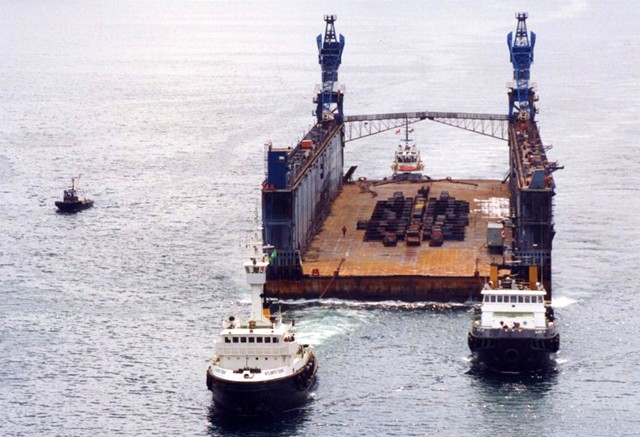
According to the Halifax Chronicle Herald, a floating drydock... well, stopped floating this past Saturday. The Scotia Dock II went down in about 50 feet of water as it maneuvered into position to hoist a tugboat inside for repairs.
Scotia Dock II in drier times
Geoff Britt, spokesman for the company that owns the Scotia Dock II, refused to say that it sank, instead suggesting that it "dropped below normal operating levels." Underwater for pretty much any ship that isn't a submarine should be considered "below normal operating levels," yes.
Once they figure out how to raise the wetdock, they'll be able to figure out just exactly why it went down. I suspect that once they can get down to the bilges, they'll find this: Oops.
Pacific War Pics
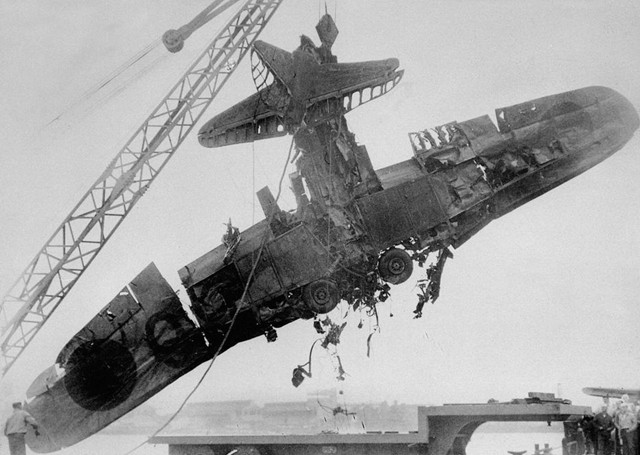
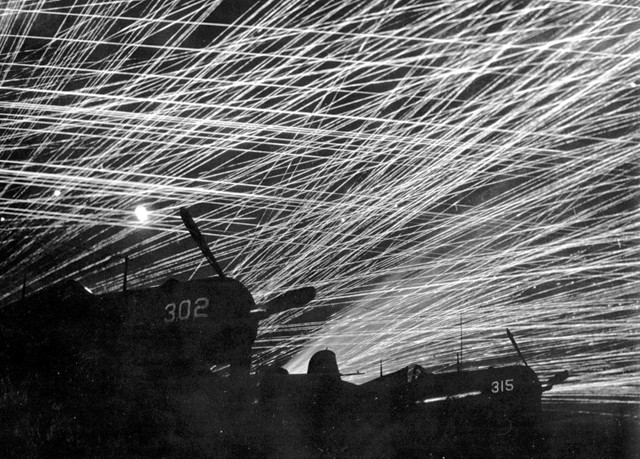
I had to work late tonight, but when I got home there was a present of sorts in my e-mail box. The latest edition of the Battle Of Midway Roundtable had come out, and contained therein was a link to a Denver Post blog. "So what," I hear you asking. Well, that particular blogpost has 110 pictures from the Pacific War, starting at Pearl Harbor and finishing at Tokyo Bay. And they aren't all the usual pics, either. For example, I give you this:
That's the wreckage of a Japanese B5N ("Kate") being fished out of Pearl Harbor shortly after Dec 7th. Or this:
That's flak over Yontan Airfield, Okinawa, sometime in March of 1945. Lots more where these came from, so go take a look. It's unsafe for dial-up users, though, as all 110 pics are inline to the post, not thumbnailed or linked.
3
#92: That sight is one I can never really comprehend. I understand intellectually what it means, but deep down I cannot really understand it. There are too many of them.
5
Aigh! #52, there looks to be a pinless grenade sitting in the sand by the troops as they rush past. Wonder if it's just a bad angle, or if it was a dud or something?
Posted by: Mitch H. at April 30, 2010 10:54 AM (jwKxK)
6
Mitch, I think the handle is down and behind, buried in the sand. But it's not impossible that it was a dud.
7
Mitch's reaction was much the same as mine when I first saw it. That grenade sitting there also makes me think that picture was staged, otherwise there wouldn't be anybody in the frame... they'd all be heading for the hills or huddling behind the landing craft, waiting for the fragments to stop bouncing.
Posted by: Wonderduck at April 30, 2010 05:12 PM (JWQqT)
April 29th, 1983: The Greatest Press Conference Ever
On April 29th, 1983, the Chicago Cubs lost to the Los Angeles Dodgers. Afterwards, during post-game press conference Manager Lee Elia, frustrated by the fans booing the team's 5-13 record, unleashed what became the greatest tirade in baseball history.
Best line: Eighty-five percent of the bleepin' world is working. The other fifteen
come out here.
Amazingly, he wasn't immediately fired... that happened in August. But he went down in history nevertheless.
Zoom Player Help?
Chiyo-chan's fully recovered from her bout with the sniffles, but I need some help. Zoom Player is my primary media program, I'm quite fond of it, but after reinstalling it everything starts up at 640 x (whatever) resolution.
How in the world do I make Zoom Player start playing a video at its native resolution??? I know there's a way to do it, I just can't find the right combination of thingies to make it happen and it's driving me crazy!
1
I don't know either, and I've used Zoom Player for years. Alt-2 sets it to native size for the currently playing video, but I'm not sure how to get it to do that automatically.
Posted by: Pixy Misa at April 28, 2010 10:44 PM (PiXy!)
2
That's something they changed in V7. It no longer automatically switches tto the native resolution when a video starts playing. You have to hit ALT-2.
Following a hint as given above, I just opened the options panel. Under Interface there's a "position and size" choice. One of the check boxes says "Auto-Size User Interface to fit Source Video Resolution (on load)".
When I checked that, it did size itself to the next file I tried to play. (V7)
Viruses Suck
So I came home from work, booted up my computer, and went into the bathroom. When I came back, my antivirus programs were screaming bloody murder. Oh, merde. Immediately, I tried to start Malwarebytes' Anti-Malware program... and got an error message. Trend Micro? Error message. Anything? Error message. Rollback? Error message. Crepe.
Then other, random, error messages began to pop up. As in, my video card no longer had drivers, for example. Time to break out the reinstall disc and the Flash Drive Of Doom!
Four hours later, Chiyo-chan is fresh and new again.
Viruses suck.
UPDATE: Yes, I know what caused it, and yes, I'm an idiot.
Hercule Where Rumpole was basically my cat, his counterpart Hercule was Ph.Duck's kitty. Together, the two of them were a more furry version of Laurel and Hardy. Where Rumpole was a big, dumb, lovable galoot, Hercule was the epitome of what one thinks of when you think of a cat... aloof, independent, reserved, dignified, dexterous yet capable of extreme moments of silliness. All of it in a small fur-covered frame. I always called Hercule a medium-hair; his fur was too long to be a shorthair, but too short to be a longhair. Still, it always seemed like he was mostly fur... the biggest he ever got was 12 pounds, where Rumpole nearly reached twice that size (muscle for the most part).
When Rumpole died two years ago, Hercule lost a bit of his zip... which was understandable, as they'd been together for 15 years or so, ever since Hercule was one. Shortly after Momzerduck passed away last September Hercule, then nearly 18 years old, got very ill. His kidneys weren't working well, and amongst other things, Ph.Duck had to "top off his tank" every day with an IV bag so Hercule would be hydrated. He was down to 6 pounds, moving kinda slow as you'd expect an 18-year-old cat to do, but still (mostly) happy. Just a couple of weeks ago he was (slowly) chasing after a laser pointer and nomming catnip.
Earlier this week, Hercule jumped off Ph.Duck's bed and... well, we're not sure exactly. What we do know is that for a couple of days, his right front paw was, for all intents and purposes, dead. Maybe he sprained it, maybe he threw a small blood clot, maybe it was a pinched nerve. It came back, though, and we sighed a sigh of relief. This afternoon, as Ph.Duck and I were watching the GP of China, Hercule started yowling. When Ph.Duck went to check on him, he found Hercule on the screened-in porch, dragging himself using his front legs. His hind legs and tail were no longer working... much like the front paw earlier.
We bundled him up and took him to Dr Kathleen, the vet that's cared for all of the family's pets for 30 years or so. The Doc performed a quick but in-depth examination, and made it clear that it might clear up... or it (more likely) might not. Either way, it was agonizingly clear that Hercule was no longer the happy cat he had been and was no longer enjoying his time here. And so we put him to sleep, and hopefully he's bossing Rumpole around for the amusement of Momzerduck.
42?
Today is the Day of Independence for the Conch Republic. Soyuz 1's ill-fated flight was launched today in 1967. The Chinese People's Liberation Army Navy was established on this date in 1949. In 1989, Baywatch premiered on April 23rd. NHL Hall of Fame member Tony Esposito was born in 1943, and Howard Cosell died on this date in 1995.
And in 1968, in a hospital somewhere near Wrigley Field in Chicago, a Wonderduck was hatched upon an unsuspecting world. Nothing would ever be the same again.
2nd Try: "Happy Birthday!" is kicked back as a duplicate post. Fair enough, but how many ways are there to say 'happy birthday', not counting different languages? This comment is now, I'm sure, sufficiently unique, but hows this:
Happy Birthday! Congratulations on both the Original Occurrence and the Joyous Anniversary!
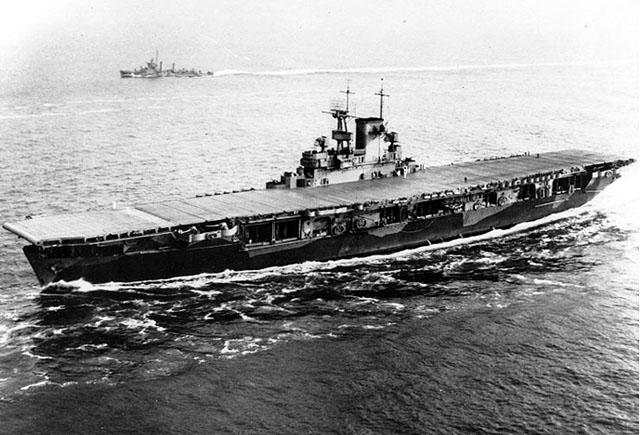
USS Wasp: The Worst US Carrier In The Pacific
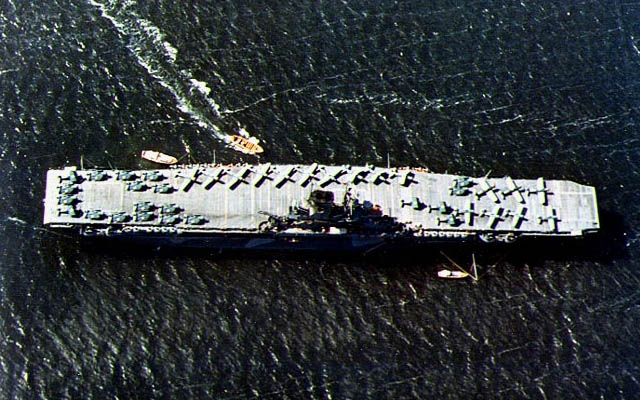
When you think of aircraft carriers from WWII, which do you think of? The stately Lexington class? Maybe you flash to the carriers that held the line in the Pacific, the Yorktowns? Perhaps you think of the Essex class, some of whom stayed in service into the '70s and one of which lasted until 1991? Or maybe your thoughts tend towards the Japanese Kaga and Akagi? One can't forget the first aircraft carrier lost to air attack, the British Hermes, and their Illustrious class is an interesting type of ship indeed.
In fact, most people would think of many, many ships before their thoughts headed to the seventh carrier commissioned into the US Navy, the Wasp.
And to be brutally honest about it, there's good reason for this lack of recognition. To say that her career was lackluster would be on the charitable side of accurate.
The USS Wasp was designed and laid down while the US Navy was still under the constraints of the Washington Naval Treaty, which placed limits on the maximum tonnage of new naval builds. The maximum allowable tonnage for the US's aircraft carriers was 135000, with no single carrier able to exceed 27000 tons at full load (an exception was made for two ships converted per nation; for the US, these were the USS Lexington and Saratoga. Their weights were still counted against the total, however). As the two Lexingtons ate half the limits on their own, and the Yorktown and Enterprise, both in the process of being built, were showing signs of being overweight, the Wasp's designers were under incredible pressure to cut weight whenever possible. It quickly became obvious that she was shaping up to have many of the same traits as the USS Ranger (CV-4) which, like the Wasp, was constructed to get the most use out of the treaty limits. In short, she was going to have to be small.
There is nothing inherently wrong about the concept of a small carrier; the later Independence-class CVL proves that quite well. The problem arises when the carrier being designed is a full-fledged fleet carrier, but it has to be shoehorned into a size completely unsuitable for the task, which is what happened to the Wasp. The Yorktowns came in at about 26000 tons at full-load; the Wasp wound up being nearly 7000 tons lighter, but was still expected to carry almost the same size air group (76 planes for the Wasp, 90 for the Yorktowns).
To do all this on a smaller hull, compromises had to be made. She wound up about 85 feet shorter (741 feet vs 824 than the Yorktowns) in overall length. Of course, this made both the flight deck and hangar smaller as a result. This made life cramped for the air group, even though it was reduced to begin with.
In an attempt to alleviate some of the congestion caused by the reduced topside real estate and to counterbalance the weight of the full-size island starboard, the flight deck and hull was bulged to port. While this improved traffic flow on the flight deck, it did have some consequences. This bulge gave the Wasp the same beam as the larger Yorktown class. However, in a weight-saving measure, her machinery spaces were smaller, producing 75000 shaft horsepower (shp). Comparing this number to the Yorktowns' 120000shp and the substantially smaller Independence class' 100000shp is educational to say the least. As a result of this unfortunate combination of decreased power and wide hull, the Wasp could only make 29.5 knots at full steam, considered too slow for operations with the main fleet. Another problem with this speed, combined with the truncated flight deck, is that there was very little room for error for a fully-loaded torpedo plane (at the time, the hideously underpowered TBD Devastator) during takeoff. This was recognized early in the design process, however, and as a result the Wasp was not built with the specialized facilities required for torpedo planes. Of course, this was considered acceptable in the name of weight savings.
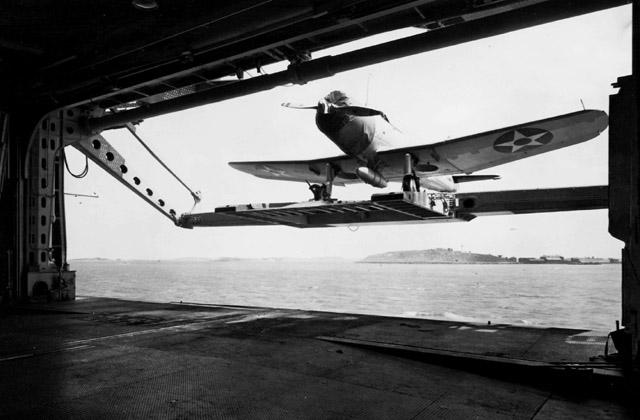
In another attempt to save weight, she was constructed with only two elevators, fore and aft. The midships elevator was replaced by an innovative design that after the war became commonplace: a deck-edge elevator.
Unlike those on modern carriers, though, this one was a skeletal framework that had a socket for the tailwheel to sit in, positions for the main gear, and moved the plane in a semicircle up to the flight deck. This was the first ever deck-edge elevator, and is probably the one shining part of the Wasp's overall design. Still, all the weight saving was successful in that she slotted nicely into the Washington Treaty tonnage limits.
Like the similarly undersized Ranger, it was thought that the Wasp was unsuitable for operations in the Pacific. At the onset of war, she served primarily as an airplane ferry, taking two loads of Spitfires to Malta for the British. A month after the second of these runs, the Battle of Midway left the US Navy with only three operational carriers in the Pacific, with one of them (the Saratoga) still suffering the scars from a submarine-launched torpedo. It was decided that the Wasp would be transferred as it was marginally more capable than the Ranger. Carrying TBF Avengers (a torpedo plane, which she wasn't truly able to handle), Dauntlesses and Wildcats, she was part of the covering force at Guadalcanal that was withdrawn by Admiral Ghormley, which put the entire operation at risk. The next month or so was spent patrolling and providing cover for convoys heading to 'Canal, until she was sent south, missing out on the Battle of the Eastern Solomons. That battle cost the Navy the use of the Enterprise as she was badly mauled. Shortly thereafter, the Saratoga proved to be a torpedo magnet of the first rank. As she was sent to the West Coast for repairs, that left only the USS Hornet and the Wasp covering the entire Pacific.
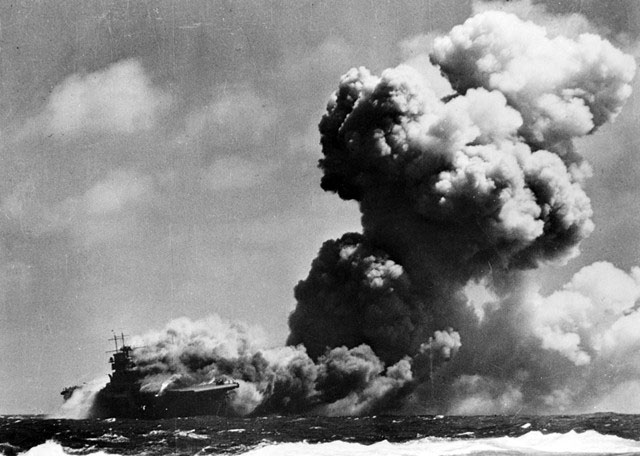
In mid-September, however, she was engaged in flight operations when the Japanese submarine I-19 performed the greatest feat of marksmanship by a submarine ever. The I-19 fired a full spread of six torpedoes at the Wasp, three of which hit. Two others passed ahead of the carrier, one of which struck the destroyer O'Brien as she maneuvered to avoid the other. The O'Brien sank shortly thereafter. The sixth torpedo apparently passed underneath the stern of the Wasp, narrowly missed the USS Landsdowne, then proceeded on for another seven minutes before striking the USS North Carolina, a wound that required a month in Pearl Harbor to fix.
One of the worst decisions the Wasp's designers had made in their quest to save weight was the deletion of just about any armor plating. While this would have been normal for most Japanese carriers and was considered the price of speed for them, the lack of armor for the Wasp extended to her having absolutely no torpedo protection whatsoever. Further, her two engine rooms were grouped close together instead of being separated (to be fair, this was a failing common to US carriers at the time). Another strike against her was that, when the torpedoes struck, she was engaged in flight operations. Her avgas system was in full use, in other words, with predictable results when she was hit.
45 minutes after the torpedoes hit, the fires onboard had consumed most of the forward part of the hangar deck and were raging out of control. Abandon ship was called, and the Landsdowne was detailed to scuttle her. At approximately 9pm on September 15th, 1942, she finally sank in a pool of blazing gasoline.
A victim of terrible design choices, she never really got a chance to prove herself in battle (the Guadalcanal landings notwithstanding) and has thus faded into obscurity. A shame, as she could have been an outstanding "medium carrier" if designed just a couple of years later, when such things were recognized as being feasible. That's all hindsight, however. In use as she was actually designed, she was unfortunately the worst US aircraft carrier in the Pacific... and the unluckiest. To be fair, no carrier on the planet at that time would have survived taking three torpedoes at once.
Especially when they're Long Lance torpedoes, the best torpedo of the war.
I've always thought of Saratoga as a ship with poor luck. she survived the war, to be sure, but how many times was she hit? Like three? (And having survived the war, Sara was sacrificed at Bikini. Surely such a great old lady deserved better, but I guess they had to use something.)
But you've convinced me that Wasp was worse. Sara got hit, but didn't sink, and Sara accomplished quite a lot. Sounds like Wasp didn't do anything important except get attacked.
2
It's possible that the Sara wasn't useful for much after her third bout of battle damage (after the two separate torpedoeings). She was hit by four or five bombs late in the war, had the entire front of her flight deck burnt out and her hangar deck had some major damage as well. She was repaired on the West Coast, but you've got to think that there'd be some lingering shock damage to her hull, no matter how good the repairs. *shrug* That's just speculation, though.
Posted by: Wonderduck at April 15, 2010 11:35 PM (mfPs/)
3
Well, they needed to use at least a couple carriers for targets, and I suppose it makes more sense to use a thrice-damaged old lady than one of the new Essex CV's.
The Navy was standing down after the war anyway, so all the oldest ships were decomissioned. The only alternative futures for Sara would have been to be a floating museum, or more likely to be scrapped.
5
Nope! To me, the story of the Shinano has been told enough times before. No, I prefer the more, shall we say, esoteric ships. I was giving thought to the Langley, or one of those myriad of Japanese carriers that nobody's ever heard of.
Posted by: Wonderduck at April 16, 2010 05:38 PM (mfPs/)
6
I'm not really sure it's fair to heap abuse on the Langley. It was the first carrier ever built by anyone, and it was built on top of the hull of a coal carrier. It was proof-of-concept, and for that it worked extremely well. But it was modified in like 1923; of course it was obsolete by WWII.
7
I completely agree, Steven. This series of posts, like the Hoshoone, will tell the stories of the ship(s). If the story is positive, then it'll be so. If like the Wasp it's negative, I'll hit that, too.
I'm actually considering making one megapost on the three "first carriers", the Hosho, Langley, and Hermes. Though even that's a bit of a misnomer, as the Langley wasn't the first keel up carrier for the USN. That technically was the Ranger... but I LIKE the Langley.
Posted by: Wonderduck at April 16, 2010 06:26 PM (mfPs/)




 The roadbed for the crossing has been strengthened, the pavement for the street replaced and relaid, and much of the terrain was replanted with grass. The local fire department now trains with a few of the derailed cars, practicing for the next big fire and hoping it never comes.