Xmas With The Librarian
It's the last Thursday before Christmas, and since I'm going to New Mexico for a few days on Saturday, The Librarian and I decided to make tonight our Christmas celebration. So, after watching Dr Horrible's Sing-Along Blog, which is great by the way, we exchanged gifts.
She got the book I Slept With Joey Ramone, written by Joey Ramone's brother, and the box set of Monster (thank you VERY much, Robert!). And me?
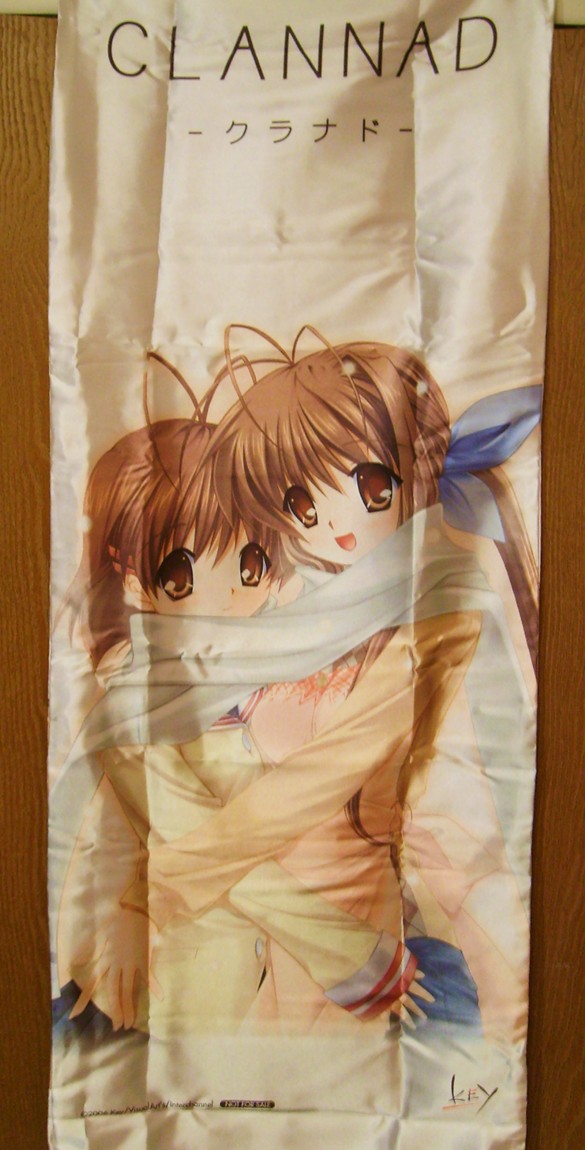
Look, The Librarian gives the best presents. Last year, she conspired with Momzerduck to give me the Rubber Duck Factory. This year, though, she nearly beat that. She gave me this: It's a body pillowcase, in case you can't tell, featuring Nagisa and Sanae Furukawa! Even better, it's a promo item, meaning it wasn't actually for sale. Better still, I think it's from the game as opposed to the anime, since KyoAni's logo doesn't appear anywhere on it. That's far from certain, though.
Yes, I have no idea what I'm going to do with it, but it's amazingly cool anyway! Thanks, The Librarian!!!
1
That is awfully neat... but nowhere near as neat as the Factory, c'mon! *grin*
(I haven't yet slogged my way through all of Clannad. Bad KyoAni fanboy, no biscuit... oh wait, I'm not a KyoAni fanboy, I forgot!)
Posted by: GreyDuck at December 18, 2009 12:30 AM (o5Lvb)
2
Those are definitely the game's character designs. The interchannel name in the copyright suggests that it's a promotional item for the release of the PS2 port in 2006.
Posted by: Andrew F. at December 18, 2009 06:53 PM (KY8yE)
Posting For Posting's Sake
So the past few days, I've felt a little disinterested in posting here at The Pond. Obviously there isn't much going on in Formula 1 right now, points payout change notwithstanding. My anime watching has sort of trickled away. And despite a link to the Tone 4 post of a few months back in the recent Battle Of Midway RoundTable newsletter, I don't have any pressing need to write about the War in the Pacific at the moment.
However, I am happy to announce that Monday will see the beginning of the annual 12 Days of Duckmas series. So you've got that to look forward to.
It'll be interesting, as I'm going on vacation next Saturday, and will be gone until the 23rd. Well, my destination has a computer, I suppose. I'll just have to upload everything ahead of time.
So I guess this post is just to say I'm alive and don't go anywhere! Oh, and the following picture is completely unrelated to anything: -Banner of the Stars, ep03
1
If you don't have anything to write about the War in the Pacific Richard Fernandez at Belmont Club has something to read about the loss of the IJN battlecruiser Kirishima during the Naval Battle of Guadalcanal.
(http://pajamasmedia.com/richardfernandez/2009/12/13/the-five-minutes/ if I botched the link)
Posted by: Ed Flinn at December 13, 2009 06:54 PM (suTNB)
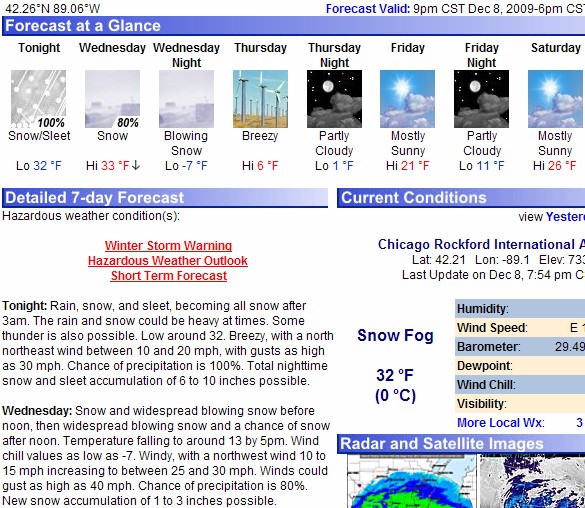
Snowmageddon 2009: The Snowmanator: Snow Day! Snow day! Yesterday morning, there was nothing on the ground... the
above is what greeted me when I stuck my head outside. The University
of Wisconsin-Madison, about 70 miles north of here, has closed for the
first time since 1990. Duckford has gotten around 10 inches, with
another 1"-4" expected by the noon.
However, the bad part is going to be the wind. We're expecting
whiteout conditions later as the wind picks up. Roads are lousy,
according to the live chat taking place on one of the Duckford TV
station's website, with pretty much everything outside of the city
itself being dangerous and impassable. In city, only the major East-West streets are clean; North-South are bad because of drifting. The plows come through, but the wind just blows it over again.
A couple hours to our west, in the Quad Cities, Iowa, they're reporting blizzard conditions and emergency vehicles stuck in city centers. That's what we've got to look forward to, yay! I'll update occasionally during the day.
Winter has returned to Duckford, with a frickin' vengeance. The drive home from the Duck U Bookstore took me nigh on 25 minutes instead of the usual 10-12. About half of the trip was done blind; the snow was coming down so heavily that, when the wind blew just right (i.e.: at all), I could see maybe past the hood of the Duckmobile.
I'm glad I made it home, but I feel fearful for the ducklings back at Duck U. This is Finals Week, y'see, and there were quite a few scheduled tonight. Hopefully, the kids realized that their safety is more important than their grades and called their professors.
Still no word on if Duck U will be in session tomorrow... snow days are even better when you're an adult.
1
So a lot of the students there don't live on campus?
Posted by: Steven Den Beste at December 09, 2009 01:13 AM (+rSRq)
2
About 250 out of the 1000 or so full-time students. Duck U has always had a heavy commuter student base... I was one for half my time there, for example.
There's a lot of little farm towns around Duckford, so not only do a lot of the commuter ducklings have to drive 30-40 miles to get here, but it's through open fields and secondary roads. Safety becomes an issue on days like this.
Posted by: Wonderduck at December 09, 2009 07:28 AM (C32SO)
Dive Bomber
Back in the early days of dive bombing, the British Air Ministry attempted to answer the question "what IS a dive bombing attack?" In their definition, which was generally accepted by the various air forces, when the aircraft drops its bombs while descending at an angle of 20 degrees or less, it was executing a shallow glide bombing attack. From 20 to 60 degrees, it was a steep glide bombing run.
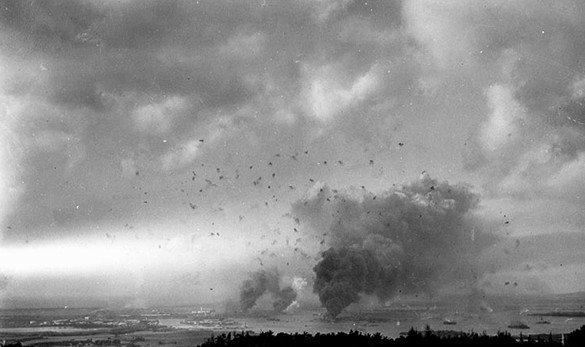
However it was only when the pilot guided his craft into a plummeting descent of between 60 and 90 (also known as 'straight down') degrees that he was performing that most accurate, deadly and dangerous manuever, a dive bombing attack. It was dive bombing that blew open the way for Germany's blitzkrieg across Europe. It was dive bombing that helped pummel Pearl Harbor's facilities and airbases. It was dive bombing that killed HMS Hermes, the first aircraft carrier to be sunk by aircraft. It was dive bombing that sank four Japanese aircraft carriers at Midway. It was (mostly) dive bombing that shut off the flow of supplies to the Japanese soldiers at Guadalcanal. One could go so far as to argue that dive bombing won the naval war in the Pacific.
Yet it was the dive bomber that disappeared from the lineups of the various air forces almost as soon as World War II was over. Why?
*THE PLANES
For all intents and purposes, there were four major planes designated as Dive Bombers in World War II. Oddly, the worst of the bunch is the one that's best remembered and is thought of as the prototypical DB.
The Ju87, better known as the Stuka, was used by Germany as heavy artillery. Luftwaffe liason officers were attached to Wehrmacht units as what we would now call forward air controllers for Close Air Support. The Stuka would be called in to pummel strongpoints with the type of accuracy only available to dive bombers. The Luftwaffe had better designs to chose from when the time came to begin preparing for war but the Stuka had the support of Ernst Udet, who was the Director-General of Equipment. However, it was quite slow when carrying the usual bombload of 1100lbs, maxing out at about 150mph. In comparison to the other planes on this list, it had a very short range of about 300 miles It was also quite unmanueverable and could be hacked out of the air in immense numbers by even small amounts of fighters. When escorted by fighters, however, the Stuka could be very effective. It was able to dive vertically when executing an attack, which was devastating against stationary targets. After the Battle of Britain, where the Stuka's weaknesses were brought to stark light, the plane should have been withdrawn from action. Germany had no choice but to use it throughout the war, in upgraded forms, as there was no replacement. Despite all this, it is images of the Stuka, stooping upon a target with its landing-gear-mounted sirens (called "Jericho's Trumpet" by crews) wailing, that leap to mind when the public thinks of dive bombing.
The Aichi D3A (Allied code name 'Val'), was the primary dive bomber of the Imperial Japanese Navy for most of the Pacific War. A contemporary of the Stuka, it flew slowly enough that drag from the fixed landing gear was not considered an issue. It was rather sturdy for a Japanese warplane, yet manueverable enough to be able to hold its own against fighters when unladen. While it generally could not dive as steeply as the other planes on this list, when combined with the highly experienced pilots of the IJN it was phenomenally accurate. During the Indian Ocean raid at the beginning of 1942, Vals caught the British cruisers Dorsetshire and Cornwall 200 miles off of Ceylon and scored on 85% of their attacks, sinking both ships in minutes. Later, Vals participated in the attack on HMS Hermes, scoring 40 hits from 70 planes. With a maximum speed of 240mph (less with bombload) and a maximum range of 915 miles, it was perfectly suited to naval war in the vast ranges of the Pacific Ocean. Its main weakness was that it could only carry a 551lb bombload, which was marginal against larger vessels.
The Douglas SBD, or Dauntless as it was commonly known, was used by the US Navy and Marines throughout WWII, though it was supplanted by the SB2C Helldiver in 1944. It was never entirely replaced, however. With a top speed of 255mph and a range of 770 miles without a bomb, the Dauntless was also quite nimble, racking up quite a few kills against the Japanese Zero. Early in the war, it was common to see Dauntlesses acting as anti-torpedo-plane interceptors, though this practice stopped when the number of fighters carried by US carriers was increased. It could carry a 1000lb bomb. The Dauntless is credited with singlehandedly sinking six Japanese carriers, including four in one day at the Battle of Midway. When carrying a bombload however, the Dauntless only had a combat radius of about 200 miles or so, fairly short in the Pacific. It was also used by the Army Air Force as the A-24, but was generally unsuccessful, more from a lack of institutional enthusiasm for dive bombing than poor performance.
The Curtiss SB2C Helldiver was the ultimate in dive bombers. Able to carry a ton of bombs (or a torpedo) in an internal bay, it could go nearly 300mph with a maximum range of 1200 miles (unladen). A big plane, it was rather unmanueverable and complex to maintain. After early teething problems were ironed out, though, it became quite a useful bomber, participating in all major actions in the later years of the war in the Pacific. It was never as popular amongst aircrews as the Dauntless, being nicknamed "Beast" or "Son of a Bitch 2nd Class", though later versions of the plane were undoubtably better in every way than the smaller SBD. Due to a lack of targets, the Helldiver didn't ring up a large kill total of ships, though they were instrumental in the sinking of the Yamato and Mushashi, the IJN superbattleships.
Other dive bombers in World War II included the British Blackburn Skua, the Soviet Pe-2 and IL-2, the Vought SB2U Vindicator, the German Ju88 and the Japanese Yokosuka D4Y Suisei, which was the only plane that could argue the SB2C's title as "best dive bomber."
*THE TACTICS
Dive bombing was much more than just "point yourself at the target and dive".
A dive bomber would approach a target from around 10-15000 feet altitude, dropping in shallow dive down to about 5000-7000 feet. Upon reaching the push-over point, a dive bomber would throttle back to about 50% maximum power, extend their dive brakes, and begin a steep dive down to around 1000 feet. Each plane would reach a different high speed during this dive (the Stuka would hit around 350mph, while the Dauntless would hover around 240mph). Upon reaching its release altitude (again, around 1000 feet), a pilot would retract his dive brakes, increase throttle and pull up steeply at around 5g. Again, depending on the plane and the bravery of the pilot, the altitude would bottom out around 500 feet or less as the dive bomber rapidly exited the area.
Against an immobile target, a squadron of dive bombers would approach and dive from different directions so as to confuse the defending antiaircraft guns. As always, however, coming out of the sun was usually the preferred method of attack, so as to limit the defender's visibility.
Against a ship, however, the rules were different. In a perfect setup, a squadron would dive heading upwind and in the direction of the ship's travel (heading from stern to bow, in other words). The planes would all attack from the same direction, one after the other, in line astern. A vigorously manuevering target, however, did cause some headaches for a pilot. He would have to change the attitude of his plane to follow the ship's path, all the while hanging against his seatbelt/harness.
Early in the war, particularly for the Japanese, it was nearly impossible to shoot down a dive bomber after it began its dive with anti-aircraft guns. Early gun directors could not deal with a plane moving at high speed and shedding appalling amounts of altitude in a short time, making a plunging dive bomber nearly invunerable. Indeed, during the Battle of Midway, Japanese AA managed to shoot down only one Dauntless. The best defense against a dive bomber at this time was to shoot it down during its approach, usually with a fighter.
*THE END OF A WEAPON
It was improvements in anti-aircraft fire that spelled the end of the dive bomber, however.
By the end of the war, it was practically suicidal for any dive bomber to approach an American ship. More (and better) AA guns, under radar direction, using proximity fuzes, could blow any plane out of the air at long ranges. It was bad enough for a torpedo plane, having to fly in a straight line at a relatively low speed, but at least they could stay a good distance away from their target and still release their weapon. For a dive bomber, however, which basically had to overfly its target, they were sitting ducks. By the end of the war, a Japanese naval vessel, which never carried a particularly large number of AA guns even under the best of circumstances, could expect that it would have the number of AA guns doubled or tripled from what it had carried at the beginning of the war.
And though the Axis powers never developed the proximity fuze for their AA guns, when you're putting enough bullets in the air you often didn't need them. German anti-aircraft guns were fearsome indeed, which is one of the reasons the Allies didn't use dive bombers much in Europe. Indeed, the RAF and FAA, who are often credited with creating and formalizing the concept of dive bombing, never had more than a couple of squadrons of dive bombers at any time during WWII. This despite the benefits of the type being on display against them in Poland, Belgium and France. The reason given was that it would be too costly in men and machines, and it's hard to debate the point.
Another reason for the disappearance of the dive bomber was the rise of what is now called the multi-role aircraft. The F4U Corsair, for example, could perform steep diving attacks nearly as well as the Dauntless despite the lack of dive brakes, had a longer range, and could carry a greater weight of bombs to boot. The P-47 Thunderbolt was another excellent fighter that could double as an attack plane, as was the Focke-Wulf Fw190. Using a fighter to do a bomber's job, and perhaps do it better to boot, made a lot of sense, particularly in the crowded hangar decks of an aircraft carrier.
The massacre of a squadron of dive bombers by such technology as a surface-to-air missile could easily be imagined, but by that time the dive bomber was no more.
*EPILOGUE
The dive bomber, in some ways, still lives on today. It's not hard to see modern precision guided munitions (or "smart bombs") as the direct descendant of the bombs dropped by Stukas, Dauntlesses and Vals. To continue the analogy, the air-dropped torpedo became the stand-off missile (such as the Tomahawk cruise missile or Harpoon anti-shipping weapon).
However you look at it though, today's attack pilot still needs to do the same thing as the dive bomber: put a bomb on a relatively small target with skill and precision.
This post is dedicated to Mort Price, USMC, Dauntless rear-seat gunner.
1
I think Il-2 could only do shallow dives. Initially its main application was anti-armor work, and it was reflected in the design. It had two long-barrel 23mm cannons that easily penetrated top and rear armor of anything up to and including Pkzf-IV, and usually carried cluster bombs PTAB.
Pe-2 was a true dive bomber, despite having 2 engines, and not being able to dive at full 90 degrees. One of the favourite tactics was "Polbin's wheel" (after Col. Polbin, its inventor), when each aircraft only released one bomb and doubled back in line. The continuous pummeling denied an effective resistance from the ground.
As for Stuka being obsolete, well, it was. But then again, Rudel! The deadliest man in an aircraft, ever.
Posted by: Pete Zaitcev at December 01, 2009 12:29 AM (/ppBw)
2
The Il-2 could do just about anything you told it to, Pete. It's one of the most remarkable planes of WWII. Ground attack, dive bombing, there's even some record of it carrying out torpedo attacks. The only thing it couldn't do is defend itself from fighters.
So I listed it under "other".
I'm not entirely sure the Val could do a 90-degree dive, but it sure as heck was a DB... the Pe-2 surely counts as one.
Posted by: Wonderduck at December 01, 2009 12:50 AM (C32SO)
I think it might be worth mentioning that when it came to ship-based AA, there were three kinds. They used heavy machine guns, and 40 mm artillery, and 5" DP guns.
The first two kinds could elevate quite a lot, but the 5" guns, which were the most effective, pretty much could not. I'm not even sure the 40 mm guns could elevate 90 degrees. HMG's could, but they were useless against any target above about 2000 feet.
So one reason dive bombers did well compared to torpedo planes was that when you were coming straight down you were out of the view of the most dangerous guns that would like to shoot at you.
The F6F could also carry a 2000lb bomb, and late in the war US carriers tended to carry about three quarters Hellcats and about one quarter Avengers.
Posted by: Steven Den Beste at December 01, 2009 01:08 AM (+rSRq)
4
The 5"/38 caliber gun used throughout WWII on all US Navy combatants could elevate to +85º in Dual-Purpose mode. The 40mm Bofors L/60 could do a full 90º. The L/50 version could only do 80º, though.
The 5" didn't usually fire vertically; it's job was to smack planes out of the air before it got that close.
Posted by: Wonderduck at December 01, 2009 01:18 AM (C32SO)
5
Great article, Wonderduck. I'd never given much thought to why dive bombing disappeared after WWII - or why I heard it so rarely mentioned in European accounts aside from German Stukas.
Oh, and a suggestion for a future post: the last dive-bomber, the Skyraider. (Didn't see much action as a dive-bomber, but that was its original reason for being.)
Posted by: UtahMan at December 01, 2009 12:49 PM (p1tb6)
6
Wow! Super post!!! I was going to pass up on it since I know nothing about dive-bombers and next-to-nothing about WWII. But I started to read it and it sucked me right in. I loved it! Now hopefully I will be able to remember what I read. I love history, but cannot retain the details about anything --- not names, dates or places! Nada! Which is why I majored in math and computer programming in college. Anyway...thanks Wonderduck!!! XOX
Posted by: Gerberette at December 01, 2009 10:54 PM (0erIh)
7
Well... Chechelashvili, for example, is credited with 2 Bf-109, 2 FW-190, 1 Ju-88 individually (which alone made him an ace - of Il-2!), and 10 more aircraft as a part of group. So it was largely down to the ability of pilot and rear gunner, some of whom were credited with a2a kills as well. In modern terms, the key with Il-2 was angles fight at the deck, but of course nobody taught Il-2 pilots how to do it.
Posted by: Pete Zaitcev at December 02, 2009 01:05 AM (/ppBw)
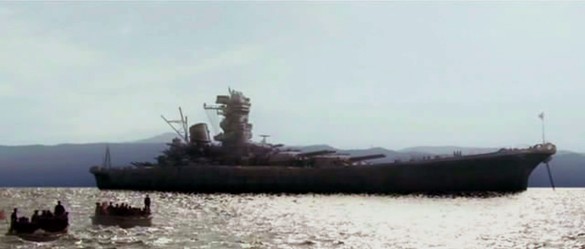
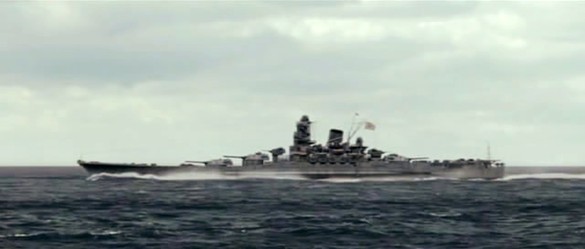
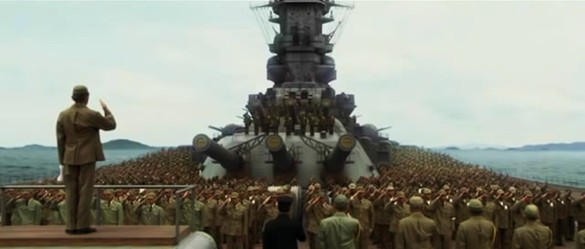
The Japanese "Saving Private Ryan"Otoko Tachi no Yamato, or "The Men of Yamato" in English, tells the story of the final sortie of that famed battleship. Not from a strategic standpoint, mind, but from that of her men. The script isn't brilliant, but you do know and care about these sailors by the time the American carrier planes begin to appear as the battleship approaches Okinawa.
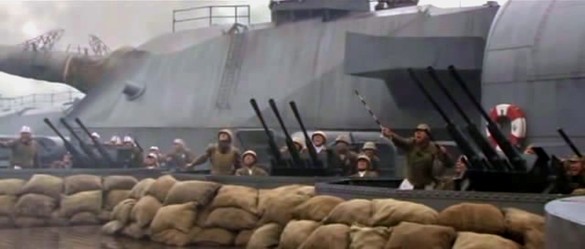
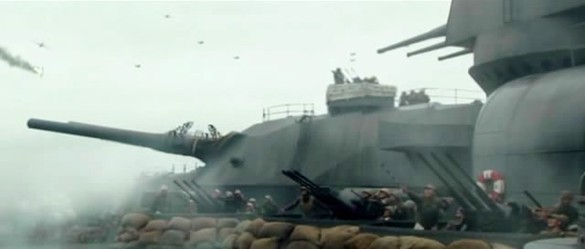
But the main character in this movie is the Yamato herself. No expense was spared in the making of this epic film, including a 1:1 scale set of the forward section of the ship, and the port side of the island area (the anti-aircraft guns in particular) that cost ¥600 million (nearly $7million).
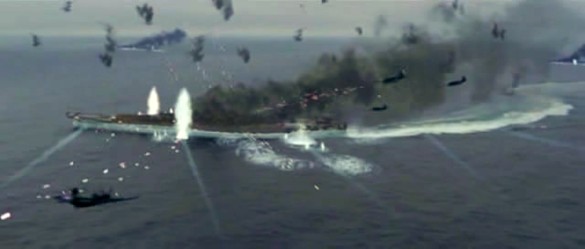
While the producers did wind up reusing a lot of the CG footage in the two major battle scenes, it's barely noticeable amidst all the chaos of war. And make no mistake, this movie pulls no punches when it comes to the combat... if you can't stand the sight of blood, this is not the movie for you.
If you can stomach seeing people opened up by machine-gun rounds and the deck running red with blood, however, what you'll get is a war movie that ranks up near the top of the list. It's not as good as Saving Private Ryan or the HBO miniseries Band of Brothers, true, but it's lightyears ahead of, say, Tora Tora Tora or Midway.
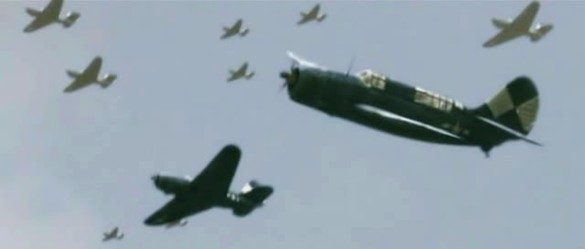
While this screencap makes it look obvious that we're looking at models or CG, in motion it's nearly flawless. The amount of detail is immense, both in the planes and in the Yamato herself.
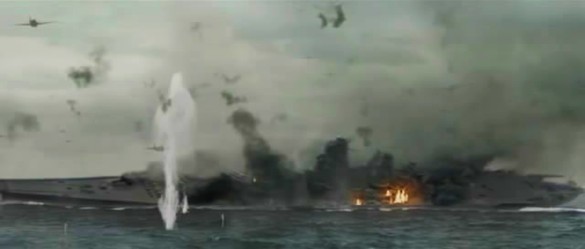
But when the final attack begins, the great ship goes to hell in a hurry. You barely notice that the whole fight is nearly 30 minutes long.
The sailors aren't supermen. There's no "one man shooting down a squadron", or even a single plane, like you might see in an American war movie. They're just there to serve the guns, and die. And die they do, in droves.
If you can find a copy of the movie, I recommend it heartily. It's well-done, historically accurate, and beautifully shot. You get the feeling that you're watching a documentary on the shipboard life of the Yamato, rather than a feature film, but it's never dull, despite the 2-1/2 hour length.
It's not perfect, but it's plenty good, and a fitting tribute to the men who crewed her.
It was the ultimate kamikaze mission. It's sad to see that many good men sacrificed for essentially no gain.
There was virtually no chance of Yamato succeeding in the mission it was assigned, and even if it had succeeded it would have been a bad ending for a good ship. Their orders were to beach the ship and to use their guns to provide fire support for the infantry, for as long as fuel and ammunition lasted.
But between code breakers reading Japanese dispatch orders, and picket submarines seeing them coming, and Mark Mitscher's carriers, they had no chance of getting close to Okinawa. One afternoon of flying by a fraction of the American planes in the vicinity, and Yamato was doomed.
It was actually a dive bomber that administered the death blow, though it took a long time to make a difference. One of the very first bomb hits set off fires that were never controlled. Eventually the fires reached the magazine for number 2 turret and set off the ammunition there, causing the ship to blow in half.
Simply a waste of good men.
Those pictures look fabulous. Did you managed to acquire a DVD?
Posted by: Steven Den Beste at November 24, 2009 12:30 AM (+rSRq)
2
No, I'm afraid it's just a rip I found online. 640x272 resolution, so it's REALLY widescreen, but also really small: 2.5 hours, 1.5gb filesize.
It's never been released here, it appears.
Posted by: Wonderduck at November 24, 2009 08:24 AM (C32SO)
Actually, the Yamato had already capasized and sunk by the time the magazine exploded. The US Navy had learned a lot when they sank her sister Musashi at Sibuyan Sea during the Battle of Leyte Gulf (Namely, have all the torpedo bombers consistently go after one side of the ship - spreading the torpedoes on both sides just made the Japanese damage control efforts easier.). And it was later determine that magazine 1 was the one that exploded - which might not have been from the fires caused by the bombing (The primary bomb load-outs of the dive bombers and fighter-bombers from Task Force 58 was geared to knocking out the topside stations - it would have taken a properly dropped 2000 lb AP bomb to break through Yamato's deck armor.).
And the truly frightening part? Task Force 58 only used the aircraft from 2 1/2 of her 4 carrier groups to sink the Yamato and her escorts (One carrier group was conducting UNREP at the time and could not arrive back in time. Another one had most of their strike get scrambled due to awful weather.). Most of the Japanese were shocked at the sheer number of American aircraft coming at them - each time the first couple strike waves finished, the Japanese thought the Americans had shot their bolt...Right up until the next wave arrived.
I do like how they managed to get the SB2C Helldivers correct.
Anyone who does not read Japanese could do a lot worst than read A Glorious Way to Die by Russell Spurr, which covers both the Japanese and American side of the battle. It is definitely not the most authortative book, but definitely the most readable. The most emotionally powerful book available is supposed to be the translation by Richard Miniter of Requiem for Battleship Yamato, which was written by her assistant radar officer. Never read it myself, but it has an excellent reputation by those who have.
C.T.
Posted by: cxt217 at November 24, 2009 03:24 PM (QSek/)
4
You can see it starting to roll over in that second-to-last screencap, by the way. There's no clear shot of it making the final tumble in the movie; it's merely implied by the cinematography.
Posted by: Wonderduck at November 24, 2009 06:35 PM (C32SO)
5
I feel like an idiot not looking for the DVD when I went to Japan in August. Great movie, great Hisashi soundtrack. You really get some insights into the heart of Japanese culture. Especially how the characters prepare for death on what everybody knows is a pointless mission. You have to think what might have been different if those lives and so many others had not just been wasted.
Posted by: Jcarlton at November 27, 2009 06:24 PM (mKHVN)
6
I'm not sure how to really translate the title effectively; Yamato is the noun, so it's not really the men of Yamato, it's the men's Yamato. Perhaps "Our Yamato" would work, given the point of view.
The DVD is on sale for ¥2992 on Amazon Japan, and I've been meaning to put in an order soon, so I'll pick up a copy. Even at the current heart-breaking exchange rates, that's not a bad price.
It looks like the author has a lengthy non-fiction version of the story, plus two novels, the second one titled Onna-tachi no Yamato. Its cover picture and blurb make it sound like the framing story that IMDB describes for the film.
-j
Posted by: J Greely at November 28, 2009 10:50 AM (2XtN5)
I'm sorry to have to be the guy to tell you this, but EVERY aircraft carrier that could launch airplanes in Task Force 58 sent aircraft to try to sink the Yamato task group! EVERY ONE of the twelve aircraft carriers sent out aircraft - ALL of Task Groups 58.1 (4 carriers), 58.3 (5 carriers) and 58.4 (3 carriers).
And Russell Spurr's book is better than nothing, but it is replete with errors. If this were to be a person's only source about the attacks on the Yamato task group, then a person's knowledge would be very slanted indeed. I have listed a bunch of Mr. Spurr's errors, and can make them available if you're interested.
Yamatodebunker
Posted by: David F. Anderson at December 27, 2009 01:06 PM (2kPCR)
Wonderduck's Tales From The Radio Biz
In the previous post I mentioned that, free music notwithstanding, radio was never going to make me rich, but it was the greatest job I've ever had. There are two distinct reasons for that.
The first reason is, hey, it's radio! Everybody listens to the radio, everybody knows what it is, everybody has an idea of what goes into it, and most people think it's a "cool" job. "You really get paid to do that?" was a common theme when it came up in conversation. Never mind that shows like WKRP in Cincinnati or Midnight Caller show only the fun part of the job (though Midnight Caller did it better than any show I've seen, they still got some stuff wrong), and not the show-prep, people think (or thought, at least) that Radio was a glamourous job.
The second reason, though, is the stories that everybody who works in the biz for any amount of time accumulates. And that's what this post (and perhaps others down the road) will talk discuss. What type of stories? Well, pour yourself a cuppajoe, tune in WDUK radio, and listen to The Wonderduck. And remember, all of these are true...
THE NIGHT DUCKFORD WAS DESTROYED It was 1988, and I was working my usual Saturday night shift at the time, board operator for a recorded-on-vinyl national program, Cruisin' America with Cousin Brucie. While it was a canned show, I still read a brief news and weather update at the top of the hour. The newsroom was right next to the studio, with a small window set into the wall between the two for no good reason that I could ever discern; during the day, the news guy actually came into the studio to read the news, and at night the news staff went home.
Now, to understand what's about to occur, you need to know that I was the only person in the station at the time. The sister station to mine went off-air at nightfall, so they had gone home, and I was three hours into my shift. Since my show was canned, I had the door to both the studio and the newsroom open, in case some breaking news came down the teletype from either UPI or the National Weather Service. Yes, teletype: computers weren't common yet, and the internet didn't exist at all. All our news and weather came through the UPI teletype. Important news was announced by a ringing bell and the chatter of the 'type.
So, I'm sitting in the booth reading something as Cousin Brucie turned and turned. My news and weather update was five minutes in the past, and I could relax until the next commercial break. Then, from the newsroom, came the peal of the bell and the rattling of the teletype. Unconcerned, I walked over, ripped off the report and took a look.
******FLASH NEWS******
The city of Duckford, Illinois, population 125000, was destroyed tonight by a mile-wide tornado. More to follow...
A moment later, the bell rang again:
******FLASH NEWS******
The city of Duckford, Illinois, population 125000, was destroyed tonight by a mile-wide tornado. The tornado moved from northwest to southeast, cutting directly through the second largest city in the state. Thousands are feared dead. The National Weather Service in Chicago, Illinois, reported the funnel cloud was moving at 40 miles an hour, and may have been a F5 in power, the strongest possible. More to follow...
Hm. Really? After checking on the state of the show, I strolled out of the station. Clear sky above. Walking to the parking lot, I could see the usual glow of the city lights (the station was about a mile east of the limit of Duckford, and there weren't any buildings within a couple of miles). Returning to the booth, I ran the commercial break, then called Momzerduck at the Old Home Pond. No problems at all, just a light breeze.
Chuckling, I pinned the printout to the bulletin board in the newsroom and returned to the studio... at which point the phone "rang" (actually, it lighted up. As you can figure, a ringing phone in a radio booth doesn't work well). It was the news room of WBBM-AM in Chicago, asking if the FLASH NEWS report was real. I confirmed that, indeed, it was real and that I was actually dead, we laughed, and wondered just what the folks manning the master teletype at UPI were smoking that night. And that's where it ended.
Except WGN Radio, 50KW blowtorch that covers most of the US and Canada at night, ran the story. My grandmother in New Mexico heard it and called Momzerduck in a panic. Whoops.
So that's the night I was on the board when Duckford was destroyed. Funny, I don't feel dead...
UPDATE: Forgot to mention that we late found out what really occurred. The National Weather Service office in Kansas City was running a test of their systems by sending test messages out via their network. The test messages, which I covered above, were supposed to have a special header that would send them out, but prevent the teletypes across the country from printing them. Somehow, the messages were sent out without that header, resulting in the destruction of Duckford. In later conversations with friends of mine at other, larger, Duckford radio stations, they were getting phone calls all night from media outlets across the country, asking if it was the straight dope. I still wonder how many people were fired because of this snafu...
Posted by: Steven Den Beste at November 21, 2009 09:29 PM (+rSRq)
2
The local NPR affiliate here actually read over the air the "Bill Gates has bought the Vatican" story some years ago. They got remarkably far along before a neuron fired.
Posted by: The Brickmuppet at November 21, 2009 10:30 PM (V5zw/)
3
That reminds me of a weird intel message that we got when I was in the Air Force: Apparently, the troops at higher HQ liked to run practical jokes on their new analysts to see how gullible they were. One day they told a brand new 2nd Lt that female Israeli fighter pilots had just landed on an Egyptian airfield, opened their canopies so they toss flower petals as a gesture of peace, then flew off back towards Israel.
Normally, if the new analyst fell for the gag, he/she would rush off to the shift supervisor to be laughed at. However, this newbie thought the news was urgent enough to send out over the airwaves to all Air Force bases immediately, without checking with the supervisor first. Needless to say, the message was followed by a disclaimer less than an hour after it went out.
All of the enlisted intel troops at my base got a chuckle out of the initial message - until our officer in charge believed it, and we had to talk her out of briefing it to the base commander...
Posted by: Siergen at November 22, 2009 01:00 PM (TJQ10)
Radio
In lieu of anything anime, F1 or rubber duckie to post about (one day there will be an anime about a rubber duckie that drives a F1 car and I'll have to shut The Pond down out of sheer joy), I'll instead talk to you about one of the great loves of my life.
Radio.
As a young duckling, I grew up listening to "The Great 89", WLS-AM outta Chicago. This was back before they turned into the talk radio abomination they are now, and instead played music from high atop the downtown Burger King. John Records Landecker (and yes, Records truly was his real name) brought his "boogiecheck-boogiecheck-ooh-AH" into Pond Central, amusing this fresh out of the shell duck every night. Les Grobstein, the sports newscaster is a legend in Chicago, and has recently returned to the airwaves, too. Lyle Dean, the main newsman, had the greatest voice ever.
But it was Larry "Superjock" Lujack and Tommy Edwards that truly warped my brain. As "Uncle Lar" and "Lil' Snotnose Tommy", they reported on bizarre goings-on in the animal kingdom in their world-famous Animal Stories segment. Just hearing Lil' Tommy break up puts a smile on my face. Better'n a shiny new dime!
But I grew up wanting to be Larry Lujack. It didn't happen, but it was a nice dream while it lasted. I only spent 10 years in the business and never made more than $7.00/hr at it, but it was the greatest job I could ever hope to have.
On Memorial Day in recent years, WLS has taken to bringing back some of their legendary voices for a full day of remembering the good ol' days. Here's some snippets from the 2007 "Big 89 Rewind":
You know what? This post went a completely different direction from what I was planning.
Ah, memories. When I was a kid I had a transistor radio (8 transistors! Wow!) that only picked up AM, and I used to listen to baseball games on it on KEX.
Those were Portland Beavers games, and that was during the period when Luis Tiant pitched for them, before going up to the big leagues. Portland was the AAA farm team for the Cleveland Indians at the time. (Now they're farm team for the Padres.)
Tiant got traded to Boston, and when I was in college Boston made the world series. They won only 3 games, and Tiant started all three of those.
KEX was easy listening then. But seems like these days AM stations change their formats more often than their underwear. I just searched and found out that they're all-news now. I wonder if they still broadcast Beavers games?
Posted by: Steven Den Beste at November 20, 2009 01:29 AM (+rSRq)
2
Seven dollars an hour AND your pick of all the LPs the station was decommissioning, if I remember rightly. Just a few warps and scratches.
Posted by: Vaucanson's Duck at November 20, 2009 10:25 AM (XVJDy)
3
Quite true, that. Most of 'em were in pretty good shape, too.
Posted by: Wonderduck at November 20, 2009 09:41 PM (C32SO)
Broken
I've tried to avoid writing a post like this, but I can't do it anymore. If you don't want a closer look at the person behind The Pond, then don't click on 'More', and enjoy the pretty picture.
I wish there were something I could say. I have plenty of experience with depression, but no answers for you. And I'm a firm believer that truisms do more harm than good, so I won't spout any.
I'm sorry you're feeling bad.
Posted by: Steven Den Beste at November 16, 2009 12:11 AM (+rSRq)
2
Man, if there's anything at all I can do, let me know.
Posted by: GreyDuck at November 16, 2009 10:35 AM (3q5Q5)
3
My roommate is being treated for depression issues by a doctor, who's re-balancing her brain chemistry through diet and the use of vitamins and amino-acids... No drugs. She said the same things, that while the drugs helped her depression, the side effects were sometimes just as bad. I'm sorry to hear that you're struggling.
Posted by: madmike at November 16, 2009 10:44 AM (XfPWJ)
4
Seriously: do the therapy. Yes, it sounds like utter bullshit, but try it; you can always quit going if it doesn't seem to be helping you. And it can't hurt. It might help--and more than you can see it helping, at least from where you are right now.
It is bullshit, but it's bullshit that works.
Look: knowing what I know about the five stages of mourning, all the texts on psychology I've read over the years--even with my better-than-average knowledge of how humans cope with things I still get my emotions in a wad when something bad happens. Even though I can look at how I'm feeling and say, "Gee, right now I'm in 'bargaining'...." it still doesn't change the fact that I'm human and have to go through it like everyone else.
You're no different. Losing your mother means losing your greatest connection to the history of your family, losing the one person who unconditionally loves you...and your pain is normal, even two months later. (My dad died not-quite three years ago and I still miss the hell out of the guy.)
...but it's also important that you not force yourself to go to therapy; you won't get anything out of it if you're fighting it. You need to be ready to go, ready to deal with the issue that brought you there; and that means recognizing that you've been dealt a blow that you're unable to cope with on your own, at least right now.
The most important thing to remember about that: there is nothing wrong with this. You're human; and no human can cope with everything by himself. Go get some help. Ask the Librarian what she thinks you should do. Ask Ph.Duck. Ask your friends--they know what happened and they want you not to hurt like this. Don't they?
Posted by: Ed Hering at November 16, 2009 03:28 PM (z8tFa)
5
The only advice I can offer is to stay in contact with as many people as you can as often as you can manage. Therapy is one way to do that. There are many others. Ed's suggestions are good.
Probably none of it will make you feel better in the short run. The payoff is in the long run.
Hang in there. We're all pulling for you.
Posted by: Jonathan Tappan at November 16, 2009 07:15 PM (7wFYN)
6
I am a new reader of your blog, and for a long time I have known your blog through the periphery of my memory, until a reader linked me to this blog, and eventually, this article.
I feel very bad for your loss of two months back. Being a new reader, there is nothing worth to offer and aid in your grief. A Malay proverb once said, "Heavy on the eyes, heavier still to carry [the burden]."
I will, however, offer you a kind word to say: don't give up yet. I like to know you more, your articles and your idiosyncracies more, your F1 ideas (but hey, my #1 wish is to get rid of Bernie Eccelestone who's treating the sport like some bloodsport – and after then I will rave about the return of Mercedes!). Your anime stuff, your ramblings.
You are the "hidden" side of the anime blogosphere that I never get to know – not listed on Anime Nano!, Animeblogger Antenna, or Haruhi forbid, AnimeBlips.
Don't give up yet. I am only beginning to try and see the good side of a subculture that I have grown alienated from.
Posted by: TP at November 18, 2009 03:44 AM (uNVr9)
7
Get exercise. Even if you just go out and walk, move about. This is surprisingly important with regards to mood.
( I advise not excerising in a mlb jersey....but then I'm biased)
Posted by: concern troll at November 21, 2009 06:14 PM (V5zw/)
8
Yeah, I'm almost as blank as you were, Wonder. Been sitting here making up and discarding one thing to say after another. None of them seem right.
All I can tell you is that you've got plenty of friends and support. Lean on them, like you did here. The first few weeks are damn hard, and after that it's still not easy. But after a few more months, you'll find that you'll be fine for a while, until that one stray thought takes you back to where you don't want to go.
And although it gets better over time, that will never fully go away. It does lessen in intensity over time, and the more active you stay, the less time there is to brood. (Of course, now you've taken a double whammy, thanks to the storm.) Personally, and as someone who is permanently on "mood altering drugs," I don't recommend them for temporary issues like this. Grieving is part of the healing process.
Posted by: ubu at November 27, 2009 05:28 PM (ycOVV)
Ask Wonderduck (almost) Anything!
It's time for a new thing here at The Pond: Ask Wonderduck (almost) Anything!
Here's how this works... you ask a question, and I'll answer it! Dead simple! But wait, there's more! The best question (in my opinion) will get a full-length post devoted to the answer!
Now, there are a few questions I won't answer: anything related to current politics or religion. I started The Pond lo these many years ago in an attempt to get away from political or religious squabbles, and to this day I've pretty much managed to stay clear of those things. If you DO ask a question related to such topics, please expect to be mocked horribly.
But wait, there's even more!
If you ask a technical question, I'll do my best to answer it correctly, but use it at your own risk. So if you ask, say, "how do I install a left-handed widget in my 2002 Kia Econobox," the results are on your head, not mine.
With all that out of the way, Ask Wonderduck (almost) Anything!
How often do you get a chance to ask a hyper-intelligent duck that can type a question, after all?
Posted by: Wonderduck at November 11, 2009 08:03 AM (4Mcos)
8
Many years ago SDB posted an explaination of why locally generated power would be inefficient to put back on the grid. It had to do with syncronizing the AC wave. Is this true and how do all the windmill farms do it?
Posted by: Les Ross at November 11, 2009 09:54 AM (ns1pi)
Ohhh...kay. What are those predictions? (Or do I only get to ask one question?)
I hope USF1 (and the other new teams) is successful--a new built-from-scratch Formula One team would make a refreshing change from teams throwing in the towel (or just plain going bankrupt, like Super Aguri did). However, USF1's web site (http://www.usgpe.com/) is awfully sparse at the moment; in the Internet age, that sort of thing doesn't bode well.
Posted by: Peter the Not-so-Great at November 11, 2009 07:00 PM (c62wM)
10
@Les Ross: If I followed Steven's rules of alternative energy discussion, I'd refuse to answer your question on the grounds of it being about religion. I did, however, say any question.
My guess, and while I've done absolutely no research on the subject it seems like a fairly decent guess, has to do with scale. A full-size windmill farm, with many many individual 'mills, should probably be viewed as one power-generating site, as opposed to many single 'mills. If there's a way to take the output of all of those 'mills and send them into one converter, and from there onto the power grid, that's more efficient than one converter, one 'mill.
That's why the windmill in your back yard, which may be enough to power your house (or not; there's no wind here right now), probably isn't worth counting on the grid.
Posted by: Wonderduck at November 11, 2009 07:25 PM (4Mcos)
11
Why aren't sloths living for hundreds of years? They hardly use any energy and having such low metabolism would seem ideal for a long life span. The highest number I've seen is 32 years for a zoo animal. They just seem like the closest mammal version of the long lived turtles with their extremely slow movements.
Posted by: ColoradoJim at November 12, 2009 12:12 PM (bzIDI)
12
Has there been any more information about the fish kill that happened after the train derailment? http://wonderduck.mu.nu/train_derailment_one_week_after
I assume that the problems that led to the crash have been addressed. But then, this is Duckford...
Posted by: Vaucanson's Duck at November 12, 2009 01:12 PM (XVJDy)
13
@Vaucanson's Duck: Nothing that I can find, or that I've heard. The EPA is still saying that the derailment didn't have anything to do with it. While I have a real hard time believing that, who knows? As far as the problems go, the last time you were here, we drove over the regraded tracks. The crossing is perfectly smooth now, or near as makes no difference, and the railbed looks like it's been elevated a few feet the height it used to be. So, it's probably unlikely to happen again... but it was pretty unlikely to happen the FIRST time.
@ColoradoJim: It's not that they're slow, it's just that they're slow to our eyes. Sloths are actually multi-planar creatures, much like tessaracts. What we see as a slow-moving, lethargic beast is just a projection of these awesome creatures, some of whom can move at a sizable fraction of the speed of light. Indeed, on the plane they really exist upon, the night sky is an incredible sight as the sloths scream through the atmosphere fast enough that the air actually burns behind them. They also like showtunes.
Posted by: Wonderduck at November 12, 2009 05:50 PM (4Mcos)
Here's a what if one for you- which US presidential election would have changed history most if the result was switched-
a) for the better,
b) for the worse,
Andy
PS: the answer to 'why?' is 'why not'
Posted by: Andy Janes at November 13, 2009 01:27 PM (ysrxI)
15
I think there's little doubt that the election of 1864 was the single most important in the history of this nation. Would it have been better or worse for McClellan to win? I have no idea. But it sure as hell would have been different.
Posted by: Steven Den Beste at November 13, 2009 06:18 PM (+rSRq)
16
Maybe not so much important as pivotal. Arguably the election of 1792 was the most important, even though Washington ran unopposed (or because he did).
Posted by: Steven Den Beste at November 13, 2009 06:34 PM (+rSRq)
17
Do you mean the election of 1788? 1792 was Washington's re-election for a second term. I'd argue that both 1796 and 1800 were more important than 1792; 1796 because Washington opted for retirement rather than a third term (President for life would not have been a good precedent for this country), and 1800 because, no matter how John Adams felt about TJ at the time, he did step down and let Jefferson take over after John lost the election. . . . .
Posted by: go-daigo at November 14, 2009 02:09 AM (DbMND)
18
You're right, I was thinking of Washington's first election.
Posted by: Steven Den Beste at November 14, 2009 11:42 AM (+rSRq)
Side-effect of a mid-twentieth century eugenics program to develop a "duck master race"? This was, of course, before the duck high-command settled on cybernetics as a means to achieve global domination...
Posted by: Siergen at November 15, 2009 02:07 PM (TJQ10)
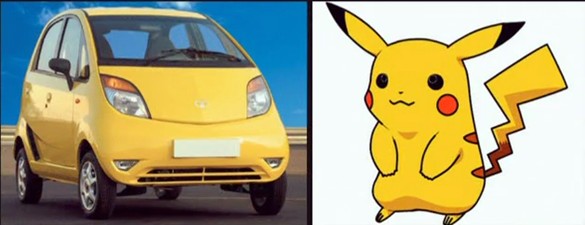
Tatamon?
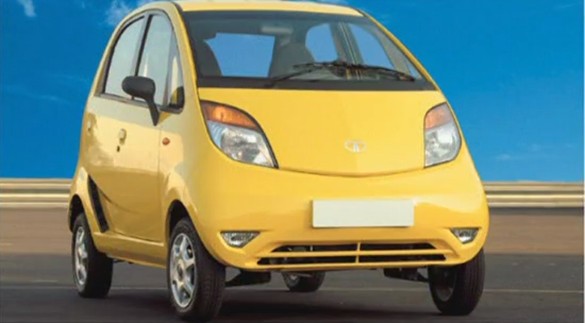
This is the Tata Nano: It has a two-cylinder engine that generates 35hp. It is capable of accelerating to 37mph in eight seconds. It can seat four. The trunk does not open. It gets about 55mpg. It costs approximately $2200, making it the least expensive production car in the world.
1
I bet it can't be sold in the US, because I bet it won't pass the 5 MPH bumper test.
Posted by: Steven Den Beste at November 09, 2009 12:29 AM (+rSRq)
2
And you'd be right. While it has passed front and side impact crash testing in India, those tests are less stringent than what we have here in the US.
Posted by: Wonderduck at November 09, 2009 01:04 AM (4Mcos)
3
Supposedly a version will be sold in Europe eventually (though probably not by Jag or Land Rover dealers!).
Posted by: Andy Janes at November 09, 2009 01:41 PM (cEaZp)
Remember That Torpedo 8 Detachment?
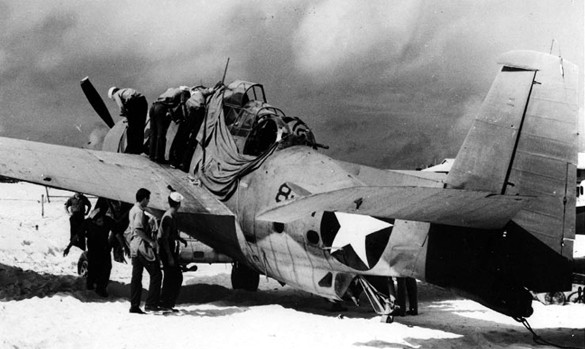
The first combat experience of the Grumman TBF (latter named the Avenger) came at the Battle of Midway, with a detachment of planes from Torpedo 8. We all know how that turned out: five TBFs shot down, and the sixth a flying sieve.
The pilot of the surviving TBF was Ensign Bert Earnest. He later went on to fight with VT-8 at Guadalcanal. He retired from the Navy as a Captain. Along the way, he earned a Purple Heart, two Air Medals, and three Navy Crosses.
Albert K Earnest, CAPT USN (RET) passed away on October 26th at the age of 92.
1
Considering your interest the WW II Pacific theater, I was wondering if you could answer a question that has been nagging at me for years. I have read several books which state:
Because they had armored decks, British carriers suffered less damage in Kamikaze attacks than the wooden-decked American carriers.
Although I have seen this claim in several books, I have never seen any mention of Pacific battles involving British carriers. Which battles against the Japanese (if any) involved British carriers?
Posted by: Siergen at November 08, 2009 02:47 PM (pnoBR)
2
Siergen, the Royal Navy participated in the Okinawa campaign and the carrier raids against Japan afterwards.
Their Okinawan contribution was substantial, actually. While they weren't directly involved in the battle for Okinawa, they were positioned between Formosa and Okinawa, attacking island airfields and making it difficult for the Japanese to reinforce and strike from that direction.
While it's true to an extent that armored flight decks did protect the RN CVs against kamikaze attacks, they had serious drawbacks as well. The obvious one is the limitation the armored decks placed on the size and number of planes the carriers could embark. RN CVs carried somewhere between half to 2/3rds as many aircraft as their USN counterparts, and it became very clear that the best defense against the kamikaze wasn't armor, but fighter cover. Near as I can find, the RN suffered about 75 kamikaze attacks, and had four carriers hit. The USN had to deal with about 1900 kamikaze attacks... and had four fleet carriers hit. Having a lot of fighters in the air helped protect the fleet a lot more than the armored decks did.
The other, hidden, cost of the armored flight deck became clear after the war. RN CVs Formidable and Illustrious were both hit by kamikazes. Post-war, both carriers suffered fires in their hangars. The Formidable's was caused when a Corsair fell off an elevator and its guns fired. The fire was contained entirely within the hangar box, which acted like a furnace. Her hull was actually deformed by the blaze, resulting in her being scrapped. This amount of fire damage wouldn't've occurred in the non-armored USN CVs.
Illustrious' fire was a small fuel explosion that an Essex-class CV wouldn't've noticed. The RN CV's hangar, however, contained the explosion completely, again causing deformation.
In both cases, however, damage surveys a few years later found that the kamikaze impacts caused serious hull stresses previously unexpected. The armored deck did stop them planes from getting inside the hull, yes, but it also transferred the impact damage to the hull itself.
Even if the later fires hadn't occurred, the two carriers probably would have been scrapped quickly. Even those armored carriers that didn't have fires onboard were soon scrapped post-war, and in those ships that had been hit by kamikazes, there was varying amounts of hull damage caused by impact shock.
So the armored flight deck worked to an extent, yes, but it had huge drawbacks, too.
By the way, today's Nimitz-class CVNs are technically armored deck carriers, and in theory could suffer the exact same sort of hull damage from missile impacts. In practice, though, they're so much larger than the WWII-era RN CVs that the threat from such damage is minute: something big enough to cause hull damage to a Nimitz via shock effect would be big enough to cause serious damage conventionally. Hull shock would be the least of the carrier's worries at that point.
Posted by: Wonderduck at November 08, 2009 03:45 PM (4Mcos)
Part of the reason that the RN CVs carried fewer planes is that all the steel used in the armored flight deck weighed a hell of a lot, so the ship simply didn't have enough extra floatation to carry as many planes as a USN CV.
Of course, the only way to find these things out is to try them. And there were experiments tried by the RN that were successful. For instance, they were the ones who found a safe way to land Corsairs on CVs, so they switched over from the Hellcat sooner. (The Hellcat was a fine plane, but the Corsair was better.)
Posted by: Steven Den Beste at November 08, 2009 04:33 PM (+rSRq)
4
Thanks for the very detailed response! I wonder why the books I've read didn't cover the British involvement at all. I can understand why some authors chose to concentrate on the bloody invasions and the fire bombing of the Japanese cities at that stage of the war. However, none of the books I've read covered British naval activities in the Pacific after their loses during the initial Japanese expansion.
Posted by: Siergen at November 09, 2009 06:17 PM (TJQ10)
There was also a period in 1943 where the US was down to two CVs in the Pacific, and Enterprise was urgently in need of several months in drydock. That left Saratoga the only US CV available for the Solomon area, and by that point it had become amply clear that CVs shouldn't operate alone if it could possibly be avoided.
So the British loaned us HMS Victorious to operate as part of a task force with Sara. (In radio signals, Victorious was referred to as
#USS_Robin">USS Robin.)
Posted by: Steven Den Beste at November 09, 2009 07:40 PM (+rSRq)
Posted by: Wonderduck at November 09, 2009 08:30 PM (4Mcos)
10
Siergen, the recent book by Max Hastings, Retribution, gives quite a bit of coverage to the Brits at the end of WWII. Now, to be clear, he pays more attention to their activities in India, but if my memory serves there's a good bit on their naval contribution.
There's a trade version of Retribution available, and it's well worth the $20 or so it'll cost. Oh, and ignore the WaPo review on the Amazon page: it tilts so far to the left I'm surprised it didn't cause my monitor to fall over.
Posted by: Wonderduck at November 09, 2009 08:37 PM (4Mcos)
Posted by: Siergen at November 09, 2009 09:21 PM (TJQ10)
13
Can't claim that I am, Siergen... looks interesting, though.
Posted by: Wonderduck at November 09, 2009 09:28 PM (4Mcos)
14
Churchill was pretty insistent on the British contributing in some fashion - in his history, he mentions several times that he did not want it to be said that the British accepted American help when they were under threat, but didn't reciprocate in helping defeat the Japanese.
That said, the specific contributions they made were somewhat limited - they didn't have a whole lot of naval force in the region, they kept a fleet in the Bay of Bengal, and the time between V-E and V-J didn't leave them enough to get major Atlantic fleet assets into the Pacific. (I didn't get the impression that they were vigorously planning such a move, but a lot of that was a desire not to have British fleet elements wholly dependent on an American supply train.)
Churchill had a lot of good things to say about practically everybody, but curiously, he hardly mentioned MacArthur at all. I got the impression that Churchill didn't have a whole lot of contact with him and didn't have a particularly good opinion of him - there were a couple of exchanges that you could interpret as "yes, we'd be glad to help you out, even if that means our units end up having to coordinate with MacArthur." Honestly, I don't know if there was something specific there - certainly MacArthur had a lot more contact with the Australian government than most American commanders, and since Australia was a Dominion... but no, nothing at all from that.
(Then again, Churchill had actual bad things to say about Australian politics, which cost him a couple of divisions at a time when the British couldn't afford them; it's entirely possible any transfer of antipathy would be going in the other direction! But at the same time, I don't have a lot of use for MacArthur myself - good shogun, lousy general, at least from his WW2 performance.)
Posted by: Avatar at November 09, 2009 10:24 PM (pWQz4)
MacArthur was actually a pretty good general, or he could be. The military conduct of the New Guinea campaign was very competent and effective; you have to give him credit for that.
MacArthur's problem was that he thought he was better than he really was. That's a pretty serious flaw in a top commander.
I think Churchill's insistence on participating in the Okinawa campaign was completely appropriate.
Posted by: Steven Den Beste at November 09, 2009 10:40 PM (+rSRq)
My Fourth Birthday
October 25th, 2005 dawned cool and clear. My alarm clock went off at 730am, as I was scheduled to open at the Duck U. Bookstore, but I just couldn't manage to wake up. Even a good shower couldn't manage to clear my head. Well, I'd been up late the night before, I just needed more sleep, right? I got dressed and drove to work.
I assume. Even at the time, I couldn't remember doing so. One of the store's part-timers, who worked with me that morning, said that I seemed really out of it that morning, and I'm sure that's right. But I was at work, and I had some stuff to do: a stack of invoices and credit memos that needed to be sorted and matched to their respective store-generated paperwork.
In the middle of doing that, however, something happened. Something bad.
My heart gave a huge grinding thump. Then it felt like it was tumbling down a flight of stairs for a moment, and then... it began to race. I felt a cold sweat forming on my forehead and was, suddenly, very very warm. I got up from my desk in the back room and walked unsteadily to the bathroom, wondering just what was happening.
When my heart kept racing, and seemed to be going faster and faster, I began to get scared... which, of course, made my heart go even faster. I staggered back to the store and asked my co-worker to call 911.
A lifetime (or maybe 10 minutes) later, two EMTs showed up. One of them starting asking me questions ("How do you feel?" "Tired." "Do you know where you are?" "Duck U." "Do you know who you are?" "I'm Batman."), while the other began pumping up a blood pressure cuff on my arm and holding my wrist. After a second, he said "I can't get a pulse."
My heart was going so fast that the EMT could not distinguish one individual beat from another. My blood pressure was too high for the cuff to read. They got me on a stretcher and began to roll me out of the Bookstore, just as my boss walked in. "Are you okay, Wonderduck?" "I'm going to the Hospital, Andi."
In the ambulance, the EMTs hooked me up to high-tech sensors and discovered my pulse was around 250bpm, my bp was a number I can't remember now, but was something like 300/200. Ook. Fortunately, they knew just what to do. "We're going to give you a drug that'll stop your heart for a real short time. It might be a little uncomfortable."
Yeah. Uncomfortable. Go ahead. Zap. Yup, he was right... a brick rested on my chest, but the heart didn't slow down. Zap again. Bigger brick... and my heart slowed down. Ahh.
In the ER, they discovered my magnesium and potassium levels had cratered. Since these control the heart AND brain function, which explained my fuzzyheadedness and my heart going faster than a dance club on speed.
They kept me overnight, and the only thing on the TV was a World Series game that had gone into extra innings... which the hated White Sox won, dammit. A bad day all around.
I had suffered something called Superventricular Tachycardia. It isn't usually life-threatening, but that hardly matters when it's happening to you... and the longer it lasts, the more dangerous it gets. In my case, it had gone on for nearly 45 minutes before they dropped the bricks on my chest, which is plenty long enough. I now take a medication to hopefully prevent it from ever happening again, and potassium and magnesium supplements, just in case. I've also stopped drinking caffeine (coffee or colas) and alcohol completely since the former is a stimulant and the second fights with the preventative medication.
So today is the 4th anniversary of my first brush with mortality... and what could have been my last, too, if I hadn't done one simple thing. I've said it before, and I'll say it again: if you feel something odd going on with your heart, CALL 911 IMMEDIATELY. You might think "eh, it's nothing", but you'd feel really dumb if it stopped altogether, wouldn't you?
So, please, if you get nothing else from The Pond, ever: call 911.
Hotblack Desiato Called
...he wants his car back: The limited edition Lotus Exige Scura.
"It’s the weird colour scheme that freaks me. Every time you try to operate one
of these weird black controls, which are labeled in black on a black background,
a small black light lights up black to let you know you’ve done it..." - Zaphod Beeblebrox, The Restaurant at the End of the Universe
Stark, Raving Sane
As long-time readers of The Pond know, in my prior life I was involved in the theatre... or should that be The Theatre? In amongst all the myriad shows I worked on or performed in (somewhere close to 200), there had to be a favorite, right?
Well, yes, but nobody's ever heard of The Mating Rituals of the Male, which was a one-man show/senior project that a friend of mine wrote and starred in. After that, however, I find that I have to go with a pair of plays that will be forever joined at the hip.
The first, everybody knows... or, at least, they should: William Shakespeare's Hamlet. The second is not so well known, Tom Stoppard's Rosencrantz & Guildenstern Are Dead. For those of you unfamiliar with it, R&GAD is about two minor characters in Hamlet, characters who are confused about why they're in the play Hamlet, and confused about what's going on in Hamlet, since all they see of it is what occurs in the precious little time they're in the script.
It doesn't so much "break the fourth wall" as not believe the fourth wall exists in the first place; the play is, the audience is integral to the existence of said play, and that's that. While the titular characters don't ever actually dialogue directly with the audience, they quickly realize the situation they're in, and therefore there must BE an audience, Q.E.D. ("We're actors-- we're the opposite of people!" is a line that will never fail to make a theatre person laugh)
The movie of R&GAD is a minor masterpiece in and of itself, starring Tim Roth and Gary Oldman as the two leads. As indicated in the play, however, neither is entirely sure which is Rosencrantz and which Guildenstern (though the credits reveal Oldman is Rosencrantz, Roth Guildenstern). Richard Dreyfuss, as the scenery-masticating Player King, is also present to good effect.
I bring this up because this evening, I stumbled upon a short story that is brilliant in concept: what would happen if Shakespeare managed somehow to see R&GAD? Fortunately, the author of this work is up to the challenge, but then Harry Turtledove does have a thing for alternative history, doesn't he?
SF publisher Tor has made the entire short story, "We Haven't Got There Yet", available on their website, for which fact I am eternally grateful.
When it comes to judging art, opinions will vary drastically.
I grew up in Portland OR, and when I was in high school, some people from there put together a trip to Ashland OR, home of the Oregon Shakespearean Festival. This was in the spring, during what was then known as "Stage 2", which is when they put on things that weren't Shakespeare.
So I saw Antigone, and I saw a couple of other things I can't even remember, and I saw R&GAD. Their staging of it was particularly effective for me because it was very minimal. Before the ship, the stage was completely bare. No props at all. The backdrop was blank. It added to the surreality of the whole situation. And it added to the claustrophobia, as other characters entered and left freely from all directions, and yet R&G could not find an exit.
It also made for quite a shock once they did end up on the ship, and suddenly the stage was dressed, and there were sound effects in the background of the sea.
Stoppard himself was responsible for the film, so by definition it fits his image of the story. But I found the minimalistic version at OSF so effective that in turn I was very disappointed by Stoppard's film. It's too lush. The setting is too realistic. And R&G move around too much. They don't feel trapped, the way they did at OSF.
I really hated the film version.
Posted by: Steven Den Beste at October 23, 2009 01:22 AM (+rSRq)
2
In my limited experience, a good stage production can ruin a movie for you, especially when you see the play first. The first time I saw Guys and Dolls was at the Midland, TX community theater. When I subsequently saw the movie, I thought it was terrible.
Posted by: Ben at October 23, 2009 08:04 AM (be3H9)
3
I loved the film version of R&G, but I never had the opportunity to see it on stage... especially not at OSF. While I was a season ticket holder at OSF, I did see Stoppard's "Arcadia" which was also equally wonderful. His work is fantastic.
Posted by: madmike at October 23, 2009 08:51 AM (vwlCI)
The four times I've seen a stage production of R&GAD, including the one I worked on, the sets have been much like how Steven described it, except for one small difference. Instead of being bare all the time except for the ship, the set is detailed only when they're actually in a scene (or observing a scene) from Hamlet, such as when they watch Hamlet's "To be or not to be" solilliquiy (and even then, they were on a blank stage... Hamlet, on the other hand, was not).
The whole key is lightning-fast scenery changing and careful lighting of the stage...
Posted by: Wonderduck at October 23, 2009 12:03 PM (OS+Cr)
And that's what Stoppard didn't do in the film. I'm not sure where it was filmed, but it was a gorgeous setting. R&G move around a lot, to different settings, and it's always amazing looking. Almost distracting.
But it ruins the mood that the play itself is trying to establish. It almost makes me wonder if Stoppard had forgotten his original idea for the play.
Posted by: Steven Den Beste at October 23, 2009 12:10 PM (+rSRq)








 #USS_Robin