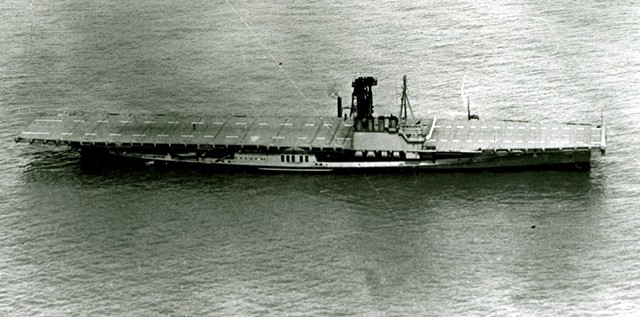
Warbird UpIn the comments of my post on the paddlewheel aircraft carrier Wolverine, reader The Old Man asked "How many WW2 carrier training birds are on the bottom of the Great Lakes and perhaps could be salvaged?"
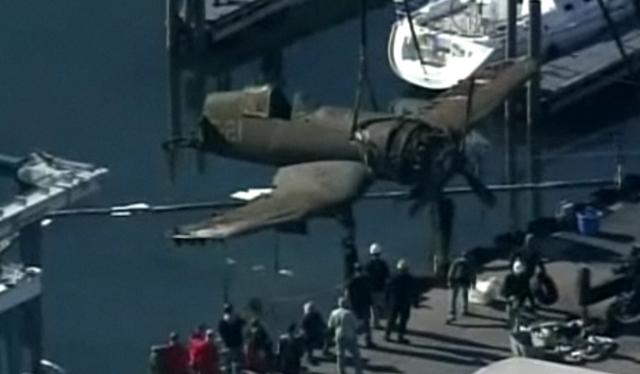
Well, as of Monday afternoon the answer is "one fewer," as salvers brought up a doozie.
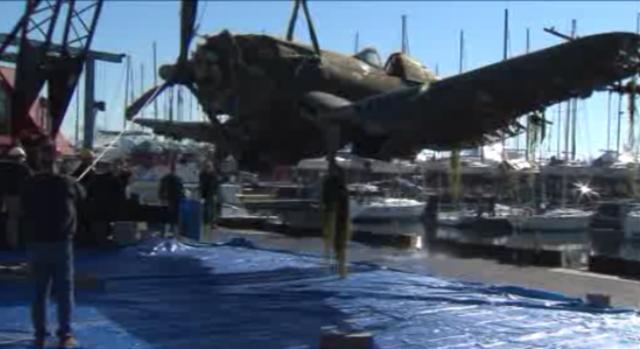
It's a Corsair, but not just any Corsair. That right there is the world's only known surviving F4U-1, the first marque of the bent-wing bird. It was sometimes known as a "Birdcage Corsair" for the latticework framing of the cockpit.
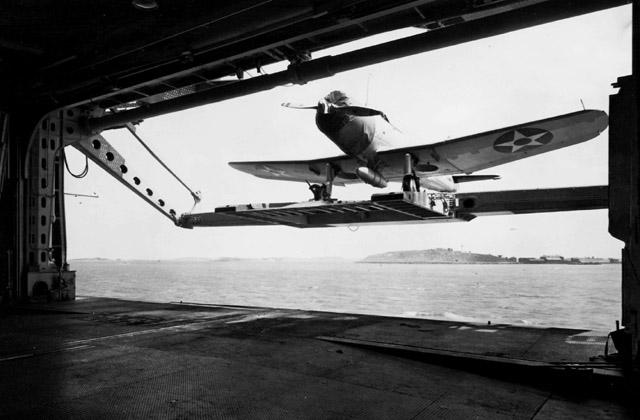
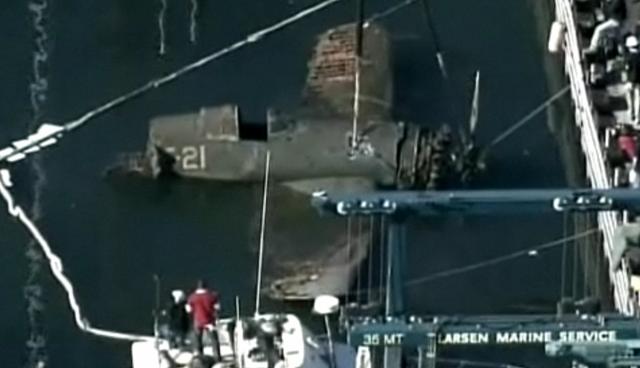
On June 12th, 1943, Ensign CH Johnson tried to land F-21 on the deck of the Wolverine. Losing sight of the LSO on approach, a common enough occurrence for the long-nosed Corsair, Ensign Johnson took a wave-off and, applying power, began to peel off to the left. Unfortunately, he had settled enough that his tailhook caught a wire, slamming the plane down onto the deck hard enough to split the rear fuselage from the rest of the Corsair. The tailhook assembly was ripped free of the plane as well. Both chunks of the F4U fell overboard and sank, though the front section stayed afloat long enough for Ensign Johnson to escape without harm.
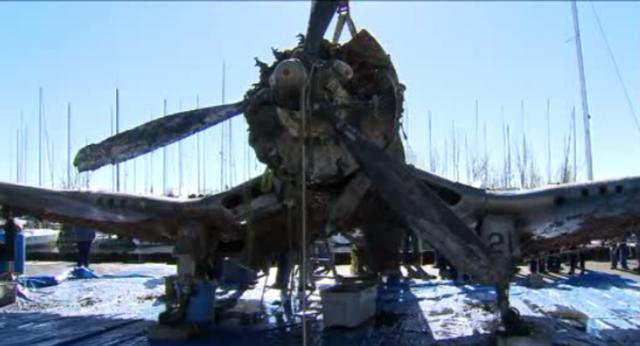
The plane is in remarkably good shape for having been submerged in Lake Michigan for 67 years. The underside is coated with zebra mussels, a common enough problem in the Great Lakes these days. There is rust, of course, but the structure of the Corsair is wholly intact. Indeed, the salvers brought up both pieces of the plane. The only bit missing? The tailhook assembly. Eventually, the F4U-1 is destined for the National Navy Aviation Museum in Pensacola, FL.
The salvage company that performed the rescue, A&T Recovery, says that there's at least 80 more warbirds sitting on the bottom of Lake Michigan, many of which are within 50 miles of Chicago. Almost all of them are Dauntlesses and Wildcats of various types. The F4U wasn't seen in the air above Lake Michigan, as the Wolverine and Sable were really not big enough to handle them comfortably. It may have been there as part of an attempt to requalify the Corsair for carrier operations, as the type had already been limited to ground-based squadrons in late 1942.
While Ensign Johnson got away unharmed from this crash, he wasn't so lucky later. He was killed in a midair collision over Hawaii on Thanksgiving Day, 1943.
1
Bloody awesome. Remarkable condition for the time spent underwater, but I imagine cold temps at depth had almost everything to do with that.
Posted by: The Old Man at November 10, 2010 12:03 PM (Bhe/R)
2
Cold, no light & no free oxygen work really well to preserve objects in water. Using a dry suit & hel/ox in Lake Superior while diving wreaks demonstrated that.
Posted by: Tony von Krag at November 10, 2010 12:31 PM (VGXAE)
I knew the Great Lakes had a number of shipwrecks on their bottom, but I never thought about airplanes.
Interestingly enough, that wreck doesn't appear on Wiki's page of surviving Corsair's...yet. (There are five F4U-1A's listed, but no F4U-1's.)
Posted by: karrde at November 10, 2010 08:50 PM (ekCkq)
4
Karrde, I don't think it counts as a survivor yet. I mean, look at it; two pieces, both heavily rusted. It will, eventually, but not yet.
It never will be flyable, by the way. The Naval Aviation Museum is all static displays; they won't restore it all the way, even if it could be.
Posted by: Wonderduck at November 10, 2010 10:10 PM (vW/MM)
5
A D*** shame that IMO. When I went in the USAF in '67 there were still some WW2 birds flying, making that wonderful noise. As the saying goes "Jet noise, the SOUND of FREEDOM." so to is the beat of a recip on run-up.
Posted by: Tony von Krag at November 11, 2010 09:58 AM (VGXAE)
6
Much better condition than if it had been in warm salt water. I'd read about this on the 'net earlier but it didn't really hit me what the fuss was about until I saw the photo of that three bladed prop. I'm so used to the four "paddle wheels" of the later models. You can actuall read some of the lettering on it and much more of the sheet metal is there than what I'm used to seeing. Some of the local guys who troll the Texas fresh water lakes with magnents say that they've pulled up stuff steel that was rusty but that if it was from deep enough down it was surface rust. A couple have firearms that they restored to working condition. The mineral contents of the lakes cause a variation of course.
Posted by: toadold at November 13, 2010 04:28 PM (qX4Ip)
Let's Talk Books
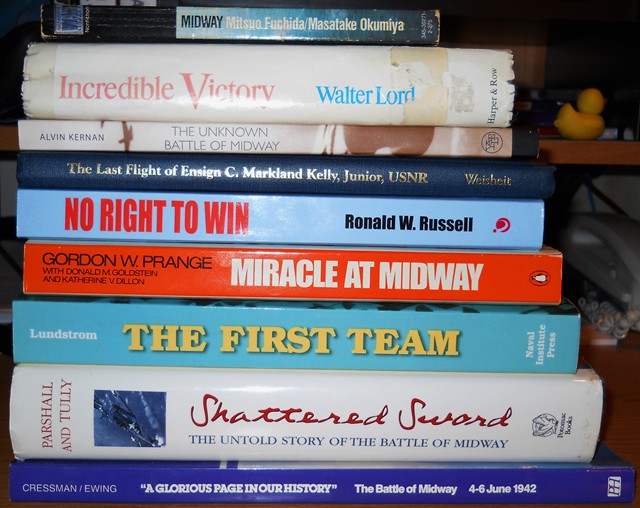
A couple of years ago, I was at the Duck U Bookstore when one of our history professors came in. At the time, we had a small area set aside on the counter for "Staff Picks", books that those of us who worked at the Bookstore had read and recommended. My two picks that month were World War Z, which I had just finished reading, and Shattered Sword, the 2005 book that turned a lot of what was known about the Battle of Midway on its collective head.
Knowing that the professor in question taught a class on WWII, I suggested Shattered Sword to him, and thus began a close to 45 minute dialogue on Midway and the Pacific War in general (it was summertime, during a stretch where we might go the entire day and see maybe three customers). When we were finished and the prof had purchased both of my "Staff Picks", one of my co-workers looked at me with something akin to stunned disbelief. "He's a history professor, how were you able to to talk to him like that about his specialty?", for indeed, his specialty was the Pacific War and Korea (where he himself served).
I thought for a second and replied "I read a lot." Her reaction, again, was stunned disbelief. "History books? You read history books for fun?"
Well, yeah. I do.
I'd like to write a little bit about some of the books on Midway that I've in my collection, if I may indulge myself a bit... and, seeing how it's my blog, I think I can.
In "The Codebreakers", Kahn devotes an entire chapter to the code group at Pearl Harbor, particularly talking about their performance during the Midway campaign. As you say, it's clear that the code breakers themselves were not in doubt about what "AF" meant, but since they were trying to convince Nimitz to gamble the fleet on it, they needed proof.
The "Midway" movie is a travesty in a lot of regards, especially concerning the codebreakers. That scene where they talked about "15%. No, 10%" is bullshit. In fact, they completely decoded and translated the entire Japanese operational order which was transmitted in JN-25B just before the superencipherment tables were changed, and gave the whole thing to Nimitz so he could use it to plan his battle. He couldn't have learned more if he'd personally attended Yamamoto's flag briefing session.
Posted by: Steven Den Beste at September 23, 2010 12:34 AM (+rSRq)
Bee-YOOT-eeful post, Duck. Ordered up a copy of "A Glorious Page" while I was reading your post. Please to send the info WRT Last Flight as I think I need that to go with my copies of Shattered Sword and A Dawn Like Thunder.
Thanks for feeding my history jones....
Posted by: The Old Man at September 23, 2010 12:59 PM (+LRPE)
3
Got interested in Midway flight to nowhere after seeing the movie battle of midway on tv over Memorial day. The magnetic declination in the Midway Islands in 1942 was just under 10 degree positive from true north. If that guy that went the wrong way "flight to nowhere" and left the torpedo bombers unprotected had not used this declination it might explain the whole mystery. This seems to be a common mistake for new crews, especially is they are used to using some other declination say from the US west coast. Thank God for GPS these days. Thanks, nice site
Posted by: ted parsons at June 02, 2011 02:06 AM (i4M8y)
If the magnetic declination was added instead of subtracted the difference would be from 240 to 270 degrees, almost exactly (to the degree) the diffence in the flight paths reported during the battle. Just so no one thinks I'm a know it all, the reason I thought of this was that I failed desert phase of Ranger school for sending my company in on the wrong heading during a raid. We jumped into in west Texas and heading out on a heading I planed while still in Ft. Benning GA (incorrectly using Ft. Benning GA magnectic declination).
WWII had very unpleasant results much worse than mine, interestingly with possible overall benefit to the battle as chance or providence would have it (who knows what the fighter cover would have been like over the successful bombing runs if this mistake had not happened). I know its possible to easily screw this up, as it happened to me too.
Posted by: ted parsons at June 02, 2011 08:10 PM (i4M8y)
5
OK I know its 30 degrees verses 20 degrees difference but what the alternative explaination?
Posted by: ted parsons at June 02, 2011 08:57 PM (i4M8y)
I remember that the first one that came down got us over to the left. Lt. Cmdr. Waldron, who was on his air phone, asked Dobbs if that was a Zero or if it was one of our planes. I didn't know whether Dobbs answered him or not, but I came out on the air and told him that it was a TBD. He also called Stanhope Ring from "John E. One, answer" and we received no answer from the air groups. I don't know if they even heard us or not, but I have always had a feeling that they did hear us. I think that was one of the things that caused them to turn north as I think the squadron deserves quite a bit of credit for the work that they did.
Personally, I was just lucky. I've never understood why I was the only one that came back, but it turned out that way. I want to be sure that the men that didn't come back get the credit for the work that they did. They followed Waldron without batting an eye. I don't feel like a lot of people have felt that we made mistakes and that Waldron got us into trouble. I don't feel that way at all. I know that if I had it all to do over again, even knowing that the odds were going to be like they were, knowing him like I knew him, I'd follow him again through exactly the same thing because I trusted him very well. We did things that he wanted us to do not because he was our boss, but because we felt that if we did the things he wanted us to do, then it was the right thing to do.
Posted by: ted parsons at June 02, 2011 09:17 PM (i4M8y)
Name This Mystery Ship IV
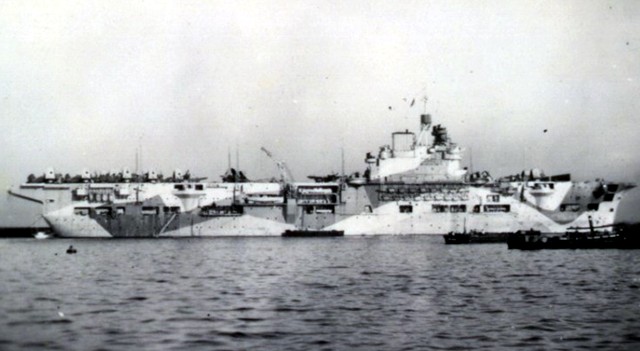
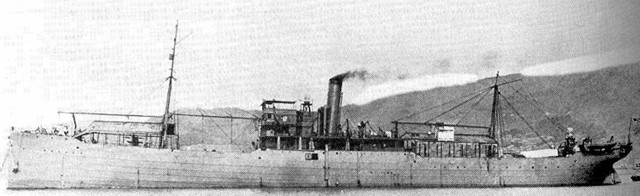
While I am working on the post that Siergen won for identifying the HMS Unicorn last time around... he selected a topic I know next to nothing about... here's another possibility for someone to win their very own post on a topic of their choosing! Name this ship:
Winner gets a post on a topic of their own choosing... hopefully not one as difficult as Siergen's, but pretty much anything is free game!
I'm hoping this one is difficult... if it's not, you guys are even more obsessive than I am!
UPDATE: Okay, maybe it was still "easy." Only took about four hours for Pete Z to come up with the Wakamiya, a seaplane carrier of the IJN.
She's best known as the ship that launched the world's first naval-launched air raids (against German targets in Tsingtao) on September 5th, 1914... 96 years ago today. In a way, this humble 8000 ton vessel with its four seaplanes and canvas-and-metal hangars is the direct predecessor of today's 104000 ton, 85 plane Nimitz-class carriers.
Posted by: Pete Zaitcev at September 04, 2010 09:56 PM (9KseV)
3
My guess may have been derived from the same set of blueprints (it was laid down a few years after this ship), but yours looks like an exact match, while mine had several differences.
Posted by: Siergen at September 04, 2010 10:36 PM (WLKpA)
Posted by: Wonderduck at September 05, 2010 12:29 AM (blg68)
5
My guess derives from typing "seaplane carrier" into Google and then looking at pictures. It only took 10 minutes, but only after I wasted hours trying to match hull design to various IDs and even AKs. I thought it was one of the conversions, I forgot what they were called.
Please post the wrap-up of Rocket Girls that you teased a bit over 3 years ago (thought about asking Oh Edo Rocket, but I doubt you watched that).
Posted by: Pete Zaitcev at September 05, 2010 08:35 AM (9KseV)
3
I will neither confirm nor deny your working theory, Steven, but I do want to point out that the US Navy did use "dazzle" paint on their CVs... for example, the Essex-class Hornet.
Posted by: Wonderduck at August 28, 2010 09:17 PM (ODvBe)
4
...and I see you found that out on your own as I was typing. Heh.
Posted by: Wonderduck at August 28, 2010 09:18 PM (ODvBe)
8
When I was in Air Force intel school, they gave us a mnemonic for a method of IDing ships. Similar to the WEFT method for aircraft recognition (wings-engine-fuselage-tail), it gave you the main features to look for and compare when trying to ID the target.
I'm pretty sure that the ship mnemonic was MAST. However, I'm damned if I can remember what all the letters stood for... Main hull-Armament-Superstructure and T____? I haven't been able to find the MAST method on the internet either.
Like Steven, I first checked the escort carriers, but that overhang at the stern and the size/shape of the island didn't match. I then checked the US light carriers; these looked similar in overall size, but again the shape of the stern was wrong.
Then I checked the aircraft on the aft flight deck. Those sure looked like roundels on the wings, and the US Navy started painting the bottoms of their carrier planes dark blue fairly soon after Midway, as I recall. That led me to the Brits.
Posted by: Siergen at August 29, 2010 01:26 AM (WLKpA)
9
Damn Siergen beat me to it, I recognised HMS Unicorn straight away. She was built as a maintenance carrier but ended up being the inspiration for the colossus and majestic class light carriers, some of which were still in use in the 90's
Posted by: Andy Janes at August 29, 2010 02:50 PM (vdxg1)
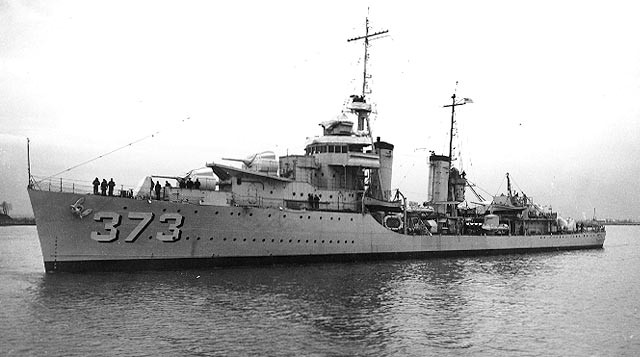
USS Shaw
Like the USS Hammann, there was nothing particular special about the USS Shaw (DD-373). Just one destroyer in a fleet with dozens similar to her, really.
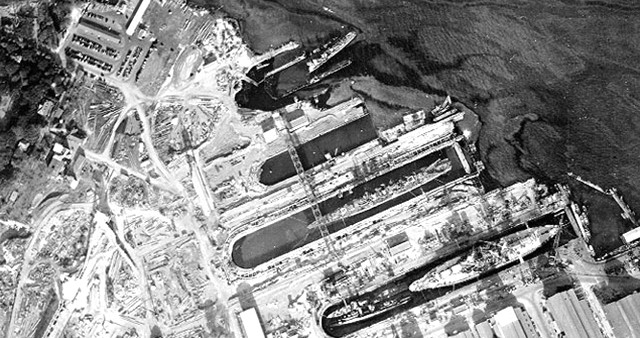
Laid down in 1934 as the tenth of the Mahan-class of destroyers, she weighed in around 1500 tons. Armed with five 5"/38 guns and a whopping 12 torpedo tubes, there was no question that she was quite able to fight other ships her size, and with a top speed of 35kts she could outrun many of the ships she couldn't stand toe-to-toe with. None of these numbers, however, made her different than any other destroyer in the US Navy. She joined the Pacific fleet in 1940 after her shakedown cruise, training and overhaul. In November of 1941, she found herself at Pearl Harbor, in a floating drydock for the sort of repairs that any ship needs after a while.
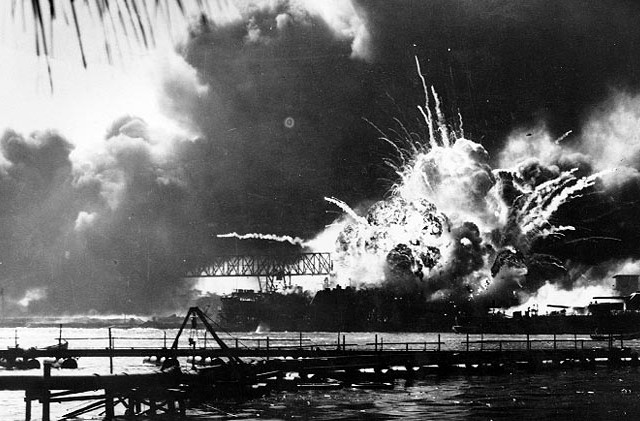
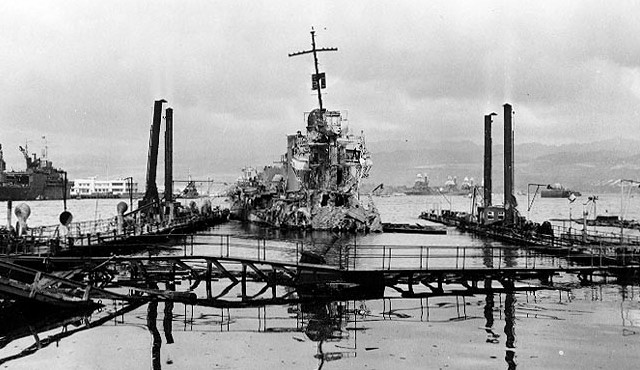
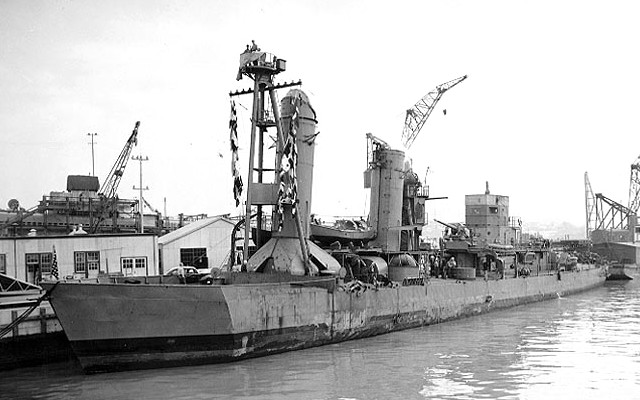
It wasn't until December 7th, 1941 that she became famous, thanks to one picture. The Shaw, hit by three bombs probably meant for the USS Nevada,
was set ablaze. While the crew attempted to extinguish the fires, it
was quickly realized that the attempt was doomed to failure and abandon
ship was called at 0925. Five minutes later, her forward magazines exploded.
After seeing this photograph, one could be excused for thinking that the Shaw was destroyed, in much the same way as the USS Arizona. Indeed, for some 30 years I just assumed that was the case. In fact, it wasn't.
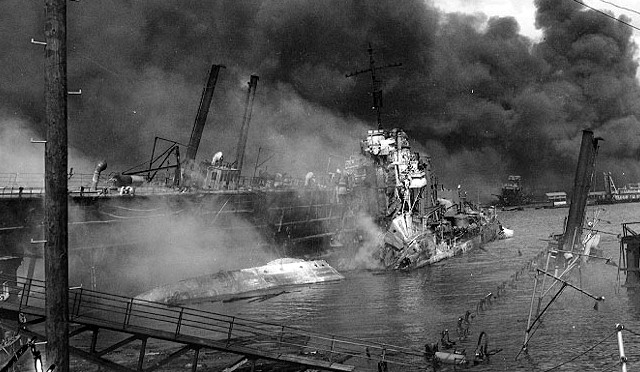
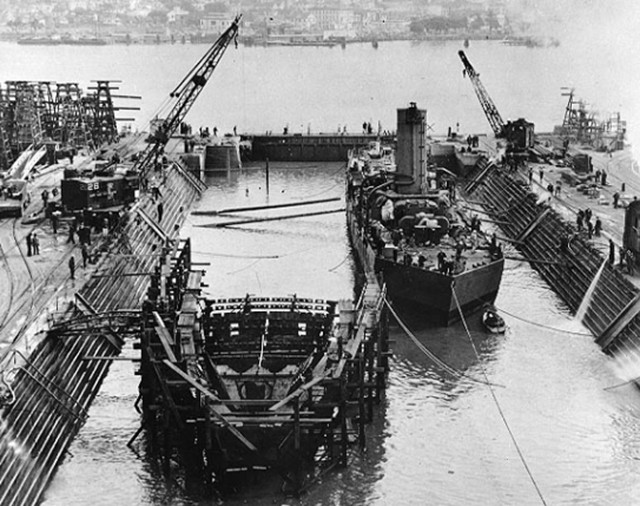
The explosion severed the Shaw's bow completely and to be honest, fairly neatly... at least as far as that sort of thing goes. It also sank the floating drydock she was in (YFD-2, in case you were wondering), which went a long way towards extinguishing her fires.
If you'll direct your attention towards the top of this picture, you'll see just how dramatically she was truncated... as if an axe amputated everything forward of her bridge structure. If you look at the bottom of the picture, you'll see the Cassin and the Downes just forward of the battleship Pennsylvania. In fact, the sole Pearl Harbor survivor I've met served on the Downes. But I digress.
Someone had the bright idea that the Shaw, bifurcated though she was, could be repaired. Refloated, fitted with a wooden bow and fixed up enough to be able to sail on her own, she steamed off to San Francisco. There, she was "placed under the anchor" and refit with a replacement bow.
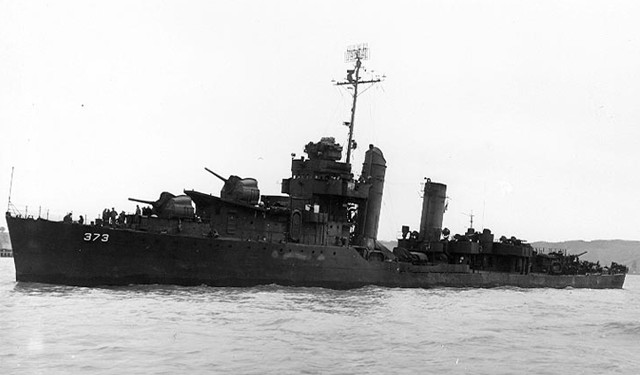
By the end of August, 1942, 68 years ago, the USS Shaw returned to Pearl Harbor, a ship whole again. She served through the rest of the war in the Pacific, making her presence felt at Guadalcanal, Cape Gloucester, Saipan, and Luzon. She was decommissioned on October 2nd, 1945 and stricken from the Navy List two days later. She was scrapped in 1946, ending what could only be called an eventful life.
USS Shaw, 1945
Again, congrats to flatdarkmars for being the first to guess the Shaw's identity. Per his request, there will be another mystery coming soon!
1
At that point in the war, they were willing to jump through hoops to save any hull that could be saved, just because they were desperately short.
A ship damaged that badly in 1944 they would have written off in an instant. But by that point brand new destroyers were pouring off the blocks in the US at a rate of dozens per month.
The US probably also still had the drydock capacity to do the installation and repairs at that time. In 1944, US drydocks would have been crowded to capacity both with American and Allied ships needing overhaul and repairs.
Of course, we are talking about a US that in 1941, before it entered the war, laid down 85 destroyers, taking an average of 6 months to complete each one (And depending on which yard you are talking about, a destroyer would be completed in 4 months.). That is slightly under half the destroyers built by Japan between 1921 and 1945.
What really mystifies me is why Cassin and Downes had their machinery reused in new hulls. I can understand reusing the reduction gears, but the rest of the engineering plant would not have been identical to what the likely hulls would have been designed for.
C.T.
Posted by: cxt217 at August 25, 2010 10:57 AM (f834w)
Name This Mystery Ship II
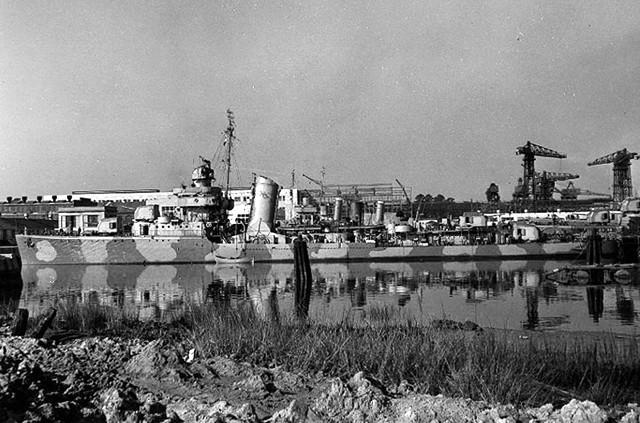
Once again, no clues or hints. Leave your guess in the comments. The first to give the correct answer will win a post on a topic of your choice!
And, for the record, I won't write about religion, politics or pr0n (though anime ecchi is okay). Anything else is free game!
3
>"I know it's got to happen, but it's always sad to see pictures of great old fighting ships being prepared for salvage."
Very true, although in this particular picture she's actually preparing for re-construction after being grievously wounded at Pearl.
It took me a while to get this one; I couldn't figure out what *type* of ship it was supposed to be, but I kept thinking it looks sort of like a destroyer but with a strange, crude bow and no forward superstructure. It took me a while to convince myself that the simplest explanation was actually the correct one. Based on the shape of the funnels, I started looking for records of Mahan-class destroyers that had been severely damaged (at first I was thinking rammed or torpedoed), and that's how I came across the Shaw. In hindsight, I remember having read about the Shaw's destruction, but had not realized the extent of the efforts made to salvage her. So I enjoyed this challenge because I learned something new in the process of figuring out the answer.
Posted by: flatdarkmars at August 24, 2010 10:37 AM (zxqxC)
USS Hammann
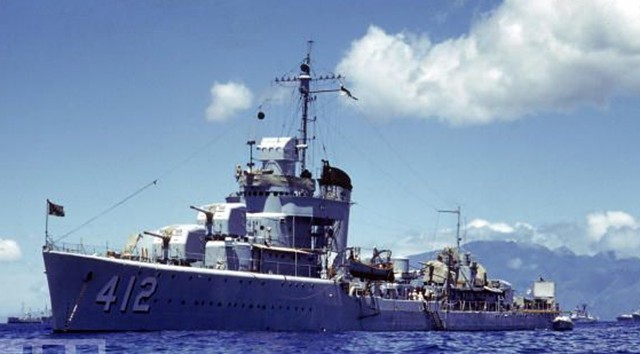
The life of a destroyer is never a glamorous one. Big enough to be a target but small enough to easily die, the destroyer's main job is to protect bigger, more important, ships from those that would attempt to harm them.
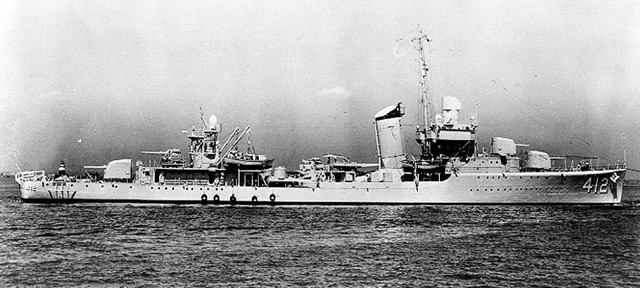
The USS Hammann (DD-412) was the fourth of the Sims-class of destroyers, commissioned in 1939. 2200 tons at full load, her twin screws could push her 348 foot length through the water at 35kts. She was armed with four 5"/38 guns and eight torpedo tubes, a common enough armament for a pre-war destroyer. She also carried a few .50cal machineguns. In comparison to what DDs would carry just a few years later, that seems a light load of weapons, but nobody really knew the threat aircraft posed at the time.
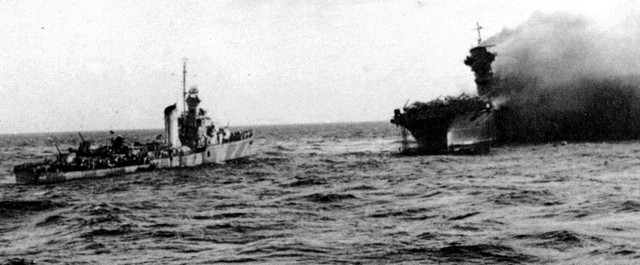
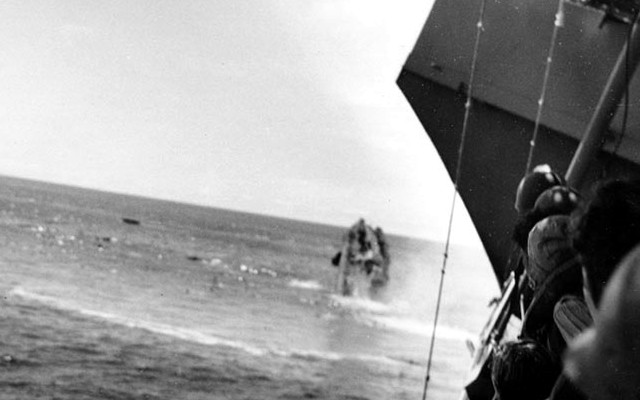
The Hammann was to be blessed (or cursed) with an active, but short, life. She was assigned to Task Force 17 and served as the plane guard destroyer for the USS Lexington at the Battle of the Coral Sea. She also collected many of her crew when the time came to evacuate the carrier.
The Hammann backs away, decks crowded with Lexington crew.
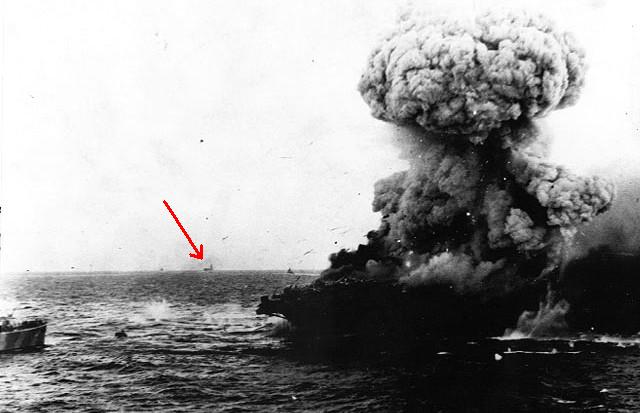
The Lex explodes. The Hammann's bow is to the left, the arrow points to the USS Yorktown.
After the Coral Sea, the Hammann escorted the damaged USS Yorktown in her dash back to Pearl Harbor. While the Yorktown underwent a crash repair program, Hammann replenished in preparation for the Battle of Midway.
We all know what happened there. The hastily repaired Yorktown took three bombs and two torpedoes and ended up dead in the water. Again the Hammann rescued survivors from an abandoned carrier, this time transferring them to a larger ship. On June 6th, 1942, the destroyer pulled alongside the Yorktown to provide power, hoses and pumping for firefighting efforts. While alongside, the Japanese submarine I-168, taking advantage of lousy acoustic conditions, slipped inside the destroyer screen surrounding the crippled carrier and loosed four torpedoes at her. One missed. Two went beneath the destroyer, striking the carrier. And one slammed into the side of the Hammann. Her back broken, the Hammann jackknifed and sank in four minutes.
The Hammann's stern portion goes down
Most of her crew ended up in the water, surprised but alive. The destroyer, however, seemed to have other plans for her men. Shortly after she went down, a massive underwater explosion occurred when her depth charges detonated. This is somewhat odd, as the man in charge of them says that they had been safed. Some have said that her boilers exploded. Either way, the concussion from the explosion snuffed out the lives of 80 of her 192 crew.
There was nothing particularly special about the USS Hammann. Just another destroyer in a fleet that had dozens... hundreds... of them. But circumstances put her alongside the first two American carriers lost during WWII, and nothing but horrible luck made her the first American loss at the Battle of Midway. She earned two battle stars for her service, and her captain, Commander Arnold True, was awarded the Navy Cross for his work at Midway.
1
Ship recognition is not my strong suit. I was going to guess the USS Hammann, but the port holes in the bow look wrong. How about the USS Warrington DD-383?
Posted by: Siergen at August 21, 2010 12:05 AM (jMQcx)
2
That's certainly a strange configuration for a ship. But it's a bit hard to tell for sure because I'm having a hard time telling what's the ship, and what's on the shore behind it.
Now as to that "a topic of their choice", you'll write a post about anything? I'll have to ponder that a bit. With great power, comes great responsibility...
Posted by: Siergen at August 21, 2010 11:59 AM (jMQcx)
5
D'oh! I just realized that flatdarkmars is the one who said my first guess was right, not Wonderduck. I think I may need to get new reading glasses...
Posted by: Siergen at August 21, 2010 04:19 PM (jMQcx)
Siergen: that would be my guess. Given that US Navy did the same to other ships in the early days of Big Mistake #2, it would hard to imagine her not receiving the modification.
C.T.
Posted by: cxt217 at August 21, 2010 11:12 PM (OQ3pW)
The 'snake-skin' type paint scheme was a bit unusual for US ships even during WW2, but there is a photo of a destroyer with similar paint scheme in Richard Frank's Guadacanal.
C.T.
Posted by: cxt217 at August 21, 2010 11:15 PM (OQ3pW)
Two (Er... THREE!) More Texan Pics
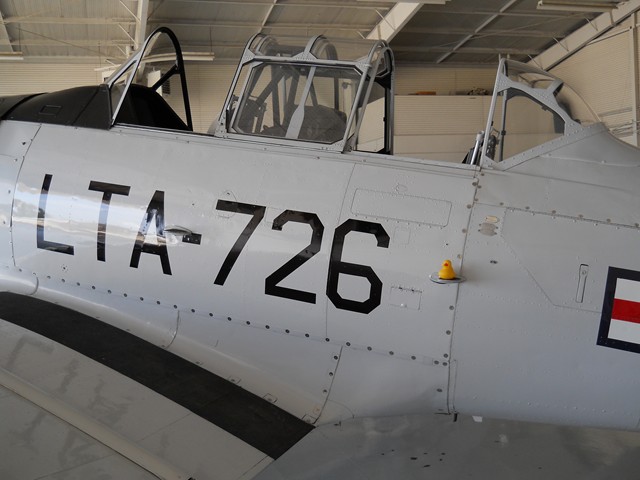
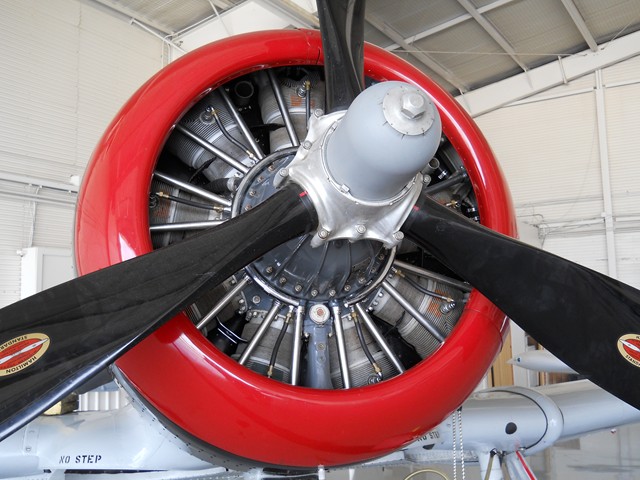
Since I find myself at a loss for things to expound about, I figured I'd throw up another couple of pictures from my trip to Courtesy Aircraft. Like this one:
It's almost like the manufacturers knew that, one day, someone would come along and want a place to put a rubber duck on the side of their plane. Oh sure, they may say it's for entering or exiting the cockpit, but I think we know better...
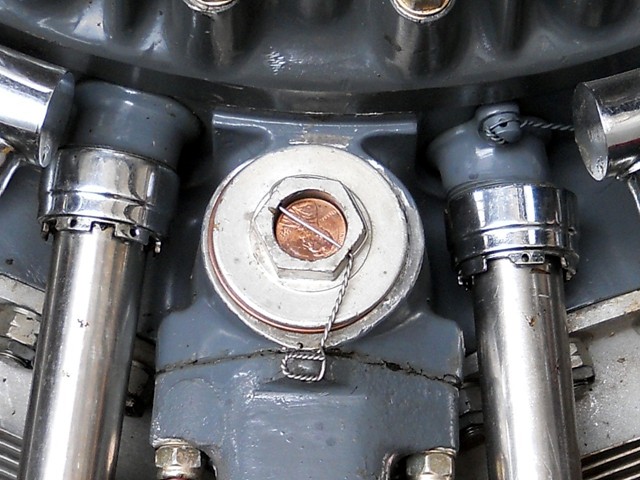
Another picture of radial sculpture. I have to admit though... I'm somewhat confused about why there's a penny wired into the engine:
I'm sure it's not a coincidence that the hole in the nut is exactly the right size for a penny. It's also not just a one-off, since the engine on the other Texan had the same arrangement. I just can't, for the life of me, figure out why it's there. Not that I'm an engine mechanic or anything, because I'm not. Ah well, perhaps we'll never find out. Lends an air of mystery to the whole thing.
Posted by: pxcasey at August 09, 2010 11:47 PM (lN7Wq)
2
I had a lot time in both the AC130 & AC47 while in the USAF, hearing any of the big piston Pratts & Wrights could shake your fillings lose on run-up.
Posted by: vonKrag at August 10, 2010 09:04 PM (VGXAE)
Wonderduck Pays Courtesy A Call
You may remember back about a week or so ago, I mentioned in a comment to reader Will that the Duckford Airport was home to a warbird restoration shop. It turns out that isn't quite the case, as I got the "restoration" part incorrect. Instead, Courtesy Aircraft is a seller of classic warbirds and modern planes as well... and I was exchanging e-mails with them. After three back-and-forths, I was told I could stop in any time during business hours to look around. How cool is that?
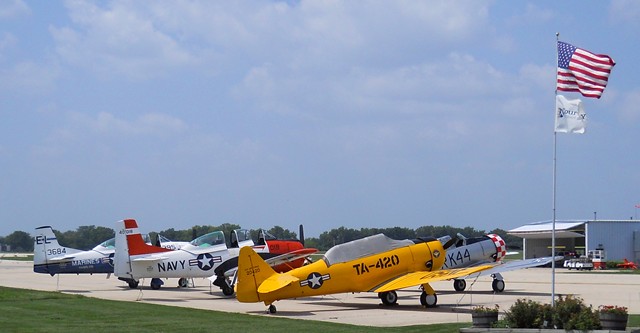
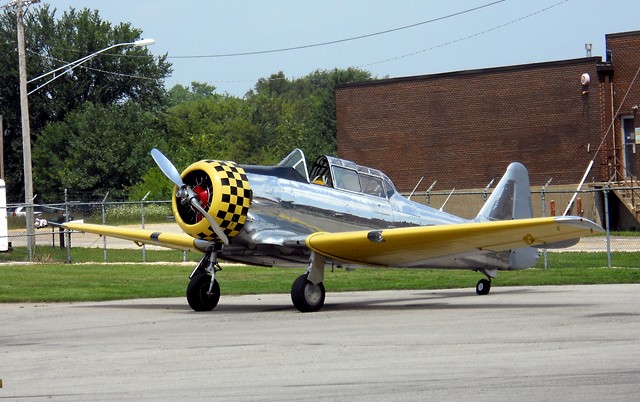
It was a sunny afternoon as I pulled into the small parking lot next to Courtesy's hangar at the Airport. I met Darcy, Courtesy's Marketing Director, and learned what I had feared: they were actually quite busy. Turns out they had a few customers in town after their appearance at EAA AirVenture, which is good! It did mean, however, that they couldn't spare anybody to escort me around the flightline. I could stick around the hangar, I just couldn't go onto the taxiway... security, y'know. I knew, and approved, even though it meant I couldn't get any closer than this to some juicy-looking aircraft:
Two T-6 Texans, just ahead of a pair of T-28 Trojans. I gather that the high-visibility yellow-painted T-6 won a restoration award at Oshkosh sometime recently, in fact. Still, the limitation didn't mean that there wasn't anything I could get close to...
1
I've read a lot of stories about pilots who saw a new model plane, and said something to the effect of "If it looks fast, it'll be fast." That ain't necessarily true; the Brewster Buffalo actually had clean lines, but it wasn't a good aircraft.
Anyway, though, when I see a DC-3, I can't help but admirre the clean shape of the fusilage. Or the way the engine cowlings merge into the wing. I do think the DC-3 is one of the prettiest planes of that era, not to mention being the best single aircraft design of all time. (Them's my opinion.)
Is there any other aircraft that's been in operational use for 80 years? (well, the B-52 is getting close to that...)
It is nice to see a DC-3 that runs, and likely runs on a semi-regular basis, as well as being in such good shape.
The Henry Ford Museum has a DC-3 (it was right next to Lindbergh's <i>Spirit of St. Louis</i>, last time I visited...more than a decade ago). But that one likely hasn't left the ground (under its own power) in years.
Posted by: karrde at August 08, 2010 07:45 AM (Ujx+u)
3
That question intrigued me, so I went looking for an answer.
The Boeing 727 is nearing 50 years in operation, and the Piper Cherokee is past that. The Beechcraft Bonanza began to be built in 1947 and is still being made today. Cessna began construction of the 172 in 1956.
The Bonanza, by virtue of the fact that it has already gone 63 years in production, will probably hit 80 years easy. The other two civilian planes, too. The 727 probably won't, at least as far as fleet service goes (there'll always be some third-world airline that has a frankenplane 727 running somewhere).
But that's about all I could find: rare company indeed.
Posted by: Wonderduck at August 08, 2010 07:58 AM (iJfPN)
4
Best I can come up with is the AN-2, which has been in production since '48 (now under license to the PRC); on the civilian side there's the Beech Staggerwing (in production between '33 and '49), though that's probably stretching what you meant. The B-52, A-4, T-38 and C-130 are all mid- to late- 50s vintage designs still in service (though the A-4 was retired from US service in '03).
Great pictures, Wonderduck.
Posted by: JP Gibb at August 08, 2010 08:27 AM (S3r8/)
5
Very cool; I really do need to visit the aircraft museum right next to my work...
Posted by: GreyDuck at August 08, 2010 09:50 AM (7lMXI)
6
En-Vee, amigo. I trust you'll visit again when they aren't so busy and bring a report of that visit also...
Posted by: The Old Man at August 10, 2010 07:46 AM (+LRPE)
7
I worked at the Atlanta airport in the mid 70's loading cargo for Kennworthy air. They had a mixed bag of DC-3,DC-6 and C-46s they loaded for other freight services. The most unusual was the Carvair a converted DC-4 for passengers and or cars,it looked like a small 747 with props. Another rather interesting aircraft was the CL-44,a large and somewhat slick turboprop. The one aircraft I most wanted to see up close was the Connie but one never arrive when I was there.
Posted by: bouff at August 11, 2010 11:28 PM (f3+Qa)
1
Ah, that brings back memories.... My dad and I used to camp out at the Oshkosh fly-in each summer. The warbirds were one of my favorite parts of the show, and eventually I could tell the difference between a T-6 and an SNJ just by the sound.
It's been years since I last went to a fly-in. Maybe next year...
Posted by: Siergen at August 06, 2010 08:47 PM (jMQcx)
AirFest 2010: Thunderbirds, Run 'Em Up!(continued from the first post)
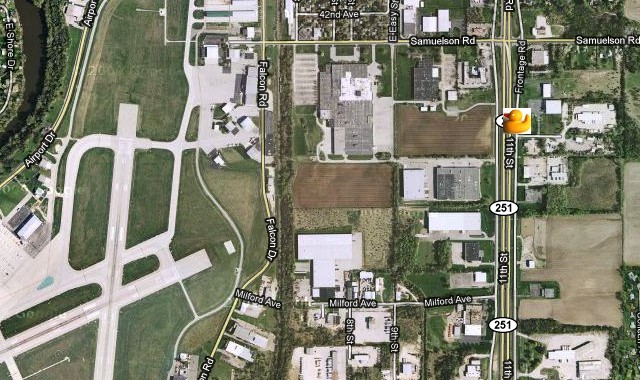
Even though I knew I was in a great position, I didn't realize until just a few minutes ago really how good it was. Here, take a look at this:
Obviously the duck isn't to scale, but that really does clear up where I was located: just over a half-mile from the end of the runway. About 100 people and myself were lined up on the east side of 251, down to about where that farm area starts. I couldn't have planned it better if I had tried... and the best part is, I DIDN'T plan it, it just worked out that way. Should have brought some sunscreen, but such is the price of spontaneity.
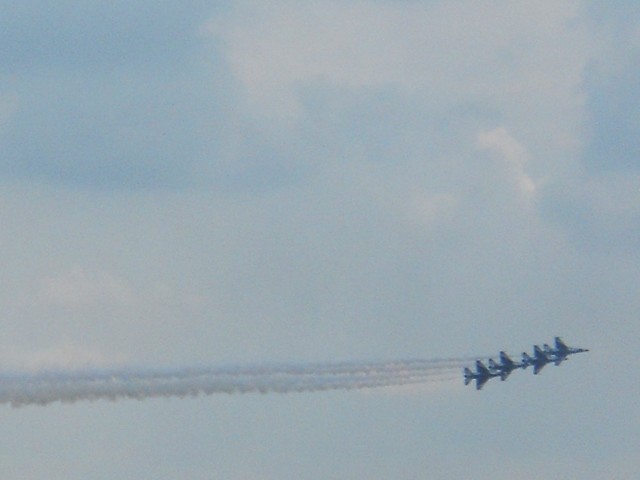
When I arrived, there were some acrobatic planes doing their thing. Then they finished up, and we waited for the main event to begin. And waited. And waited. I figure that the big dark cloud moving NW to SE over the airport had something to do with the delay As we were waiting, an older man and his wife pulled in. They'd driven up from Peoria, nearly four hours, to catch the show. "Your timing is great, they should be starting any minute!" No sooner had I said that when a roar came from airfield; not one of high-performance engines, but of thousands of people cheering. THEN came the loud whistling scream of six Pratt & Whitney F100-PW-229 engines, followed closely by a cloud of white smoke and...
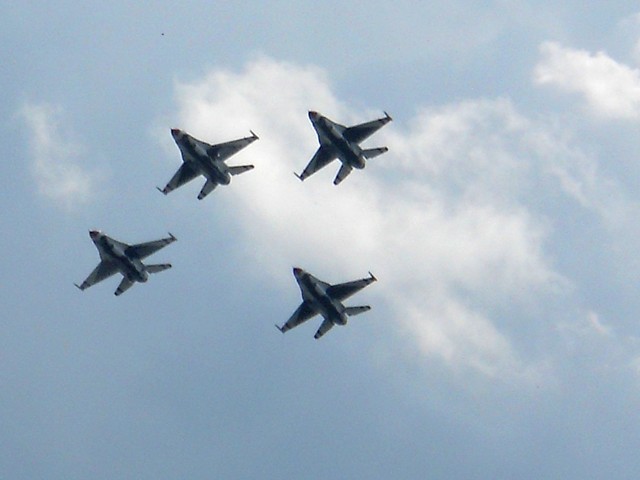
...The Diamond roared by. Actually, this isn't quite The Diamond yet, as #4 is still getting into position, but it soon would be. While I, and everybody else, were agog watching The Diamond fly overhead, the two Solos, #5 and #6, took off and went dead vertical, gone from view in an instant. Meanwhile, the four planes of The Diamond changed shape...
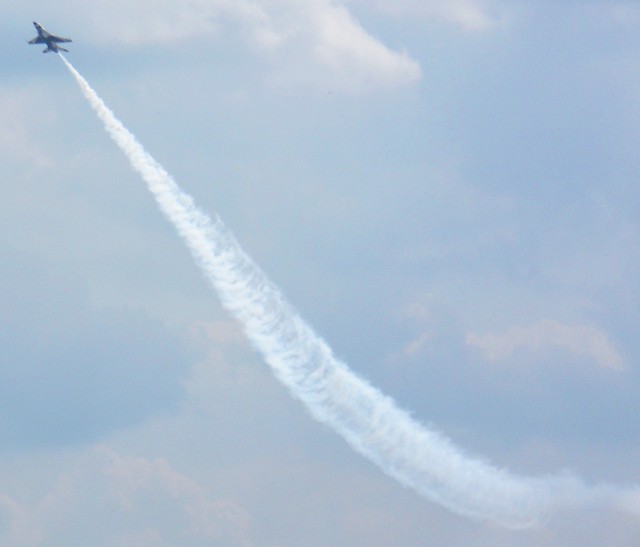
...and went by in the "Close Follow" formation, which transitioned back to The Diamond over the airfield. As soon as they cleared, #6 whipped by over my head for a knife-edge pass of the crowd. Alas, that picture is nothing but a faintly Falcon-shaped blur as he went by too fast for my camera to adjust focus. However, the lead solo, #5, was coming right towards us in a level slow roll, followed by a rapid climb-out to his right, smoke streaming all the way.
Around here, I lost track of what maneuver is which... and I don't really care. Onwards for the really cool pictures!
A profound thanks go out to the Thunderbirds for their performance...
more than a few times I simply geeked out and watched instead of taking
pictures. If you get a chance to see them, or the Blue Angels, or the
Red Arrows, or the Snowbirds, or Blue Impulse, or any other flight team,
take the time to do so.
2
A few years ago I drove up to Seattle with the family to check out the Boeing Museum of Flight. We were totally unaware that the Blue Angels were scheduled to do a show in Seattle that weekend, and they were using the Boeing runway as their staging point. So after a wonderful few hours in the museum we come out to find the parking lot adjoining the runway overflowing with people, and the Blue Angels just taxing out for takeoff, maybe 200 feet away from us. Needless to say, we did not hop into our car and drive off.
The show itself was centered on the water a mile or so off, with a hill blocking our view, so we didn't get to see the most spectacular stuff, but the activity on and around the runway was more than interesting enough. In particular, six hornets thundering down the runway on afterburner right in front of us where we could feel the roar and see the shockwaves forming in their exhaust was pretty thrilling. Unfortunately they did not do the JATO takeoff of the C-130 for some reason.
The famous picture of a Blue Angel Hornet flying low to the water, with the shockwave reaching to the surface as it passes nearby boats was taken at this performance, we could just BARELY see that portion of the show and we could see the spray but not the aircraft at that point.
Posted by: David at August 03, 2010 11:23 AM (oyblT)
3
In 2002 Ukrainians killed more than Italians in Rammstein (85 vs 67).
Posted by: Pete Zaitcev at August 03, 2010 11:36 AM (/ppBw)
Posted by: Ed Hering at August 03, 2010 04:36 PM (gLbEB)
5
David, the reason you didn't see Fat Albert do a JATO takeoff is because the US military has been running out of JATO units for a while. In fact, the last use of them was a 2009 Blue Angels show... after that, they were all used up.
Posted by: Wonderduck at August 03, 2010 05:07 PM (iJfPN)
6
Here's a link about JATO's end: http://www.codeonemagazine.com/article.html?item_id=9
Posted by: Pete Zaitcev at August 03, 2010 09:39 PM (/ppBw)
7
Good info, but that probably wasn't the reason in my case, as it was in either 2006 or 2007 that we saw things, and certainly everyone in the crowd around seemed to expect it. I suspect that they either had some last minute issue, or simply decided that since the show proper was out over the water and the crowd around the airfield was more or less impromptu that it wasn't part of the schedule for that particular show.
Posted by: David at August 04, 2010 05:35 PM (oyblT)
AirFest 2010: Eagles, Spooks, Warthogs and Hornets, Oh My!
I had an ulterior motive for purchasing my new digital camera when I did. Y'see, I knew that this was the weekend for the Chicago-Duckford International Airport's annual airshow, named AirFest. And I planned, as I alwayshavebefore, to stand in the field behind Pond Central and take pictures of the USAF Thunderbirds, this year's featured performers, as they went by overhead.
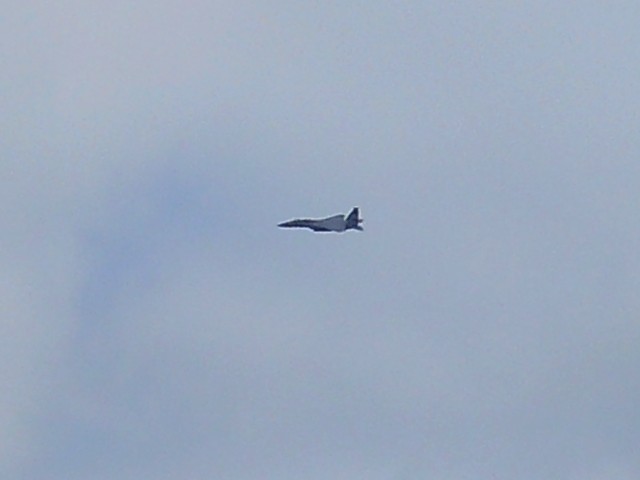
See, Pond Central is right at the edge of their performance cylinder, about two miles or so from the airport, so when they extend out from the runway they tend to fly right over my living room... literally. However, they're usually the only performers who get that close, so on AirFest weekend I make a small change to my routine. Instead of going to my usual grocery store, I head to a smaller, dingier place that has the advantage of being about a half-mile from the airport. I've not usually gotten good pictures of the "supporting acts" from this location, but there's always a first time, right? When I get to the store, there's no sound at all coming from the skies, so I head inside and do my shopping. $70 later (and I forgot to get batteries, darnit!) I emerge from the Hilander and push my cart back to the DuckMobile. As I unlock the Official Car of The Pond, I hear a strange, almost spooky, howling moan coming from the direction of the airport and getting louder. Just as I look up, one hand unlocking the car door and the other frantically trying to dig my camera out of my pocket, the first of the jet performers, the F-15E of the US Air Force's Strike Eagle Demo Team screamed right overhead and low, rolled hard left and dashed away for what I assume was to be a high-speed "sneak" pass of the runway. I quickly threw my comestibles into the back seat, moved my car about 100 feet west (no cars parking there), and waited for the moaning howl to come back. And then it did.
He played around for a little bit, including one absolutely brilliant zoom for the skies that I couldn't get a picture of because the sun was too bright, then disappeared. Content that I got at least one good picture, I got back into the DuckMobile... and then scrambled out again, because I heard a rumbling roar coming from behind me.
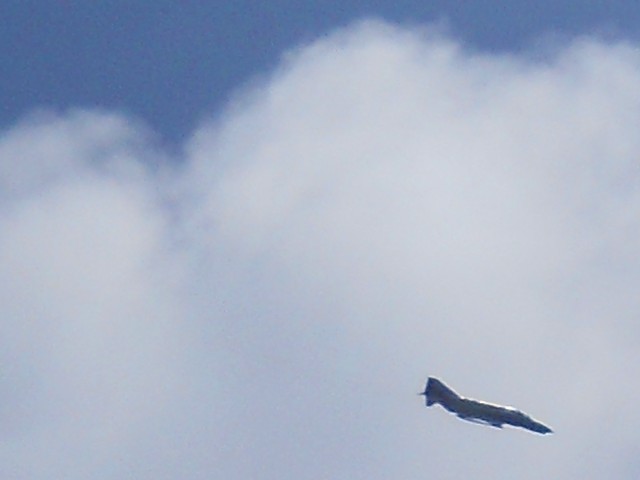
I've never seen a F-4 Phantom II in the flesh before! This one is from the Air Force's Air Combat Command "Heritage Flight". A triumph of thrust over aerodynamics, the Phantom was called a number of derogatory names over the years, such as "Double Ugly", "Flying Brick" and "Iron Sled." The Luftwaffe gave it the best nicknames, though: Luftverteidigungsdiesel ("Air Defense Diesel") and Eisenschwein ("Iron Pig"). Strangely though, I found it to be much more graceful in flight than the Strike Eagle.
1
Sounds like you had a good show!
Do you mean you've never seen a flying F-4 or never seen an F-4 at all? I thought they were pretty common in aviation museums.
The only time I've heard a sonic boom from an aircraft in the flesh was when I watched one of the shuttles come in for a landing at KSC. They've got a distinctive double boom without any engine sounds... The old IMAX movie featuring the shuttle (just looked it up: The Dream Is Alive) has a good recording of it, though you'll need the monstrous subwoofers of a real IMAX theatre to reproduce them well, but still recognizable on my laserdisc edition.
Posted by: Kayle at August 01, 2010 03:37 AM (q0jjs)
2
Kayle, I've never seen a Phantom II in the flesh, period. They are common at aviation museums, but the few that I've been to didn't have one.
Posted by: Wonderduck at August 01, 2010 08:51 AM (iJfPN)
3
I LOVE the Heritage Flights, one of the best PR ideas the USAF has had. I had the distinct pleasure of seeing two shows in '08: Wings Over Pittsburgh had an F-16 and an F-22 (it was supposed to be a P-47 and the Raptor, but bad weather delayed the Jug), but Oceana was a bit better...
And this year we're (supposed to be) getting the FA.2 Harrier!
Posted by: JP Gibb at August 01, 2010 10:41 AM (S3r8/)
4
We regularly get Hornets, Super Hornets, and Harriers flying in and out of Mesa-Gateway about a mile from my house. My parents live under the southeast end of the runway and every once in a while the Harrier jocks get frisky at treetop level after takeoff.
Now that I think about it, we regularly get C-17s, F-5s in aggressor paint, KC-135s doing touch-and-goes, and the occasional A-4 (there's some kind of commercial training outfit that uses them at the airport). There's are a F-104 and T-33 parked in a hangar as well. I've seen the 104 rolled out like they were checking the engine, but that's about it. I'd love to see it fly overhead one of these days.
Posted by: Will at August 01, 2010 10:35 PM (+tm6w)
5
Will, not to play one-upsmanship with you, but O'Hare airport in Chicago has an ANG base on the premises. Of course, it's very hard to train in the airspace of Chicago, so there's an auxiliary base here in Duckford. It's a common sight to see KC-135s and Hercs milling around the airspace of the city.
What isn't common, but does happen every now and again, is the sight of a MiG-17. Turns out that there's a well-respected warbird restoration shop here in town on the far side of the airport from Pond Central, and one of the things they did recently (I assume for a collector) was a MiG-17. They appear to have taken their aircraft to Oshkosh this year, though.
Posted by: Wonderduck at August 01, 2010 11:57 PM (iJfPN)
6
Nice pics, havent done any airshows this year, too damn busy most weekends (last sunday was the war and peace show too)
Posted by: Andy Janes at August 02, 2010 01:16 PM (uHTeu)
Wolverine Followup
About a month ago, I wrote about the world's only freshwater paddlewheel carriers, the USS Wolverine and her sister ship the USS Sable. A couple of days ago the Official First Friend of The Pond, Vaucaunson's Duck, sent me an e-mail, wondering if I'd seen the video?
Video? Of the Wolverine? Baby! Turns out it was from a Pathé newsreel, which you can see here. "Yankee ingenuity" indeed. But that got me wondering... is there any more video of the Wolverine or the Sable out there that I didn't find the first time?
Turns out, the answer would be "yes!"
Avengers and Hellcats in that clip, a wave-off and a barrier crash, too. The wave-off gives you a sense of just how small the two IX carriers really were; the Avenger looks like it won't fit on the deck, let alone land safely.
From that clip, I wandered around a bit, and found a link on another video to a blog devoted entirely to the paddlewheel carriers, aptly titled The Paddle Wheel Aircraft Carriers. It hasn't been updated in about a year, but boy, do I wish I had found it when I was doing my earlier post. Particularly because of this post which has a link to another video.
June 3, 1942: The Battle Begins
Conventional wisdom says that the Battle of Midway began on June 4th, 1942. Just as the conventional wisdom that says that the Japanese carriers were five minutes from launching a devastating attack on the US carriers is incorrect, this too is wrong. The Battle of Midway actually began on June 3rd. To be sure, all the dramatic parts of the fight occurred the following day, but the two opponents started throwing armament at each other on the third day of June.
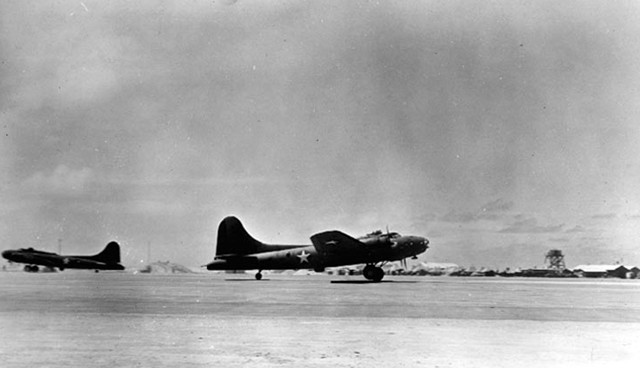
Nine B-17s took off from the runways of Midway's Eastern Island around 1230pm on June 3rd. After a flight of about three hours, they found the transports of the Imperial Japanese Navy's Midway Occupation Force, tasked to effect the actual invasion of the atoll, approximately 500 miles to the west. The B-17s claimed multiple hits on the lumbering transports, though managed none whatsoever, despite a total absence of CAP and effective antiaircraft fire.
Meanwhile, a thousand miles or more to the northeast of Midway, two light carriers of the IJN (the Ryujo and the Junyo) launched an attack on Dutch Harbor, Alaska. 12 Zero fighters, 10 Val dive bombers and 10 Kate torpedo bombers (operating in horizontal bombing mode) lifted off from the tiny flight decks in miserable weather. This attack caused minor damage to oil storage tanks and the local radio station, while some bombs hit the barracks of Ft Mears, killing 25 soldiers.
The attack on the Aleutian Islands has often been called a diversionary assault, intended to draw out the American fleet from Pearl Harbor. It turns out that that is not the case. Both the attack on Midway and the attack on the Aleutians were supposed to begin on June 3rd, but the carrier fleet tasked for the Midway part of the attack were delayed by a day by refueling problems.
Late in the night of June 3rd, four PBY flying boats of Patrol Squadron 44 took off from the seaplane base at Midway, headed for the Occupation Force. Early the next morning, one of them put a torpedo into the bows of the fleet oiler Akebono Maru. Damage was relatively light, and the ship continued underway with little delay. This was the only successful torpedo attack by the Americans for the entire battle.
The opening volleys of the most decisive naval victory in history had been fired; the next day would belong to the carriers.
During WWII most American fighter planes were armed with M2 Browning HMG. Because the Japanese planes were firetraps, the American planes were armed with 50% armor piercing rounds and 50% incendiary, alternating on the feed belts.
Against the Japanese that made a lot of sense. You needed the AP in order to do damage to engines if you hit them. But the incendiary rounds were just the ticket if you were hitting fuel tanks on wings.
Did the US use the same 50/50 belts in Europe against the Germans? Or did they use 100% AP?
2
Good question, Steven. I'll have to research that one. Fortunately, I've got just the books I'll need to get an answer, but it'll take some digging.
Posted by: Wonderduck at June 04, 2010 10:07 PM (iJfPN)
3
What kind of altitude would B-17s bomb a fleet from in the Pacific? Getting as high as possible makes sense in the ETO, but I would suspect that even a slow lumbering transport could dodge a stick of bomb dropped from 20,000 feet by a B-17 leaving contrails across the horizon for all to see.
5
Will, the B-17s attacked the transports at altitudes ranging from 8000 to 12000 feet, which was considered "medium" altitude. The transports didn't even notice the Bs until after they had dropped their bombs, and jinked very late... and there were still no hits.
When the Flying Fortresses attacked Kido Butai the next day, they came in at 20000+ feet. They were spotted early, and they again scored no hits, though Hiryu was bracketed by near misses that landed within her own length away.
Posted by: Wonderduck at June 06, 2010 11:16 PM (iJfPN)
Wolverine!
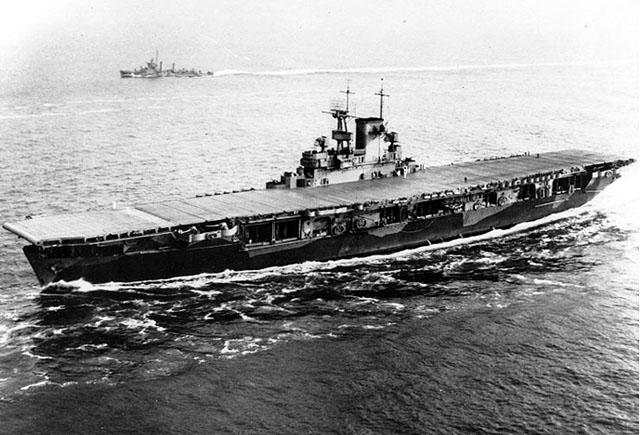
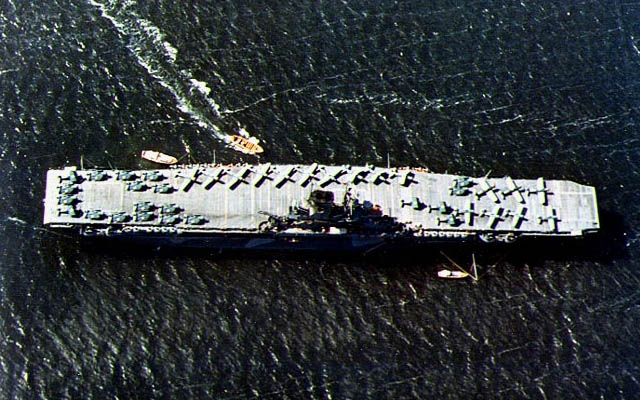
War. War never changes. In 1942, war was raging and the US Navy had a problem. It was obvious that the aircraft carrier was going to be the deciding factor in the Pacific, and a major player in the battle for the Atlantic. A gazillion carriers were going to be coming out of the shipyards, and they would need squadrons upon squadrons of planes and pilots to fill their hangars. While there wouldn't be a problem building the planes, the pilots would be another thing altogether. There would be hordes of men wearing the wings, certainly, and they would have plenty of training in how to fly their planes, but naval aviation is a different type of beast... because of the aircraft carrier.
When the Army Air Forces taught a man how to fly, they were able to assure their pilots that, at the end of a mission, they would have a nice long runway (or a well-manicured meadow) to come home to. On the other hand, most Navy pilots would be in training for carrier aviation. This meant they'd have to put their plane down on a small (at least in comparison to AAF runways) flight deck somewhere in the middle of an ocean... that was moving. That's a problem, because you can't simulate that on land. To be sure, you can paint a flight deck on a runway to give an idea of the size. You can put a Landing Signal Officer at the end on the runway to teach a pilot how to follow his instructions. You can even put arresting wires across the runway to give the rookie pilot a taste of the stresses involved with landing on a carrier. But you can't duplicate the rolling and pitching, the winds, the turbulence off the island, and the sense of scale involved (even a big carrier is very, very small in comparison to the ocean).
Prior to the start of WWII, the US Navy trained their neophyte pilots on carrier landings by landing them... on carriers. That sounds obvious and it surely is, but what do you do when it's going to take all of your current CVs just to hold the line... and they're only barely accomplishing that? Throw in the threat of submarines, and even if you had a spare carrier lying around you couldn't operate it in a manner that would make training a rookie pilot easier. Then there's this little problem with rookie pilots (and trained pilots, for that matter), in that they crash. Over and above the tragedy involved, a violent crash could cripple a carrier at a time when every flight deck mattered. But sending a squadron of pilots out to war with practically no experience on landing on a carrier deck is a recipe for disaster.
In March of 1942, the US Navy came up with an answer.
If you're like me you've been seeing a fair number of articles/posts on Netwar, Swarm war, or what have you. The idea bascially as applied to naval warfare, seems to use a bunch of smaller cheaper ships in place of one big, a ship that you have to use a lot of assets to protect. The study groups have been looking at the records of the "jeep" or "taxi" carriers in WWII.
In spite of their thing hulled construction they did fairly well in some carrier vs. carrier battles. While I can forsee ships being UAV carriers, some manned air craft will be needed even if they themselves would UAV launchers.
I hadn't thought about the training aspects in having a lot small carriers and modualr arsenal ships.
Posted by: toadold at May 24, 2010 03:12 PM (PsQky)
2
I love it. I'd heard of these prior to your article and this thought occurred to me then and recurred now. How many WW2 carrier training birds are on the bottom of the Great Lakes and perhaps could be salvaged? Would that be a +4 coolness factor or what?
Posted by: The Old Man at May 25, 2010 12:41 PM (+LRPE)
3
After being immersed in water for 60 years? There's nothing left to salvage.
4
Actually, three SBDs have been fished out of Lake Michigan in recent years, including one that participated in the Battle of Midway.
One of the three is on display at Chicago's Midway International Airport... good picture of it here. Incidentally, Midway Airport was named in honor of the Battle, just as O'Hare Airport is named after Butch O'Hare, Navy Medal of Honor winner. There's a F4F-3 on display there, and it too was recovered from Lake Michigan.
These planes were built to resist the salt water of the oceans; lake water isn't nearly as corrosive, and doesn't move around nearly as much. There were around 300 planes that went into Lake Michigan, and it's a good bet that many of them are in okay shape. The question is finding them, and pulling them out... Lake Michigan averages 279 feet in depth, with a maximum of nearly 1000 feet. It's a big place, and the planes are very small in comparison.
Posted by: Wonderduck at May 25, 2010 05:32 PM (blkx5)
Name That Ship!
As most of my regular readers know, I have a deep interest in WWII, with an emphasis on the Pacific Theater, and have had for many, many years. For much of that time I've been drawn to the more obscure bits of hardware used by the various armed forces. Everybody knows about the Mustang, the Spitfire or the Flying Fortress, and for good reason. Even the Buffalo is well-known, if for all the wrong reasons. But who champions the little guys, the Vindicators of the world? Or, really, who cares about the nigh-on forgotten things? I do, for I am as fascinated by the "backstage" people as much as the main characters, if not moreso. Heck, a couple of days ago I discovered that there was a floatplane version of the F4F built and tested (charmingly called the "Wildcatfish") and was tickled pink.
So you can only imagine my joy when I first learned about this ship:
Except I'm not going to tell you anything about it. Yet. Instead, I want to see if any of my readers know the name of this surprisingly influential vessel, or if not the name, what you can tell me about her. Leave your guesses in the comments, and no cheating!
Posted by: Brickmuppet at May 22, 2010 10:58 PM (EJaOX)
2
Oh, the explanation Wolverine was a paddle wheel merchant ship pressed into service as a training carrier on the great lakes. There were, IIRC, 2 of these.
Posted by: Brickmuppet at May 22, 2010 11:31 PM (EJaOX)
Pacific War Pics
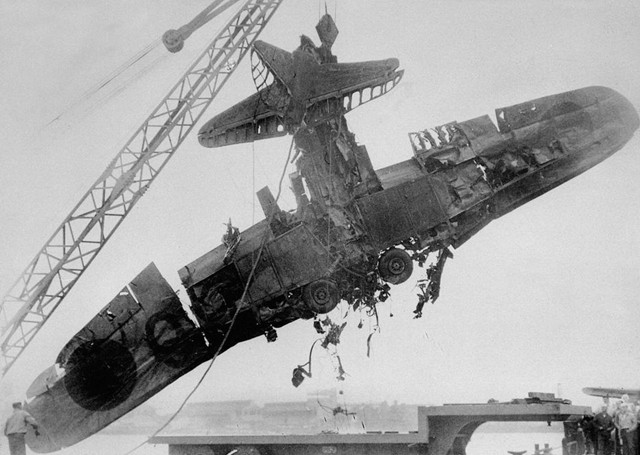
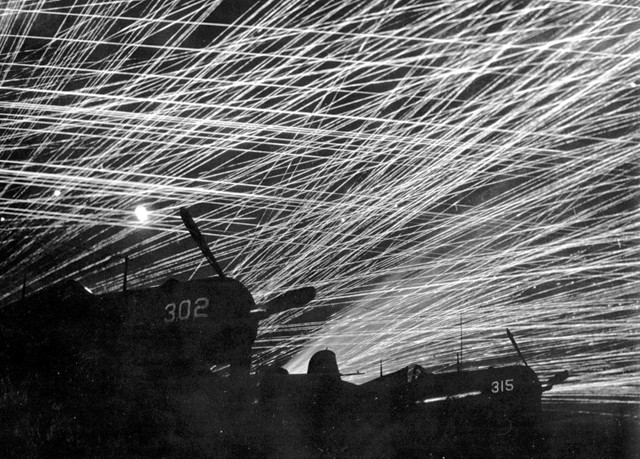
I had to work late tonight, but when I got home there was a present of sorts in my e-mail box. The latest edition of the Battle Of Midway Roundtable had come out, and contained therein was a link to a Denver Post blog. "So what," I hear you asking. Well, that particular blogpost has 110 pictures from the Pacific War, starting at Pearl Harbor and finishing at Tokyo Bay. And they aren't all the usual pics, either. For example, I give you this:
That's the wreckage of a Japanese B5N ("Kate") being fished out of Pearl Harbor shortly after Dec 7th. Or this:
That's flak over Yontan Airfield, Okinawa, sometime in March of 1945. Lots more where these came from, so go take a look. It's unsafe for dial-up users, though, as all 110 pics are inline to the post, not thumbnailed or linked.
3
#92: That sight is one I can never really comprehend. I understand intellectually what it means, but deep down I cannot really understand it. There are too many of them.
5
Aigh! #52, there looks to be a pinless grenade sitting in the sand by the troops as they rush past. Wonder if it's just a bad angle, or if it was a dud or something?
Posted by: Mitch H. at April 30, 2010 10:54 AM (jwKxK)
6
Mitch, I think the handle is down and behind, buried in the sand. But it's not impossible that it was a dud.
7
Mitch's reaction was much the same as mine when I first saw it. That grenade sitting there also makes me think that picture was staged, otherwise there wouldn't be anybody in the frame... they'd all be heading for the hills or huddling behind the landing craft, waiting for the fragments to stop bouncing.
Posted by: Wonderduck at April 30, 2010 05:12 PM (JWQqT)
USS Wasp: The Worst US Carrier In The Pacific
When you think of aircraft carriers from WWII, which do you think of? The stately Lexington class? Maybe you flash to the carriers that held the line in the Pacific, the Yorktowns? Perhaps you think of the Essex class, some of whom stayed in service into the '70s and one of which lasted until 1991? Or maybe your thoughts tend towards the Japanese Kaga and Akagi? One can't forget the first aircraft carrier lost to air attack, the British Hermes, and their Illustrious class is an interesting type of ship indeed.
In fact, most people would think of many, many ships before their thoughts headed to the seventh carrier commissioned into the US Navy, the Wasp.
And to be brutally honest about it, there's good reason for this lack of recognition. To say that her career was lackluster would be on the charitable side of accurate.
The USS Wasp was designed and laid down while the US Navy was still under the constraints of the Washington Naval Treaty, which placed limits on the maximum tonnage of new naval builds. The maximum allowable tonnage for the US's aircraft carriers was 135000, with no single carrier able to exceed 27000 tons at full load (an exception was made for two ships converted per nation; for the US, these were the USS Lexington and Saratoga. Their weights were still counted against the total, however). As the two Lexingtons ate half the limits on their own, and the Yorktown and Enterprise, both in the process of being built, were showing signs of being overweight, the Wasp's designers were under incredible pressure to cut weight whenever possible. It quickly became obvious that she was shaping up to have many of the same traits as the USS Ranger (CV-4) which, like the Wasp, was constructed to get the most use out of the treaty limits. In short, she was going to have to be small.
There is nothing inherently wrong about the concept of a small carrier; the later Independence-class CVL proves that quite well. The problem arises when the carrier being designed is a full-fledged fleet carrier, but it has to be shoehorned into a size completely unsuitable for the task, which is what happened to the Wasp. The Yorktowns came in at about 26000 tons at full-load; the Wasp wound up being nearly 7000 tons lighter, but was still expected to carry almost the same size air group (76 planes for the Wasp, 90 for the Yorktowns).
To do all this on a smaller hull, compromises had to be made. She wound up about 85 feet shorter (741 feet vs 824 than the Yorktowns) in overall length. Of course, this made both the flight deck and hangar smaller as a result. This made life cramped for the air group, even though it was reduced to begin with.
In an attempt to alleviate some of the congestion caused by the reduced topside real estate and to counterbalance the weight of the full-size island starboard, the flight deck and hull was bulged to port. While this improved traffic flow on the flight deck, it did have some consequences. This bulge gave the Wasp the same beam as the larger Yorktown class. However, in a weight-saving measure, her machinery spaces were smaller, producing 75000 shaft horsepower (shp). Comparing this number to the Yorktowns' 120000shp and the substantially smaller Independence class' 100000shp is educational to say the least. As a result of this unfortunate combination of decreased power and wide hull, the Wasp could only make 29.5 knots at full steam, considered too slow for operations with the main fleet. Another problem with this speed, combined with the truncated flight deck, is that there was very little room for error for a fully-loaded torpedo plane (at the time, the hideously underpowered TBD Devastator) during takeoff. This was recognized early in the design process, however, and as a result the Wasp was not built with the specialized facilities required for torpedo planes. Of course, this was considered acceptable in the name of weight savings.
In another attempt to save weight, she was constructed with only two elevators, fore and aft. The midships elevator was replaced by an innovative design that after the war became commonplace: a deck-edge elevator.
Unlike those on modern carriers, though, this one was a skeletal framework that had a socket for the tailwheel to sit in, positions for the main gear, and moved the plane in a semicircle up to the flight deck. This was the first ever deck-edge elevator, and is probably the one shining part of the Wasp's overall design. Still, all the weight saving was successful in that she slotted nicely into the Washington Treaty tonnage limits.
Like the similarly undersized Ranger, it was thought that the Wasp was unsuitable for operations in the Pacific. At the onset of war, she served primarily as an airplane ferry, taking two loads of Spitfires to Malta for the British. A month after the second of these runs, the Battle of Midway left the US Navy with only three operational carriers in the Pacific, with one of them (the Saratoga) still suffering the scars from a submarine-launched torpedo. It was decided that the Wasp would be transferred as it was marginally more capable than the Ranger. Carrying TBF Avengers (a torpedo plane, which she wasn't truly able to handle), Dauntlesses and Wildcats, she was part of the covering force at Guadalcanal that was withdrawn by Admiral Ghormley, which put the entire operation at risk. The next month or so was spent patrolling and providing cover for convoys heading to 'Canal, until she was sent south, missing out on the Battle of the Eastern Solomons. That battle cost the Navy the use of the Enterprise as she was badly mauled. Shortly thereafter, the Saratoga proved to be a torpedo magnet of the first rank. As she was sent to the West Coast for repairs, that left only the USS Hornet and the Wasp covering the entire Pacific.
In mid-September, however, she was engaged in flight operations when the Japanese submarine I-19 performed the greatest feat of marksmanship by a submarine ever. The I-19 fired a full spread of six torpedoes at the Wasp, three of which hit. Two others passed ahead of the carrier, one of which struck the destroyer O'Brien as she maneuvered to avoid the other. The O'Brien sank shortly thereafter. The sixth torpedo apparently passed underneath the stern of the Wasp, narrowly missed the USS Landsdowne, then proceeded on for another seven minutes before striking the USS North Carolina, a wound that required a month in Pearl Harbor to fix.
One of the worst decisions the Wasp's designers had made in their quest to save weight was the deletion of just about any armor plating. While this would have been normal for most Japanese carriers and was considered the price of speed for them, the lack of armor for the Wasp extended to her having absolutely no torpedo protection whatsoever. Further, her two engine rooms were grouped close together instead of being separated (to be fair, this was a failing common to US carriers at the time). Another strike against her was that, when the torpedoes struck, she was engaged in flight operations. Her avgas system was in full use, in other words, with predictable results when she was hit.
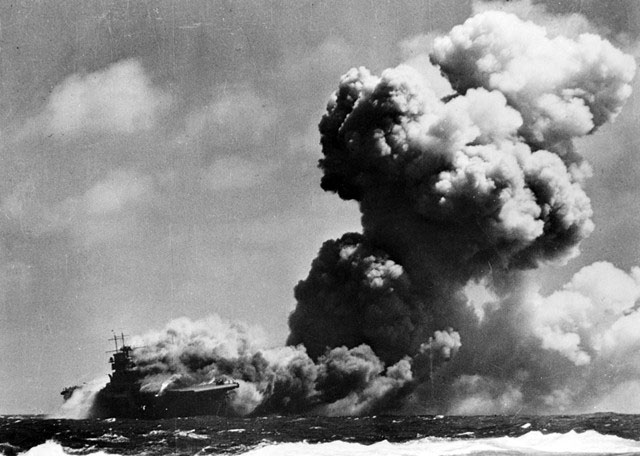
45 minutes after the torpedoes hit, the fires onboard had consumed most of the forward part of the hangar deck and were raging out of control. Abandon ship was called, and the Landsdowne was detailed to scuttle her. At approximately 9pm on September 15th, 1942, she finally sank in a pool of blazing gasoline.
A victim of terrible design choices, she never really got a chance to prove herself in battle (the Guadalcanal landings notwithstanding) and has thus faded into obscurity. A shame, as she could have been an outstanding "medium carrier" if designed just a couple of years later, when such things were recognized as being feasible. That's all hindsight, however. In use as she was actually designed, she was unfortunately the worst US aircraft carrier in the Pacific... and the unluckiest. To be fair, no carrier on the planet at that time would have survived taking three torpedoes at once.
Especially when they're Long Lance torpedoes, the best torpedo of the war.
I've always thought of Saratoga as a ship with poor luck. she survived the war, to be sure, but how many times was she hit? Like three? (And having survived the war, Sara was sacrificed at Bikini. Surely such a great old lady deserved better, but I guess they had to use something.)
But you've convinced me that Wasp was worse. Sara got hit, but didn't sink, and Sara accomplished quite a lot. Sounds like Wasp didn't do anything important except get attacked.
2
It's possible that the Sara wasn't useful for much after her third bout of battle damage (after the two separate torpedoeings). She was hit by four or five bombs late in the war, had the entire front of her flight deck burnt out and her hangar deck had some major damage as well. She was repaired on the West Coast, but you've got to think that there'd be some lingering shock damage to her hull, no matter how good the repairs. *shrug* That's just speculation, though.
Posted by: Wonderduck at April 15, 2010 11:35 PM (mfPs/)
3
Well, they needed to use at least a couple carriers for targets, and I suppose it makes more sense to use a thrice-damaged old lady than one of the new Essex CV's.
The Navy was standing down after the war anyway, so all the oldest ships were decomissioned. The only alternative futures for Sara would have been to be a floating museum, or more likely to be scrapped.
5
Nope! To me, the story of the Shinano has been told enough times before. No, I prefer the more, shall we say, esoteric ships. I was giving thought to the Langley, or one of those myriad of Japanese carriers that nobody's ever heard of.
Posted by: Wonderduck at April 16, 2010 05:38 PM (mfPs/)
6
I'm not really sure it's fair to heap abuse on the Langley. It was the first carrier ever built by anyone, and it was built on top of the hull of a coal carrier. It was proof-of-concept, and for that it worked extremely well. But it was modified in like 1923; of course it was obsolete by WWII.
7
I completely agree, Steven. This series of posts, like the Hoshoone, will tell the stories of the ship(s). If the story is positive, then it'll be so. If like the Wasp it's negative, I'll hit that, too.
I'm actually considering making one megapost on the three "first carriers", the Hosho, Langley, and Hermes. Though even that's a bit of a misnomer, as the Langley wasn't the first keel up carrier for the USN. That technically was the Ranger... but I LIKE the Langley.
Posted by: Wonderduck at April 16, 2010 06:26 PM (mfPs/)
Midway: The Forgotten Plane
The list of aircraft involved at the Battle of Midway reads like a roll call of legendary planes. The best fighter in the world in 1942, the A6M Zero. The Aichi D3A Val and Nakajima B5N Kate, striking arm of Kido Butai. The F4F Wildcat, sturdy and resilient. SBD Dauntless, the premiere dive-bomber of WWII. The hapless Brewster Buffalo. The tragic TBD Devastator. The PBY Catalina played a major role in finding the Japanese fleet. Even the B-17 Flying Fortress, B-26 Marauder and TBF Avenger made small but dramatic appearances in the battlespace.
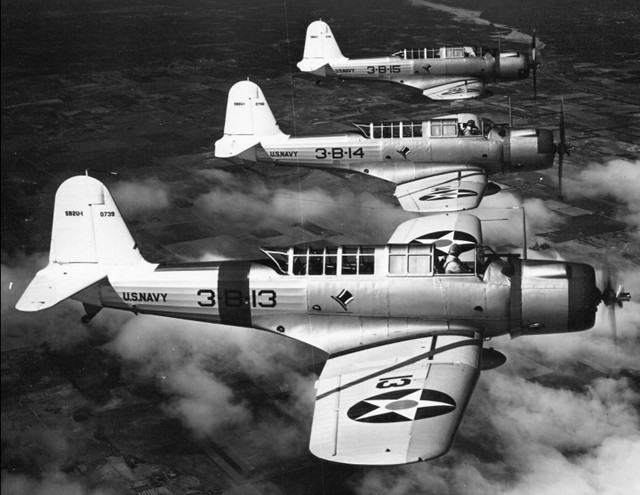
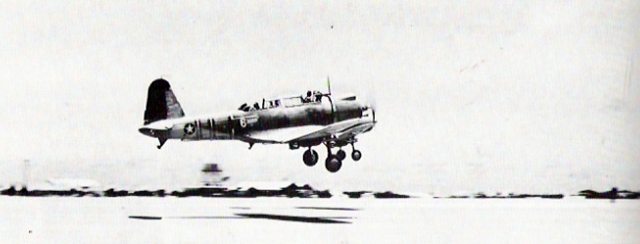
Oft neglected amongst all these stellar names, though, is a little-known dive-bomber flown from Midway by Marine squadron VMSB-241 known as the SB2U Vindicator.
Designed to a 1934 US Navy requirement, it entered squadron service three years later. On the whole, the Vindicator was a bland, inoffensive airframe with no outstanding qualities or drawbacks. The US Navy's first monoplane dive-bomber, it could carry a 1000lb bombload and was armed with two machine guns, one on a flexible mount for the observer and one firing forward. Like many planes of the time, the rear fuselage and tail were fabric covered. Powered by a 825hp Pratt & Whitney engine, it could cruise at 150mph and maxed out at 243mph. While equipped with dive brakes, these were found to be dangerously ineffective, meaning that pilots were forced to extend the landing gear when performing a steep diving attack. This limitation was countered somewhat by use of a reversible-pitch propeller. It also had a habit of shedding fabric from its airframe in a steep dive.
When war broke out in Europe, France was desperate for aircraft of all types and placed an order for 90 V-156 (the export version of the Vindicator), though only 40 were ever delivered to the Aeronavale, and 24 entered squadron service. Though originally acquired to serve on the CV Bearn, that ship sortied only rarely and never with any V-156s on board. Thus when the German blitzkrieg rolled into France, the Vindicator operated from land bases only. Most of the French aircraft were destroyed on the ground, and the rest were quickly worn out from nigh-constant (and mostly ineffectual) use.
The British Fleet Air Arm also used the Vindicator, though they called it the Chesapeake. Amusingly, their pilots gave the plane the epic nickname of "Cheesecake." Intended for use on escort carriers for anti-submarine duties by 811 Naval Air Squadron, it was quickly discovered that it was wholly unsuitable for such short flight decks. Withdrawn from carrier duty, 811 Squadron's Chesapeakes were replaced by the Fairey Swordfish and used for training.
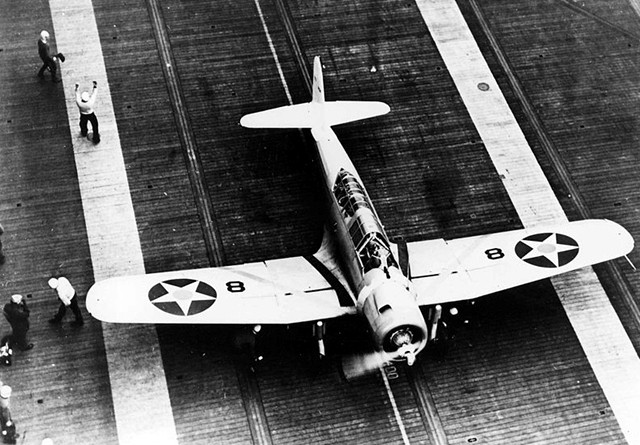
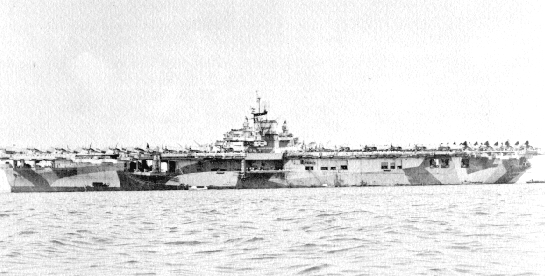
The US Navy put SB2Us on four of its carriers between 1937 and September 1942, the USS Saratoga, Lexington, Wasp and Ranger. It provided stout service but was quickly phased out of carrier service when the SBD Dauntless became available. It was around this time that the Vindicator earned its second great nickname when it became known as the "Wind Indicator." Aboard the Ranger and Wasp, the Vindicator provided cover for multiple Atlantic convoys, while in the Pacific the Navy gained valuable experience in operating dive bombers off of carriers pre-war. Despite this, no Navy SB2Us ever saw combat.
Vindicators taking off from Midway, early June 1942.
It was in service with the US Marine Corps that the Vindicator experienced its first (and last) action. The Marines were provided with a variant of the SB2U, the -3 with more armor and a much larger fuel tank. The fuel tank allowed VMSB-241 to fly the 1200 miles from Hawaii and Midway, which was at the time a world record for single-engined planes over water. The squadron reinforced Midway just before the battle itself. There were 11 Vindicators in VMSB-241, along with 16 Dauntlesses. Squadron leader Lofton Henderson put his best pilots in the SBDs, leaving the SB2U-3s, under command of Major Benjamin Norris, to be flown by true rookies, many of whom had never actually executed a dive bombing attack.
On June 4th, 1942, this mixed squadron attacked Kido Butai. With their higher cruising speed, the Marine SBDs arrived over the Japanese fleet some minutes ahead of the slower Vindicators. While the Dauntlesses went after the carriers and thus were treated rudely by the Japanese CAP, Major Norris realized that, with his slow planes, his detachment stood no chance of surviving a run at the CVs. Wisely, he and his rookies executed glide bombing attacks on the nearest Japanese capital ship, the battleship Haruna. The 11 SB2Us scored a few near misses, which did no damage to the battlewagon, while losing two planes to Zeros, while battle-damaged Vindicators ran out of fuel on the flight back to Midway. As with the TBF and B-26s, the SB2U-3's main role in the Battle of Midway was to keep Kido Butai busy defending itself from attack, preventing it from launching an attack on the American fleet.
By early 1943, all Vindicators had been withdrawn from mainline duty, reduced to training roles, and subsequently forgotten.
1
Glad to see you running another overview of a "forgotten" airframe. The nickname "Wind Indicator" kicked over my giggle box when I first heard it too. Well done!
Posted by: The Old Man at March 22, 2010 08:11 AM (+LRPE)




 , I won't post a guess in this contest unless no one gets it by Tuesday night.