August 08, 2011
Name This Mystery Ship VII
Interesting one for y'all tonight...
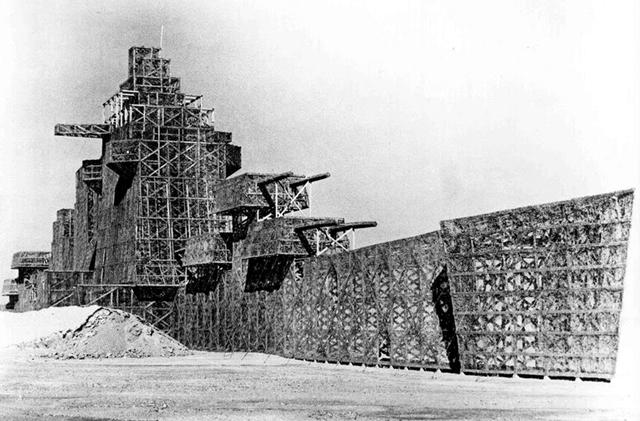
Take a guess, get it right, win a post!
Posted by: Wonderduck at
09:41 PM
| Comments (15)
| Add Comment
Post contains 19 words, total size 1 kb.
Posted by: Brickmuppet at August 08, 2011 09:49 PM (EJaOX)
2
If I was going to guess a time and place, I'd guess England in 1943 or early 1944, during the build up to Normandy. This looks like the naval equivalent of all the inflated rubber tanks which made up most of the "strength" of FUSAG.
Posted by: Steven Den Beste at August 08, 2011 11:00 PM (+rSRq)
Posted by: Steven Den Beste at August 08, 2011 11:34 PM (+rSRq)
4
Steven, saw
Senna back in March. It's great.
Posted by: Wonderduck at August 09, 2011 06:00 AM (KBBJ+)
5
Actually, I just noticed that it's a sillhouette. I bet it was built in southern California to allow Navy pilots to practice torpedo runs.
Posted by: Steven Den Beste at August 09, 2011 11:07 AM (+rSRq)
6
I'm not having much luck coming up with info on this one. But it sure looks like a Myoko class to me, although the Takao is very similar. I would agree that it's probably a training device of some kind.
Posted by: David at August 09, 2011 05:10 PM (ttXyi)
7
If you're volunteering a post for the winner, does that mean that work is no longer consuming most of your time?
Posted by: Siergen at August 09, 2011 05:45 PM (H+DyV)
8
Did I come close enough to win?
Posted by: Steven Den Beste at August 09, 2011 07:07 PM (+rSRq)
9
Well, I
did say "name this mystery ship," but I'll let it slide. Name the topic, Steven, and remember: no pr0n, no politics, no religiosity.
Siergen, actually it's getting worse. We'll be exactly two weeks away from the start of classes on Wednesday, and I feel like I'm bailing out the
Titanic with a colander.
Still, the Regional Manager was in today and he's pleased with how things are going. But dear merciful heavens, is it gonna be long. I get one day off between now and the 27th.
Posted by: Wonderduck at August 09, 2011 08:12 PM (KBBJ+)
10
This was a tough one. At least two of us were able to guess at several pertinent details "training target, Takao class", and in Steven's case, "Southern California." Yet that wasn't enough to get google to cough up the details. I'm tempted to keep playing with keywords to see if I can come up with it without actually using the name.
Posted by: David at August 09, 2011 08:32 PM (Kn54v)
11
Please write about the PBY Catalina, which was involved in the war before Pearl Harbor (it helped chase down the Bismarck) and still working hard after the cease fire, helping rescue the survivors of USS Indianapolis.
Posted by: Steven Den Beste at August 09, 2011 09:11 PM (+rSRq)
12
Twist my arm, Steven!
David, lemme know what you come up with. I just stumbled upon it a few months back while looking up something else. "Hmmm, lessee... that's good to know... uh-huh... what the hell is that?"
Posted by: Wonderduck at August 09, 2011 09:49 PM (KBBJ+)
13
"wooden ship lakebed" or "wooden ship muroc" come up with a link to a page about Edwards AFB that mentions the Muroc Maru by name. But even a search on "muroc maru" doesn't come up with anything extensive, and I haven't found the source of your image. Interestingly, most of the pages I've found claim it was a mogami class heavy cruiser, but that doesn't match your image at all.
Posted by: David at August 09, 2011 10:16 PM (Kn54v)
14
Even though I didn't win the free post, you might want to consider a response to the following:
http://gizmodo.com/5829163/the-classy-way-to-crush-a-duck-and-drink-its-blood
Posted by: David at August 10, 2011 01:52 PM (ttXyi)
15
I was trying to see if there was an online copy of ONI's recognition guide for Japanese ships to see if the Muroc Maru appeared in it, but no such luck. On the other hand, ONI's guide for German ships can make for an amusing read, especially the self-deprecating humor.
Posted by: cxt217 at August 10, 2011 02:46 PM (eMOxS)
Hide Comments
| Add Comment
August 07, 2011
The Other Zero
Whenever a nation has more than one branch of its military, something of a cordial disliking will invariably spring up between them. For example, here in the US the Army doesn't much care for the Navy, the Navy has a mild distaste for the Army, and nobody likes the Marines. When it comes right down to it however, all three know they've got to work together and when the time comes, they set aside their rivalries and land on their enemies like a ton of bricks.
And then there was the Imperial Japanese military in World War II. The Army and the Navy didn't cordially dislike each other, they flat out hated each other. Each had their own plans on how to conduct the war and only deviated from them when they needed something from the other. The only reason you couldn't say that, say, the IJN's main enemy was the IJA was that the two services didn't openly shoot at each other. This open distaste extended to the designs of each forces' aircraft. While the US Army Air Forces and the US Navy designed planes that were radically different, that's because each service had different requirements. Strangely, the requirements for the IJN and the IJA were pretty much identical, save for the need for Navy planes to land on a carrier.
Both the Navy and the Army needed replacements for their front-line fighers, the A5M (Claude) and the Ki-27 (Nate), two very similar designs. Mitsubishi won the design contract for the Navy with the A6M, the famous Zero. Nakajima's design for the replacement of their own Ki-27 was the Ki-43 Hayabusa.
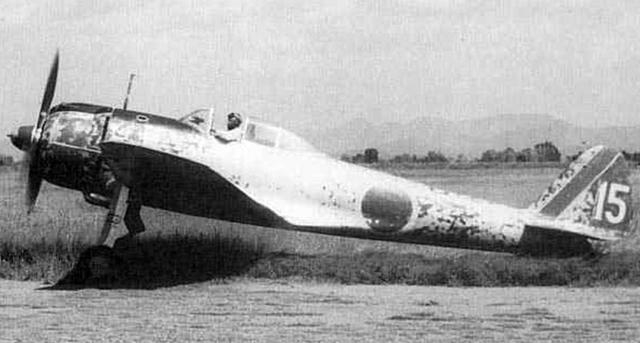
To say that there was a resemblance to the Zero would be something of an understatement. Both fighters used the same Sakae radial engine, at least to begin with. Both were slim, with slightly bent cantilevered wings. However, the Zero was nearly 700lbs heavier at all-up weight. This made the Hayabusa (Allied code name "Oscar") even more maneuverable than the already outstandingly nimble Zero.
Unlike the Zero, which passed its initial flight tests with ease, the Hayabusa was something of a dog right off the drawing table. In fact, the plane was nearly rejected on the grounds of being rather UNmaneuverable. Over the course of ten preproduction aircraft, the Oscar was modified with a larger wing, had its weight cut, and finally had a set of butterfly (or "combat") flaps installed. This proved to be the fix the fighter needed, and it was ordered into mass production.
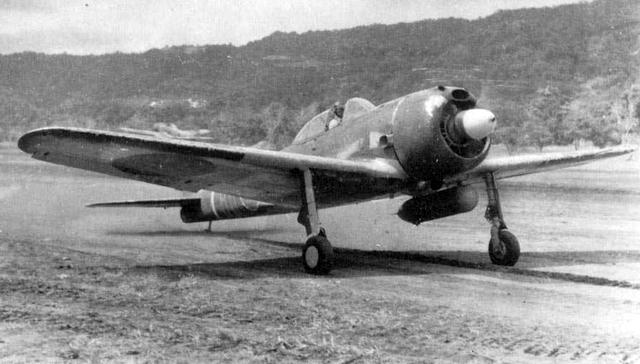
One can safely assume that the main weight difference between the Zero and the Hayabusa was that the latter did not need the sort of structural strength a plane requires to land on an aircraft carrier. One drawback of this was that the Zero, which was never what one would call a sturdy aircraft, was by comparison to the Hayabusa carved out of a single block of iron. Another way the Hayabusa saved weight was in the form of weaponry. For most of the war, the Ki-43 carried only a pair of 7.7mm machine guns, the exact same armament as a Sopwith Camel from World War I.
At the beginning of the Pacific War though, this was enough. In combat, the Hayabusa was nearly as successful as the Zero. Being able to outturn and outclimb anything in the skies, once an Oscar got on a plane's tail, it could pretty much stay there at will. It was only a tiny bit slower than a Zero as well. All of this meant that it was a dangerous package. It even had some armor for the pilot and rudimentary self-sealing fuel tanks to boot.
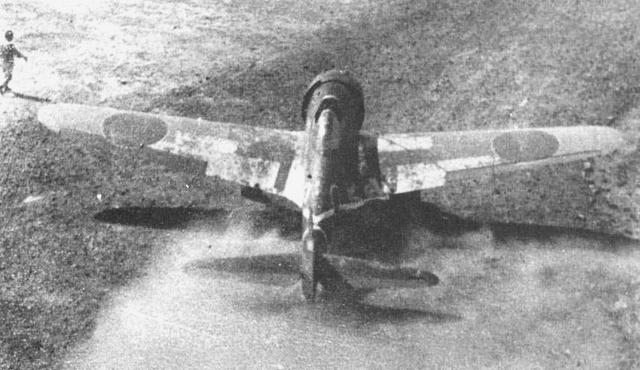
The Hayabusa's main weakness was that it was ridiculously fragile. While less prone to catching fire like the Zero, it tended to come apart under Allied gunfire. Indeed, hits that even a Zero could shrug off were often enough to cause the Ki-43 to shatter like porcelain. The hard part was landing a blow on the nimble little plane in the first place.
Upgrades were applied to the Ki-43 over the course of the war. First, a larger engine was installed that gave better performance at high altitudes, then the guns were upgraded to 12.7mm. However, these upgrades were never going to be enough to keep up with newer Allied planes like the Hellcat, Corsair or Seafire. Replaced by the Ki-44 (Tojo) and Ki-61 (Tony), it was never entirely phased out and stayed in front-line service for the entire war. As with most other Japanese planes, it ended the war in a Kamikaze role, but not until nearly 6000 were built, making it the second-most popular Japanese fighter... behind only the Zero. Every IJA ace got the majority of his kills in the Oscar, and one source in my collection even claims that the Ki-43 was responsible for shooting down more Allied planes than the Zero. Not a bad record for a fragile, slow, undergunned fighter that was overshadowed by the A6M.
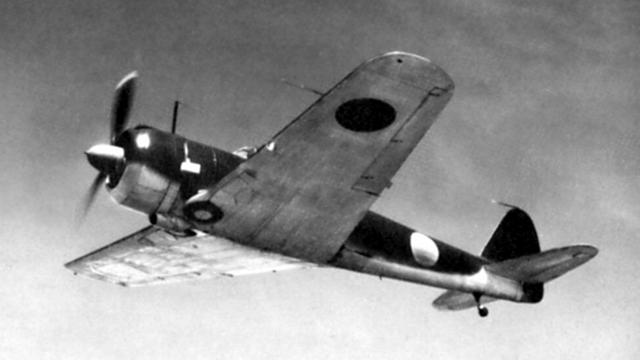
Today, only six Ki-43s are known to exist, and only one of those is in flyable condition.
Posted by: Wonderduck at
09:39 PM
| Comments (2)
| Add Comment
Post contains 853 words, total size 5 kb.
1
Aircraft design in that era always begins with the engine. The entire rest of the plane is designed around the shape, and more importantly the power output, provided by the engines.
Japanese aircraft engines were pitifully unpowerful. The Zero's engine only produced 950 horsepower. The Double Wasp (used in the F4U and F6F) produced 2000 HP when initially produced, and by the end of the war it was producing 2800 HP.
Some of that was the fuel: American avgas was 120 octane IIRC. But making it that rich means the yield per barrel of crude isn't very good, and petroleum was always scarce in Japan, so their fuel was terrible by comparison. But even if they'd been using American fuel, their engines were dreadful by comparison.
If the Japanese had tried to build their airframes the way the Americans did, with lots of strength and redundancy and armor all over the place, their engines wouldn't have been strong enough to get them into the air.
That's also why their fighters were relatively lightly armed. Guns and ammunition are heavy, and their planes couldn't carry as much as ours did.
All of which is why the Thach Weave was an effective tactic for the Americans all through the war.
Posted by: Steven Den Beste at August 07, 2011 10:09 PM (+rSRq)
2
It should be noted that within the IJN, the fighter pilots generally preferred features in the fighter design that became the A6M that was more a nimble, maneuverable dogfighter than than a fast, long range escort. The limitations of available power plants was major factor any Japanese design before and during the Pacific War, and the A6M tried to combined, with varying success, features of the two types of fighters. But its seems the majority of pre-war IJN pilots, even if they had a choice between the two types, would opt for the superior dogfighter despite the design limitations.
The ironic part is that IJN advocates of the heavier escort fighter argued that superior skill and tactics could compensate for flying less maneuverable aircraft against better dogfighers. They were ultimately proven correct, much to Japan's cost.
Posted by: cxt217 at August 08, 2011 03:12 PM (mnl77)
Hide Comments
| Add Comment
June 28, 2011
The Curious Class
The year is 1904 and James Arbuthnot Fisher had reached the absolute pinnacle of his career. After fifty years in his chosen profession, he was arguably the most powerful man in the world. You see, James Arbuthnot Fisher was better known as "Admiral of the Fleet Sir Jackie Fisher, First Sea Lord." As such, he was
the commander of the British Royal Navy, the strongest military force under the sun, answerable only to His Royal Highness, King Edward VII.
In the past, Admiral Fisher had shown two interesting traits: an innovative mind, and a love for anything
fast. Some 10 years earlier, he had essentially created the class of ship we now know as the destroyer. Now he had the power to push through his greatest idea yet: a battleship armed with nothing but one size of large-caliber guns. She was to be named HMS
Dreadnought, and her very existence made the rest of the world's battleships obsolete at a single stroke. Obviously well-armed, well-armored, and (of course) fast for her time, the
Dreadnought was a marvel.
And then he had to go and create a companion for the
Dreadnought design. The concept was a good one: a ship able to chase down and kill commerce raiders in independent action, and able to act as the eyes of the battleline in a fleet action. It was to be able to outfight anything it could outrun, and outrun anything it
couldn't outfight. To do this required two things: high speed, and high firepower... a tall order, even for today's technology.
For the early 1900s, there was only one solution... take away weight. In essence, what Admiral Fisher wanted was to build a
Dreadnought-class ship, but without all that pesky armor. And, being First Sea Lord of His Majesty's Royal Navy, what Admiral Fisher wanted, Admiral Fisher got. What he got was the HMS
Invincible, the world's first battlecruiser.
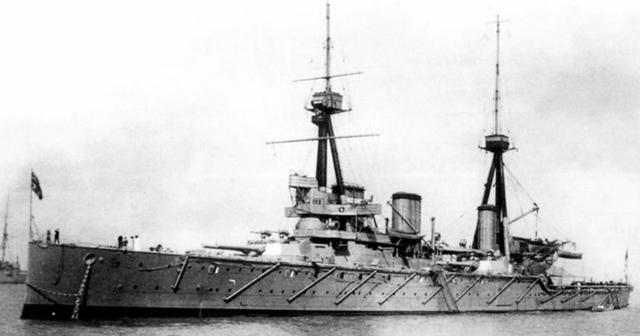
Weighing the same as the
Dreadnought within a couple hundred tons, the
Invincible carried eight 12" rifles in four twin turrets. While this was two guns fewer than the
Dreadnought, better positioning of the two wing turrets allowed them to fire to their opposite side. As a result, she could fire the same strength broadside as the bigger ship, which had only six guns on the center, and two wing turrets that could only fire to their respective sides. The
Invincible had 31 boilers driving four turbine-powered shafts, generating anywhere from 41000 to 46000 shaft horsepower, nearly twice the shp of the
Dreadnought. As a result, the
Invincible could make 25kts, and nearly reached 27kts during builder's trials. Her larger cousin could only make 21kts. But all that speed came at a dramatic cost.
more...
Posted by: Wonderduck at
11:08 PM
| Comments (17)
| Add Comment
Post contains 2317 words, total size 18 kb.
1
Considering the cost of a full battleship, were battlecruisers better than the cost-equivalent number of other, lesser warships, if that's all you could afford?
Posted by: Siergen at June 29, 2011 05:00 PM (RRRYd)
2
No. In fact, the
Dreadnought cost £1.67million,
Invincible £1.7million. The increased size of their powerplants (engine rooms, boilers, etc etc etc) outweighed the savings in price of armor by a far sight. At the time, the RN didn't include the cost of the guns in a ship's final price, but the two ships were basically armed the same in any case.
Posted by: Wonderduck at June 29, 2011 05:15 PM (6nDnY)
3
It sounds like the battlecruiser captains (or their superiors) didn't heed the "outrun anything it couldn't outfight" part.
Posted by: Kayle at June 29, 2011 07:44 PM (gpi2V)
4
Kayle, it's not that straightforward. The critical part of the Battle of Jutland was fought in fog, and there was no radar at that time. By the time the battlecruisers were aware that they were within gunnery range of enemy battleships, it was too late to escape.
In the case of HMS Hood, it was hunting Bismarck. But Bismarck's guns ranged Hood's guns. (Hood's guns had a maximum range of 32,500 yards. Bismarck's max range was almost 39,000 yards.)
Also, it was a do-or-die situation; the Bismarck had to be destroyed no matter the cost. If it successfully escaped and reached the coast of France, it would have been a mortal threat to the UK's supply lines across the Atlantic. In addition to losing Hood, the British took substantial damage to HMS Prince of Wales.
Posted by: Steven Den Beste at June 29, 2011 08:06 PM (+rSRq)
5
IMHO the UK Battlecruisers get a
bit of a bum rap.
The big problem was chemistry. The UKs cordite was not particularly stable. The Battleships HMS Bulwark and HMSVanguard and the Armored Cruiser HMS Natal were all lost to spontaneous magazine explosions
at the pier, a rather more benign environment than battle. The Japanese navy, which used UK pattern cordite, also lost 2 BBs and a cruiser to spontaneous pier-side detonation, and had a third ( the Mikasa) gravely damaged.
The 3 BC losses at Jutland were all a result of turret hits causing fires, explosions and general mayhem in the ammunition system. All might well have survived if not for the cordite issue.
Invincible herself gave a very good performance during the war clobbering Scharnhorst and is generally credited with sinking Lutzow (Lutzow received hits from other ships but they all caused minor damage. She never recovered from the pasting Invincible gave her in the moments before the British ship blew up).
While they were lightly armored in comparison with Battleships, the Invincible Class was actually better armored than the preceding
armored cruisers.
The problem was that above about 20 kts the power
increase required for an increase in speed starts to go up and gets
exponential eventuslly, so to maintain a 5 kt speed advantage over the
BBs the costs got excessive.
..so you ended up with a ship that was a bit faster, but less well armed and armored and cost
more and so was really too expensive to use on normal cruiser duties. This doesn't compute.
Posted by: Brickmuppet at June 29, 2011 08:32 PM (EJaOX)
6
Another problem the BC had was that the "run from anything bigger" concept assumes that said bigger ship won't manage to hit you before you got out of range. As demonstrated, one good volley from a BB was all it took. And the gunnery of front line ships at the time was getting much better, very quickly. Also of course, a BC can chase down cruisers, run from battleships, but it hosed if it runs up against another BC, especially if it encounters one with superior gunnery.
Posted by: David at June 29, 2011 08:57 PM (Kn54v)
7
How do you classify the Kirov class? NATO classified it as a battlecruiser, but apparently the USSR called it a heavy cruiser. I've also heard good arguments that despite the fact that we call them guided missile destroyers, an Arleigh Burke could better be described as a battlecruiser.
Posted by: David at June 29, 2011 08:59 PM (Kn54v)
8
Muppet, the
Minotaur-class, the last RN armored cruiser and contemporary of the
Invincibles, was armored almost exactly the same as the battlecruisers.
Main armor belt: 3"-6" for
Minotaur, 4"-6" for
Invincible. Deck armor: 1.5"-2" for
Minotaur, 1.5"-2.5" for
Invincible. Both had 7" of armor for the barbettes, and while the
Invincible had 7" of armor for her turrets, the
Minotaur had 8" on her heaviest guns. The armored cruiser's citadel was actually
better armored.
While the cordite
was a problem, the bigger problem was that the battlecruiser's turret armor was made out of wet toilet paper, therefore making it MUCH easier for said cordite to go kablammo.
Kayle, the British battlecruisers at Jutland ran up against something they could neither outrun or outfight: the GERMAN battlecruisers. Just as fast, nearly as heavily armed, and better armored... exactly NOT what Admiral Fisher wanted them to butt up against. That the situation really didn't allow them to run away is a moot point.
David, I knew someone would bring up the
Kirov. The correct terminology for the
Kirovs would be "Heavy Nuclear-powered Missile Cruiser." It was called a battlecruiser because... well... it wasn't a battleship, and it was far more potent than a cruiser. Heck, other than carriers, it probably the most powerful warship ever put to sea... and yes, that includes the modernized
Iowas, too.
As far as how the US Navy currently designates their surface combatants, it's totally screwed up in relation to the WWII system. The
Arleigh Burkes, using WWII designation systems, would probably be termed a CLAA (Light Cruiser, Anti-Aircraft), as that's its main mission. The now-retired
Spruance-class DD would be a CA, and the
Ticonderogas... well, they don't fit, as there was no CAAA.
Posted by: Wonderduck at June 29, 2011 09:24 PM (6nDnY)
9
The Minotaurs were good ships but ISTR reading the I's armor was actually more extensive. That is those thicknesses were carried over a larger area.
Posted by: Brickmuppet at June 29, 2011 09:43 PM (EJaOX)
10
Sanity check: "It was to be able to outfight anything it could outrun, and outrun anything it couldn't outfight."
Posted by: Logic break at July 01, 2011 05:07 AM (TPN3N)
11
"They could outrun anything they couldn't outfight" is something that was said of the American super-frigates in the first half of the 19th century.
Posted by: Steven Den Beste at July 01, 2011 06:17 PM (+rSRq)
12
No, technically
Brickmuppet Logic break is correct. Pedantic, but correct. But I don't care, the sentence is fine, the reader (as opposed to the nitpicker) understands it.
Posted by: Wonderduck at July 01, 2011 08:53 PM (ZGINl)
13
Pardon the pedantry, but that's "His Majesty King Edward VII."
Incidentally, my grandfather served in Minotaur at Jutland, in Tiger (improved half-sister of Lion) in the 20s and in Courageous in the mid-30s, after her conversion to an aircraft carrier.
Posted by: EdwardM at July 05, 2011 12:54 AM (Om4/O)
14
Tiger, when launched, was the fastest capital ship in the world, capable of thirty knots, and also one of the last to use coal-fired engines rather than oil. When my grandfather was in her, just before she was decommissioned pursuant to Washington, she was being used to trial experimental gunnery equipment. Her captain was a member of the Dewar distilling family, but was himself a teetotaller; he pronounced his surname "de War".
Posted by: EdwardM at July 05, 2011 06:12 PM (XjCFQ)
15
Another lovely excursion into nautical history, Mr Duck. Thanks.
BTW - was the Mutsu also a cordite victim? I had read somewhere that it was the victim of a peculiar AA shell fashioned for her main guns....
Posted by: The Old Man at July 06, 2011 10:12 AM (TcNy+)
16
Would you believe that the
Mutsu was probably destroyed by a suicidal crewman?
Posted by: Wonderduck at July 06, 2011 06:51 PM (3tp4g)
17
A bit late to the party, but I should mention that a big problem with British BCs blowing up to shell hits was the fact that since the Battle Cruiser Force made a high rate of fire king, the British BCs tended to leave everything else secondary, including ammunition safety. This reached the logical conclusion where they removed even the rudimentary flash-protection they had because it interfered with their ammo feeds - which might have saved 2 BCs at Jutland.
Of course, a high rate of fire would have been nice if the BCF actually shot accurately in the process - which apparently only QUEEN MARY (The 1st BC sunk.) did so consistently....
And if you think the US Navy's current ship designation system is bizarre, how about the system the USN had between WW2 and the mid-1970s?
C.T.
Posted by: cxt217 at July 09, 2011 06:03 PM (M5HQo)
Hide Comments
| Add Comment
June 23, 2011
Name This Mystery Ship VI
While we wait for my brain to function long enough to complete the battlecruiser post, I figured I'd give you folks a treat... another Mystery Ship contest! Here's tonight's contestant:
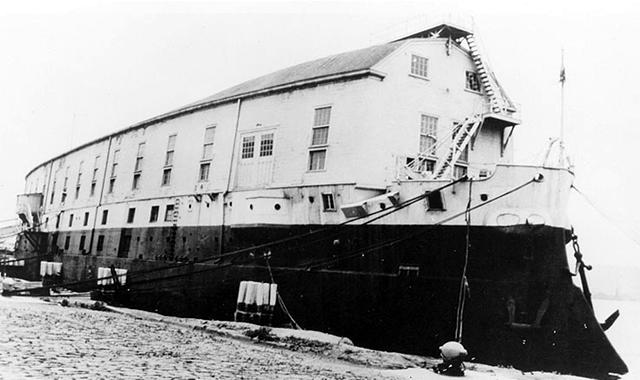
Name the ship, win a post! Operators are not standing by to take your call.
Posted by: Wonderduck at
10:41 PM
| Comments (8)
| Add Comment
Post contains 50 words, total size 1 kb.
1
Arrgh! Why did you post this so late on a weeknight? I have work tomorrow!

Other than what appears to be a workshop or offices built on top of a pre-Dreadnaught battleship or cruiser, I've got naught so far...
Posted by: Siergen at June 23, 2011 11:27 PM (/P7QN)
2
The best I can come up with the USS Kearsage or Kentucky after conversion to a barracks or receiving ship. I can't find any photos or write-ups for this, but several bow details seem to match.
And now, a few hours sleep before I need to go to work....
Posted by: Siergen at June 23, 2011 11:49 PM (/P7QN)
3
The bow looks like WWI.
I assume that the part at the rear that sticks out on the side is a latrine, right?
Posted by: Steven Den Beste at June 23, 2011 11:52 PM (+rSRq)
4
USS Prairie State (IX-15), better known as USS Illinois (BB-7).
Posted by: flatdarkmars at June 24, 2011 01:39 AM (zxqxC)
5
flatdarkmars does it again. Name your post, sir, or should I just do another one as usual?
Posted by: Wonderduck at June 24, 2011 06:24 AM (n0k6M)
6
Why did they feel the need to leave all that steel buried underneath an office building for thirty years? Couldn't they have used all that armor-quality steel in some more productive fashion?
Posted by: Mitch H. at June 24, 2011 09:31 AM (jwKxK)
7
Mitch, that's simple: it's not an office building. After the USS Illinois was changed to the Prairie State, she was also converted to become an armory ship.
That armor is, presumably, containing cordite, shell and shot by the thousands of tons. It probably wouldn't do much good if it all went up, but it's likely better than nothing.
Posted by: Wonderduck at June 24, 2011 09:53 AM (OS+Cr)
8
Hmmm your topic is... something to do with German surface commerce raiders in either the 1st or 2nd World War... I'll leave it fairly non-specific so you have some latitude to pick something interesting.
Posted by: flatdarkmars at June 24, 2011 12:13 PM (zxqxC)
Hide Comments
| Add Comment
June 09, 2011
Misunderstanding Midway
Down in the comments section of the post "
The Reason for Midway", there's a sight to warm the heart of any blogger: an energetic
argument discussion. Longtime readers CXT and Avatar are doing a fine job of carrying the flag of disagreement with Bob, I wanted to pay closer attention to something he said at the very beginning of his comments. To whit:
"
These discussions are interesting but so narrow as to be misleading. The entire Midway exercise didn't matter, regardless of outcome."
It will come as no surprise to readers of The Pond that I vehemently disagree with this statement. To be honest, in one way I do agree with Bob in that Japan had no chance of winning an overall military victory against the forces of the United States, Britain, Australia and the Dutch. However, that does not mean that Midway didn't matter, any more than it means that Guadalcanal/the Solomon Islands, Leyte Gulf, Iwo Jima, Tarawa, or even Attu and Kiska, didn't matter.
Once the first A6M2s, D3A1s and B5N2s lifted off from the
Akagi,
Kaga,
Hiryu,
Soryu,
Shokaku and
Zuikaku on their way to Pearl Harbor on December 7th, 1941, sterile discussions over such concepts that Bob mooted became academic: win or lose, the die was cast and
everything mattered. Only in hindsight can we say "it was pointless and the Pacific War shouldn't have been started". The fact of the matter is that it
did start, men
did fight, and it
did matter... every bullet fired, every torpedo launched, every bomb dropped, every grenade thrown, mattered.
It mattered to 3400 men at Midway. 29000 men at Iwo Jima. 38000 men at Guadalcanal. 7000 men in the Aleutians. 12000 at Peleliu. And hundreds of thousands more at dozens of other locations across the Pacific.
To suggest that these battles "didn't matter", no matter how large the stack of scholarship one may bring to the table, is ridiculous and insulting to those who participated and survived, those who were there and were injured, and to those who fought and died on both sides. Don't take my word for it, however... walk up to a Pacific War veteran and tell
him his actions didn't matter. Just let me know where and when you intend to do it, so I can bring popcorn.
Regarding the first part of Bob's statement, it seems clear that he doesn't read The Pond overmuch. Very nearly by definition, I blog about "the narrow", because that's where my interests lie. Sure, I could write about the geopolitical situation surrounding the beginning of WWII in the Pacific, but I'd hate every moment of it. I'm an amateur historian of the military actions of the Pacific War, with an emphasis on naval battles, and a particular emphasis on the Battle of Midway, because
that's what I like... and I write about what I like. I won't apologize for being "too narrow" for someone's taste.
Particularly when it "doesn't matter".
Posted by: Wonderduck at
10:31 PM
| Comments (9)
| Add Comment
Post contains 495 words, total size 4 kb.
1
I'll
try again.
"...that
does not mean that Midway didn't matter, any more than it means that
Guadalcanal/the Solomon Islands, Leyte Gulf, Iwo Jima, Tarawa, or
even Attu and Kiska, didn't matter...." Of course it
mattered. But I believe the people in the steel mills in the
upper mid west, the Manhattan project folks in TN & NM, the
bomber assembly workers in KS & GA, etc also mattered and that
the collective efforts of the home front meant more to the wars
outcome than the clearly heroic efforts of the military at the 'tip
of the sword'.
What
would have happened if the USA lost at Midway? Lost the
Hawaiian Islands? Lost Australia?
There
might have even been fewer front line military deaths! I don't
know. But I do believe that any rational analysis would show a
defeated Japan before 1950. Maybe even before 1946.
There
is no likely case for getting Japan past Hawaii. Existing
submarine forces and the long supply line would have stopped the
Japanese for years at Hawaii. With Japanese actions on so many
fronts, they didn't have the ability to project to our west coast.
In the absolute worst case, the America of 1944 would have
looked about the same. More carrier fleets than Japan, more
submarines and so many long range bombers that the sky would
still go dark when they were overhead. Can you imagine a
carrier fleet being attacked by B-29's (who were protected by P51's)?
And in the worst case, how many nukes would it take to
eliminate the Japanese Navy in 1946/7? Would our 700 (worst
case) nuke inventory in 1950 been enough? The method and path
of winning was not known, that we would win was.
It
is NOT any lack of scholarship OR disrespect for the efforts of the
those on the front line in the Pacific. Both of my parents are
buried in Arlington and my father-in-law spent WWII on a destroyer in
the Pacific (a high risk place to be). It is a simple statement
of fact that was known THEN as well as now. The troops in the
Pacific got the best gear last and the old stuff first. Most of
the military and most of the equipment went to Europe. So did a
lot of the Navy. Our government knew then that Japan was going
to lose. That's why we 'starved' the Pacific war. Germany
was felt to be a much closer case. It wasn't 'hindsight' or
'academic', it was the thinking of the 1941 American
government/industrial complex.
The
only real issue is the one that says the Japanese had to do this and
made a reasonable gamble that an aggressive push against the US early
would get the US out of the war. A long war against a
determined, violent Japan would discourage the US and cause them to
sue for peace. History has made it very and unambiguously clear
that by 1941 the American government/industrial complex was already
gearing up for the long war and was looking full time for a way to
get into a war with Germany. The only questions that are
relevant are [1] Did Japan really have to go to war with the USA and
[2] if they did, would bold, aggressive early actions get the USA to
sue for peace?
So
I'm left with my same three conclusions:
[1]
Really bad staff work by the Japanese military planners
combined with a toxic command structure 'forced' Japan to conclusions
that were not based on an understanding of the American people or
readily available information about the war 'capacity' of the USA..
[2]
A Japanese 'peace at any price' policy might have worked but a
war with the USA would never have a Japan favorable outcome.
[3]
"These
discussions are interesting but so narrow as to be misleading.
The entire Midway exercise didn't matter, regardless of outcome."
Wonderduck:
"... I won't apologize for being "too narrow" for
someone's taste..." I came to the Pond via a thread I
noticed on Steven
Den Beste's
site. I noticed the 'narrowness' because there were several
different entries on Midway. I decided to comment because I
thought the conclusion was wrong and that a discussion would be
interesting. Nothing wrong with being narrow. No reason
to take the geopolitical big view. Midway was an interesting
battle for so many reasons. Midway was an excellent example of
the best of our military and people. Midway was tactically
significant and strategically significant to the military progression
across the Pacific.
But
it was NOT strategically important to the actual outcome of the war.
I thought the discussion on this site went a little too far on
the importance of the Midway battle. I note you have not been dissuaded
from your view and I haven't changed mine either. No change was
expected. The goal was an exchange of views and that has been
achieved. For me, very enjoyable.
Regards
to all.
Posted by: BobReisner at June 10, 2011 04:13 PM (/ZWI/)
2
You can't really come to that conclusion, however.
War weariness
did exist. It's easy to say "there were no circumstances under which the US would have accepted anything less than total victory and unconditional surrender", but that's plainly not true from contemporaneous records. This is one of the reasons we resorted to the atomic bomb; we anticipated a tremendous number of casualties in the invasion and we were worried that the public wouldn't support the war to a final conclusion.
Midway was extraordinarily costly for Japan. They lost the majority of their carrier fleet and carrier air arm in a single operation. Change the outcome to a Japanese victory, or even an inconclusive stalemate (say, the US carriers spot the battle fleet and work them over well instead of the Japanese carrier group), and the entire course of the war could have changed.
Does that mean the Japanese could have conquered Hawaii or Australia? Probably not. But having an experienced carrier group to contest several of the initial US invasions would absolutely have raised the casualty count and slowed down the US advance.
Sure, eventually we develop nuclear weapons. But we developed and deployed them at a time where we had virtually uncontested freedom to bomb the Japanese as we liked. But what if we hadn't gotten that far yet? If we were still working our way through the Philippines, if we hadn't taken the Marinaras? Even with nukes, our strategic outlook is quite different under those circumstances.
Would we have used nukes on otherwise-valueless islands to crush the Japanese resistance? You can make the case that we'd have done better turning Iwo Jima into a pile of radioactive glass, for example. You could even see the logic in nuking places like Rabaul or Truk, bases we didn't want to take on directly but didn't really need to occupy either. We might have ended up using as many as a few dozen nuclear weapons in the end, especially if you consider the chance of interception of the bomber, etc. That's a very different post-war Pacific.
Or would we resort to a Doolittle raid, with nukes? Surely we wouldn't have had the luxury to hit only one target, and it's not likely we'd have spared Tokyo under those circumstances.
Posted by: Avatar_exADV at June 10, 2011 07:40 PM (pWQz4)
3
To back what Avatar mentioned - as Richard Frank wrote in Downfall, there were people in the Administration whose job it was to monitor American sentiment and war weariness, among them Dean Acheson. And they were detecting signs that the US public was becoming war weary by 1945. It is a tribute to the Japanese's attack on Pearl Harbor it took that long to produce the effect, but the Administration was concerned that the Japanese strategy of 'outlasting' the US and the Allies in the Pacific War might actually had a chance of working. Or perhaps just as bad, the Japanese would conclude it was working and thus stiffen their resistence.
Furthermore, as David Evans and Mark Peattie had pointed out in Kaigun, it was primarily because of the Japanese 'sneak attack' on Pearl Harbor that produced the psychological and motivational attitude among the American public for a total war to the finish, with the unconditional surrender of the enemy as the objective. Had the war opened in a different fashion, perhaps by an attack on the Philippines following a formal declaration of war, it is highly unlikely that the US public would have been willing to fight for unconditional surrender - and more than likely that a large part of the American public would have called for immediate talks with the Japanese since the 'Philippines are not worth American blood!'
As for the assertion that the US government 'knew' the Japanese were going to lose - not quite. The US government felt Germany was a more dangerous opponent than Japan and hence needed to be defeated first, but no one ever assumed either of them were eventually going to 'lose'. We have the hindsight that says it is true - but nothing in the deliberation of both the US high command, or the debates among the Allied command suggest that until the end was in sight in either theater.
Posted by: cxt217 at June 10, 2011 08:08 PM (G3oVK)
4
Bob, you're always welcome back, but next time? PLEASE don't compose your comments in Word.
Now then... "I noticed the narrowness because there were several different entries on Midway." Yes, because that's what I'm interested in. You wouldn't criticize a NASCAR blog for not writing about French cuisine, would you? Of course not.
As far as the strategic importance of Midway goes, well, I've said ON THIS VERY BLOG that it wasn't the most important battle of the Pacific War, Guadalcanal was. But saying that it wasn't strategically important to the outcome of the war is just silly. If the results had been reversed, with the US losing three carriers and the IJN zero, (as opposed to 1 and 4 in reality), there's plenty of reason to believe the war would have taken much longer to prosecute. Japan would still have lost, but not until 1946 or 1947, and it would have taken quite a few more nukes in the process.
That's important.
Posted by: Wonderduck at June 10, 2011 08:09 PM (n0k6M)
Posted by: Wonderduck at June 10, 2011 08:17 PM (n0k6M)
6
There is a school of thought, both during the war and after it, that says D-Day and Normandy was an 'unnecessary' invasion - heck, the British kept pushing that idea until FDR let Stalin essentially shamed them into dropping it. Make that what you will.
And regarding Avatar's point - B-36 bombardment groups, from Hawaii.
Posted by: cxt217 at June 10, 2011 09:09 PM (G3oVK)
7
I'm not familiar with the B-36, I'm afraid.
I'd like to endorse
Downfall as well. It's the best work I've ever read on the end of the Pacific war by a long way.
Posted by: Avatar_exADV at June 10, 2011 09:13 PM (pWQz4)
8
To feed off of cxt217's comment, I've been reading a lot of histories of the Eastern Front, and saying the outcome there was pre-determined is also a bit of a mistake. A lot of the newer histories are drawing on previously-classified Soviet archives which indicate that through mid-1943 the situation was a lot more desperate than they were willing to let on, either at the time or in official Soviet post-war histories. By the time of the battle of Berlin, the Soviets were also reaching their limits, and their operations changed from the carefully planned Bagration-style offensives to more of a frenzied 'lets just get this over with and throw everything in' final assault.
Of course Stalin wanted the Western allies engaged against Germany to draw German forces away from the front, and was disappointed in the level of support he felt he was receiving. Even relatively minor distractions like Sicily had noticable cascading effects on German strength in the East.
Posted by: Civilis at June 10, 2011 10:22 PM (/+Ti8)
9
The B-36 Peacemaker was the first true intercontinental bomber, designed in 1941 when it was looking grim for Britain. It didn't fly until early August 1945, however. Roughly twice the size of a B-29, as designed it used six radial pusher engines. Eventually it also mounted four jets along with the radials. Good article about it
here.
I'll third the support for
Downfall, though there's a new book by DM Giangreco that I've heard good things about, entitled
Hell To Pay. Same topic as Frank's book, I've been wanting a copy for the past year or so...
Posted by: Wonderduck at June 10, 2011 10:32 PM (n0k6M)
Hide Comments
| Add Comment
June 05, 2011
Missing Midway Photography
Unless you're like me, and heaven help you if you are, you may not have noticed one of the most surprising facts surrounding the Battle of Midway. That is,
where are all the pictures of the Japanese carriers? Now, I can hear you saying "Wonderduck, there's plenty of pictures of
Kido Butai at Midway out there! Just look at this one of the
Akagi!"
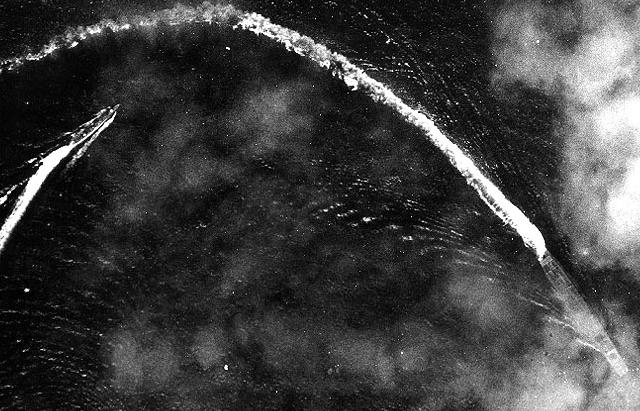
"Or this one of the
Soryu!"
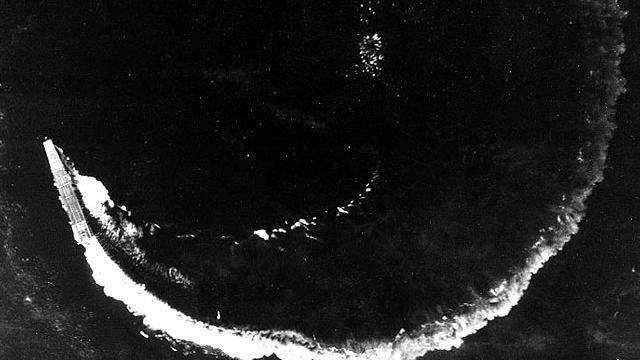
"Or this one, it's the
Hiryu!"
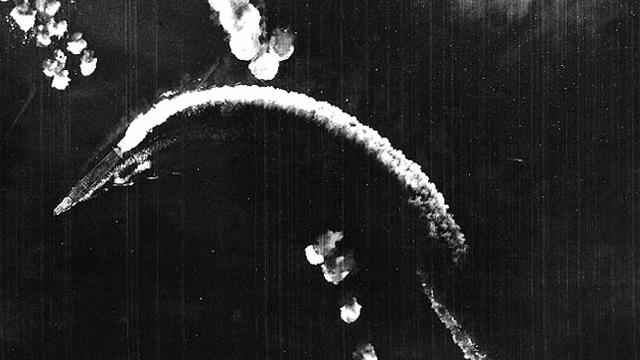
"Or this one, of the
Kaga... er... hey!"
I'm sure there are variants of the above three pictures in the National Archives, but for all intents and purposes, those are the only images of the Japanese carriers involved at the Battle of Midway that we have. Taken from B-17s on the morning of June 4th, 1942, they represent the entirety of the US photographic effort during the battle.
Or do they?
more...
Posted by: Wonderduck at
11:40 PM
| Comments (1)
| Add Comment
Post contains 911 words, total size 8 kb.
June 04, 2011
The Reason For Midway
Reader Siergen asks: "
Assuming that the Japanese had succeeded in taking Midway, did they have any plans to actually use it, such as for land-based bombing of Pearl harbor? Or was it intended solely as bait to lure the US carriers out and sink them?"
A fine question. Indeed, there was a strategic reason for the Japanese to take Midway. However, in my estimation, their reasoning was somewhat... flawed. As the War in the Pacific drew close, the Japanese military knew that they could not realistically go toe-to-toe with the United States for more than a year or so, two years maximum (let that sink in: they started a war they could not win militarily... and knew it). Instead, they intended to win politically, by inflicting such heavy losses on the US and her allies that they'd give up and go for a political settlement. In the political realm, they believed that they'd have a strong case for keeping their conquests (primarily the Indonesia area, with her rubber, tin and oil deposits) and become both self-sufficient and the unquestioned master of Asia.
To do this, the Japanese adopted a strategy that relied on the concept of a defensive perimeter. They figured that if they captured enough island bases, like Wake, Guam, Rabaul, and the Philippines, then improved them to stronghold status so they'd be impossible to re-take, they'd be able to create an impassible border that would keep the Japanese Home Islands secure. Along the way, they'd also attempt to sever the lines of communication between Australia and the US, though that would be more of a bonus than a goal. It's hard to imagine the strategy without looking at a map, so let's use a simplified one: the board for the game
Victory In The Pacific, by Avalon Hill.
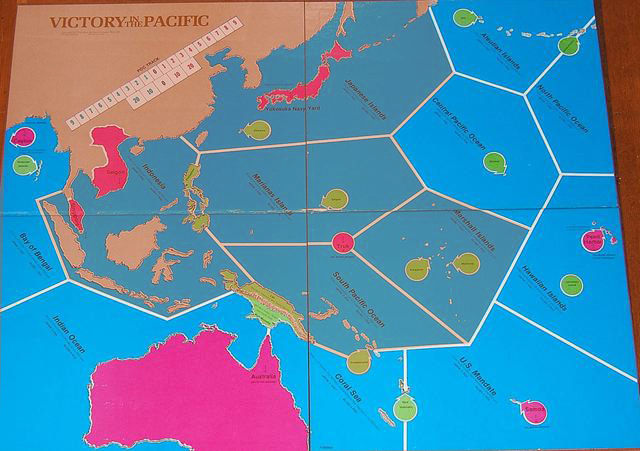
This would be the situation going into June, 1942. The shaded zones are controlled by the Japanese, the lighter areas by the US and her allies. The defensive perimeter is starkly evident this way, along with the one weak area in the strategy: there are two open paths directly to the Home Islands. The first is from the "Hawaiian Islands" area directly through the "Central Pacific"; the other, through the "North Pacific" and "Aleutian Island" zones.
Prior to the Doolittle Raid, there was quite a bit of debate in the Japanese military command as to what the next targets would be... in effect, they had been so successful so quickly, they outstripped their own plans. But then the attack using B-25 medium bombers, flying from the deck of the USS
Hornet, made clear that the Home Islands were still vulnerable, and the plans to attack Midway and the Aleutians were approved. Capturing those "areas" would prevent any attacks to slip through without being discovered and countered, either via ships sailing from Truk or from Japan proper
There was never any plan to use Midway as a point to launch aerial attacks on Pearl Harbor; even for the incredibly long-legged Japanese aircraft, the 1300 mile flight was too far a distance. Instead, it would be a self-defending base able to send reconnaissance flights out to patrol the waters around it. Just
how the Japanese would be able to keep Midway supplied was never really answered; they would figure it out when the time came.
The flaw in this strategy is that the real world isn't a game board with zones of control that prevented enemy movement, yet in effect that's exactly how the Japanese were looking at it. The Pacific Ocean is huge, particularly in the Northern and Central Pacific areas, with vast stretches of open sea where ships could sail without ever being noticed. Indeed, the fleet used in the attack on Pearl Harbor took advantage of this fact on its approach.
The attack on Midway had the goal of sinking the American aircraft carriers, no mistake about it... but defending the Home Islands was the primary goal. That the strategy behind the goal probably wouldn't have worked was apparently never considered.
Posted by: Wonderduck at
07:54 PM
| Comments (16)
| Add Comment
Post contains 676 words, total size 4 kb.
1
Thanks for the response! I also read that the natural resources in the captured territories were insufficient to make up for the embargo from the US - and the Japanese knew it before they started the war. If true, that meant not only did the Japaneses need for America to give up militarily within a year or two, but they also needed the US to "forgive and forget" and lift the trade embargo...
Posted by: Siergen at June 04, 2011 10:45 PM (FiHIo)
2
I don't know that this was really correct. It's true that they never did get the Indonesian oil fields up to the kind of production they really needed, but that wasn't foreseen before the war.
Their biggest problem was shipping, and not just because of the American submarine blockade. They handled their cargo ships suboptimally, because the Navy insisted on owning some of them and the Army did the same, and they didn't really coordinate their usage. So when the Army sent out ships full of troops and supplies to some region, they came back empty instead of bringing back raw materials. When ships were sent out to get raw materials, they went out empty. They could have substantially increased the efficiency of their cargo shipping if only the Army and Navy were more willing to cooperate.
Posted by: Steven Den Beste at June 05, 2011 01:09 AM (+rSRq)
3
It was not simply a misallocation of shipping. Japan, despite having the third largest merchant fleet in the world in size, and the most modern and efficient in quality, did not have enough shipping under the Japanese flag to handle the traffic needed in peacetime, let alone the higher shipping requirements in war. And this does not include the shipping needed for various campaigns (During the later days of the Guadalcanal campaign, the Imperial Army was pressing for major diversion of merchant shipping to support the campaign, despite being told to their face that such diversions were going cripple the overall war effort.) or the requisition of merchant ships for other purposes (Like conversions to escort carriers, minelayers, auxilary cruisers, etc.).
In fact, at the outbreak of the Pacific War, 60-75% of the Japanese merchant fleet had been requisitioned for direct use by the service or in the opening campaigns, leaving very little support the war effort as a whole. For the tanker fleet, it was >80%. No Allied planner would have dared being stupid enough do something anywhere like that.
Posted by: cxt217 at June 05, 2011 02:56 PM (PKA/z)
4
These discussions are interesting but so narrow as to be misleading.
The entire Midway exercise didn't matter...regardless of outcome. The overall outcome was foreordained by the differential in GDP and the resulting delta in war production. While I have some issue with specific entries, this web site is directionally correct ( http://en.wikipedia.org/wiki/Military_production_during_World_War_II  . The war was decided on the size of the prewar industrial base and the ability to ramp. The military efforts were heroic and certainly helpful, but the outcome was decided in the dull, boring (pick your term) factories of domestic USA. The Japanese didn't have even two years...if not for the forced entry into the European conflict, Japan would have been finished years earlier.
Japan could not have been certain of simultaneous entry of the US into the European conflict. Any Japanese planning for a short war absent US involvement in Europe was idiocy even if only public source information was available. Note the 1938-1941 difference in GDP between Japan and the USA. The GDP impact is cumulative.
Even if the US had been pushed back to continental US the outcome would have only been worse for the Japanese. In this case, the wars human impact on the US population would have been quite modest and the resurgent economy (due to war production) would have made it 'easy' to stay the course. Imagine a Japan in 1946 that owned the Pacific but was facing a US with long range bombers, scores of carriers and hundreds of nuclear weapons. The post war period saw the development of 700 nuclear bombs by the end of 1950. Imagine a wartime scale up of the nuclear production! Forget Japanese cities....think of Japanese fleet or forward airbase survival in the face of a single bomb that only had to be somewhat close.
After 60 years we should be able to take a step back and understand what really happened. And what was really important.
Posted by: BobReisner at June 07, 2011 02:29 PM (/ZWI/)
5
Bob, none of those things matter if the people of the rich country, or its leaders, don't have the guts to see the thing through.
The Japanese thought that was the case about the Americans. Even if you outproduce your enemy five to one, it still costs blood to win a war, and the Japanese thought that the Americans wouldn't be willing to shed enough blood to win.
That was their plan: after Pearl Harbor, to take and hold so much territory that the butcher's price of taking it back would be so high that the Americans would give up and make terms.
They weren't the first to make that mistake about America, and they weren't the last.
Posted by: Steven Den Beste at June 07, 2011 02:58 PM (+rSRq)
6
Everyone on the Japanese side thought the US would outproduce and outmass them if and when the Pacific War broke out. Everyone. You can argue they underestimated the production imbalance between the themselves and the US, but that is a different matter.
And barring the more extreme delusionists (Gerhard Weinberg in A World At War make for interesting reading on some of the more grandoise schemes of the Axis.), no Japanese thought it was possible to subjugate the US militarily - though quite a few Japanese recognize the US could do so to Japan.
Those were not the points. The Japanese thought they could wear down the Americans' will to continue fighting, that the Americans, confronted with an invincible Germany on the other side of the world (And YES, the Japanese WERE assuming the Germans would play a role against the US - by knocking Britain and the Soviet Union without Japan having to do anything, if nothing else.) would come to terms with Japan that would leave the Japanese in control of a vastly larger empire.
Posted by: cxt217 at June 08, 2011 08:01 AM (PKA/z)
7
I understand the assumption of foreign states of a lack of resolve by American citizens and an expectation of a US citizen desire to end any conflict early and at any cost. I understand this because I see this assumption being made repeatedly over the centuries. But, I also believe the foundation for these assumptions is not scholarship but simply wishful thinking. Any review of American open source history should have warned them otherwise.
American history from the French & Indian War to modern day is a history of substantial citizen minorities acting with incredible violence over protracted time spans. The American Revolution was a long war that was violent and resulted in a significant number of Americans being exiled from their homeland. Modern warfare (WWI & WW2 style) was created by the American Civil War...violent, industrial, encompassing the whole of society, and with little quarter given. If the Civil War was an example of American brother on brother violence, why would any foreign entity expect that the American reaction to foreign assault would be less violent and with less resolve. It was a very indifferent citizenry that was dragged into WW1. But still a speed and size of mobilization that was shocking even to the 'experienced' European warriors. WW1 was a war without real passion on the part of the American citizen, but American history and politics clearly showed that an aroused citizen minority could hold a grudge for a very long time.
While the Japanese right of passage on to the world stage was the war with Russia, could they not have not noticed the American crushing of a similarly waning power, Spain, with even less effort. Could the Japanese not notice that the Depression crushed America, indifferent to foreign affairs, had the blue water navy that they were most concerned about? In 1931 (Depression well underway), the Navy had 3 Carriers, 12 Battleships, 107 Cruisers/Destroyers, and 56 Submarines. On December 7, 1941: 8 Carriers, 17 Battleships, 222 Cruisers/Destroyers and 112 Submarines. ( http://goo.gl/9KAMi ) A Navy of this scope does not happen overnight, it is an activity that takes generations. And the Navy of late 1941 was a product of an economically distressed country under a great measure of political upheaval. It is worth noting that by late 1943 (only 2 years after Pearl Harbor), the US Navy size was greater than the combined fleets of all other countries on the planet. Was their not a single Japanese analyst in the prewar period who could extrapolate existing shipbuilding capacity (1941) to a war time condition and determine that annual ship production was quickly going to be greater than the total Japanese 1941 fleet size.
In an open society there can be significant minorities that will protest for peace visibly and even irrationally. American history shows that the 'war like' minority always holds sway and, while there can be noise, the ability of the American government to mobilize huge armed forces and the supporting industrial society for long periods and across varying economic conditions is always the case. Perhaps our enemies are distracted by our discordant environment, something that doesn't exist in closed monolithic societies. But it doesn't matter. In matters of life and death, our enemies are under a societal obligation to develop the analytical resources that can see past the noise to the true conditions. They never do and are doomed to make unfounded assumptions that cause their societies to collapse. The information to make a correct assessment about American capacity and 'will' were in the open and available to the Japanese (Yamamoto knew). The "Two Oceans Navy Bill" (July 1940) authorized 1.3MM tons of new warships, the 1939 Industrial Mobilization Plan gave the world notice of massive mobilization, in May 1940 the Office for Emergency Management and National Defense Advisory Commission were created to accelerate war planning, and in January 1941 things really started rolling with the new Office of Production management --- years before open hostilities, the American society was years into a long term commitment to war. All in the open. For anyone to see.
It was over before it started. Midway didn't matter. The Japanese had many better options and would have likely pursued them had they had a rigorous analysis of the American reality, economic and strength of will.
Posted by: BobReisner at June 08, 2011 11:08 AM (/ZWI/)
8
You make a lot of good points, Bob, and we can agree to the preposition that any war started by Germany and Japan against the Allies was ultimately doomed to defeat (Though it was not apparent to all the participants at the time.).
But in many ways, it did not matter. Both the Japanese and the Germans knew that once America entered the war, they would be outproduced - heck, the British outproduced Germany in ships, aircraft, and tanks by themselves. And the Japanese were under no illusions about the possible size of the US Navy after the Two Ocean Navy bill/Stark Plan.
But it was the Japanese' consideration about whether the US had the will to fight them - especially with a victorious and apparently invincible Germany waging war against them at the same time - that represented their thinking. That actually has some validity to it, since as Richard Franks pointed out in Guadalcanal, the Japanese had gotten a pretty sense of the domestic mood within the US in 1930s and 40s, including how the Selective Service was renewed by a margin of a single vote in the House. Any doubts about both American and Western will to fight was shared, in private, by none other than Winston Churchill, following the fall of Singapore and Tobruk. And the willingness of the Japanese to fight and die to literally the last man, and how that would impact American preceptions - that was what the Japanese expected before the war which did cause American concern during the war.
The huge productive advantage the US had is what caused the Japanese to plan on a short, decisive war of conquest before coming to terms with US - similar to how the mighty hosts of her surrounding enemies had caused two generations of the German General Staff to plan for a short, decisive war to knock out their opponents in sequence before they could be fully mobilized and act in concert. Given the Japanese' apprisal of American opinion and the massive increase in US naval strength that was coming, that seemed a workable strategy to them. The fact it was myopic is correct but in many ways, irrelevent.
Posted by: cxt217 at June 08, 2011 10:33 PM (PKA/z)
9
So the japanese believed they would win. What if Japan would never have attacked Pearl Harbor, what if they had left US alone and concentrated on carving a huge empire from China, Soviets and european colonial possessions? Would US have done anything? What could have been the triggering point?
Posted by: Ari at June 09, 2011 01:22 AM (QXAzG)
10
The problem is that Japan wasn't completely independent of the US. They required significant shipments of raw materials, including a lot of scrap steel, in order to keep their economy going.
One of the triggers that prompted Pearl was the suspension of oil and steel exports to Japan in mid- to late 1941, in response to their continued invasion of China. Once they were in that position, they couldn't just coast along as they were; access to oil was absolutely required in order to continue with the military obligations they had and the civilian economy. So they had to get access to oil, and that either meant moving against SE Asia or backing down in China.
It's extremely questionable whether backing down in China was actually an option. Any civilian government that tried it without the military would have immediately been turfed out - the Japanese system required the army and the navy to provide a minister each, and they could undo a government by refusing to do so. On top of that, anyone who advocated such a policy would have been highly likely to be assassinated.
Could Japan JUST have attacked SE Asia without the US? Eh. It's not impossible. But if the US decided to make a point of it, it would have been easy to base the fleet at Manila, and there wasn't any way to run oil tanker convoys past a hostile Philippines. So they ran the risk of being pulled into war under circumstances that would have been much more favorable to the US, while still being at risk of getting fuel-choked at any time.
Posted by: Avatar_exADV at June 09, 2011 12:37 PM (44ahZ)
11
I intend to post a response to Bob tonight. It will come as no surprise that I strongly disagree with his initial statements.
Posted by: Wonderduck at June 09, 2011 12:57 PM (OS+Cr)
12
Avatar: I would argue that a Japan that avoided war with the US and only attacked British and Dutch interest would have gotten away with it, at least for a little while. They had two domestic US factors going for them - the strongly isolationist mood of the US population at the time, and intention of FDR to go to war with Germany first while trying to maintain peace as long as possible with Japan. A US public that saw the Japanese avoid attacking American interests (In the Philippines and elsewhere.) and avoid attacking Pearl Harbor, would not have been in a mood to declare war on a Japan that was overrunning Malaya and the Dutch East Indies.
Furthermore, the Philippines were not logistically prepared for a large American force to be based on - primarily because of its vulnerability to being attacked by the Japanese. The ability of a December 1941 Pacific Fleet to do so was also questionable, given the priorities and allocations of forces to the Atlantic and against Germany - something that frustrated Husband Kimmel and his staff to no end.
Posted by: cxt217 at June 09, 2011 02:23 PM (PKA/z)
13
cxt217 in #12 get's it exactly right. By late 1941, the US had clearly decided that Germany was the opponent of choice. A relatively small island nation that knew it's limitations would have seen a path to real victory as anything other than an attack on the US. A treaty that limited China area conquests to Korea, Manchuria and northern China would have taken 'China' off the table and the American population would have lost total interest. Since France and the Netherlands had been conquered by Germany, Japanese protection in force of these and also German assets in the pacific would have likely been welcomed. Think of Japan assuming the role of a limited regional power that allowed the US and Britain to focus on the European/Mideast/Africa theaters. Japan could have easily positioned itself as an ally. An ally that would have been welcomed and whose activities to 'keep the neighborhood safe' would have been overlooked (think about treatment of Russia). It would have taken generations to integrate the arc from Indonesia to Manchuria into a real East Asia co-prosperity sphere, by 1941 japan had conquered almost all it really needed to be strong for the next 100 years. And it would have had some very appealing post war geopolitical considerations...a strong ally aligned against a weak China (likely communist) and a resurgent Russia. A very different Pacific and maybe a very different world picture with Russia having a heavily militarized Japan on the ground in Asia just below the empty Siberia.
Avatar in #10's point about a base in Manila is a stretch. A fleet would be hard to supply and Manila would be vulnerable to submarine blockage and air attack from Formosa. Plus what cxt217 said in #12. A smart Japan could publicize American attacks on still 'friendly' Japanese shipping and it would be extremely difficult for an America at war with Germany to get popular support for an attack on the Japanese fleet. Again, the only thing Japan had to do was to go out of the way to NEVER declare war on the US and to never engage in a first strike. Germany was at war with Britain for 2 years without the US stepping in as a declared partner of Britain. Yes we defended convoys, took some aggressive actions in the Atlantic and beefed up western hemisphere defense but we did not engage Germany despite provocation. Based on this example, why did Japan think the US would actively engage Japan in defense of Britain in the face of Japanese aggression against British conquests. Just another case of bad analysis and bad thinking.
Again on Avatar #10, I think the issue of US oil and scrap steel export to Japan (or rather lack of export) was not really important. Any war with the US would be the same as the export ban....nothing would come from the US to Japan with a state of war in place.
But Avatar in #10 makes my case exactly when he states the very true statement that NO Japanese government would have survived a China retrenchment or likely any military stand down / stabilization. The combination of an insular society, emperor worship and the blind desire for territorial conquest created the perfect storm to assure that all problems had the same answer of military expansion. Post war documents clearly showed that Japan had no realistic plan to stop and that there was no real post war plan, plan to end hostilities or even to 'integrate' the conquests into a rational economic system. True analysis and realistic selection of realistic options was not possible in the religious and political structure that was Japan. The choices made were to recover from ethnic/societal slights and feed the military desire to acquire territory. What other possible explanation could there be for so many bad strategic decisions. It wasn't random bad luck. Ari's point in #9 is so obvious, how could the smartest people in Japan 1941 missed that train of thought.
The linchpin of the discussion rests on two apparent thoughts about the American people by the Japanese leadership: the Americans didn't have a stomach for a long war and they were too 'soft' to fight a determined enemy. We know that these statements are not true but it is my contention that the Japanese could have determined this in 1941 from a careful reading of public source information and American history. Their (the analysts) desire to support ethnic supremacy, their feeling that other societies were structurally inferior, and that they must provide analysis that supports the predetermined conclusions of the emperor and military caused the Japanese disaster known as WWII. I won't repeat all of the prior points but I want to address some of the examples in #10. A close vote on Selective Service was nothing compared to the draft riots of the civil war (which did not affect the conduct of that war). Again, the American revolution and civil war showed conclusively that Americans would fight each other to the last man! If Andersonville showed how Americans would treat their own, what lesson should Japan have taken away? The American propensity for violence was in every newspaper every day....machine gun toting bank robbers, gangland wars in New York, Chicago and Detroit, UAW and other union organizing activity, veteran pension marches (and the government response), California efforts to restrict 'immigrants' from the mid west, ethnic violence on every group that ever migrated to the US in size (Irish, German, Italian, Jews, Chinese, etc.), and of course White on Black actions. As all of this is compared to the relatively peaceful, very structured, very stable Japanese society, I can only ask: Exactly what information were the Japanese analysts missing? A violent people that could hold grudges across many decades.
I do understand that casual viewing of dissent in American political life (and in America in general) could lead those with limited information and understanding to a conclusion that the American society could not be mobilized for war (despite what happened in the Spanish American War and the BUND rallies in the 30's). I do understand that isolationist marches and vocal 'peace at any price' fringe groups could make an impression of weakness on the ill informed. All white people look and act alike so yes, America should collapse like the French, Poles, Austrians, etc did in the face of German intensity (forgetting that Germans were also 'white'). And Roosevelt and his team didn't know about war and were only interested in the domestic economy. And so on. BUT, the analysts and war planners are not supposed to be casual viewers of limited information. These analysts were expected to be 'the best and brightest'! They should have made the effort to learn and understand. They had 2 decades and no externally imposed resource constraints...one less battleship in a 20 year period would have provided the funds to send hundreds of soon to be senior staffers to the US for a decade to learn about us. Of course, the 'visitors' would be so contaminated by the US that they could never assume a senior analysis position in the Japanese hierarchy!
America is a noisy society with many components wanting isolation and peace at any price. My belief is that America always has a range of opinion and it is a specific vocal minority that carries the day. The guy's with the guns. About 1/3 (an unsupportable guess) of America is deeply 'conservative' and they tend to run the important government agencies (Senate, State, Defense, local governments), banks, industry, religion, and the actual military. While other minorities can have impacts on the edge and minorities overlap, there is a core to the US that has acted in a very predicable way (not necessarily right) since our founding. We see it and others can as well (or should).
It wasn't Midway, just really bad staff work. All the answers were available. There were good choices to be made (from their view). The only impediment was a closed mind. Turns out to have been a pretty big impediment.
Posted by: BobReisner at June 09, 2011 04:35 PM (/ZWI/)
14
Bob, sorry but as much as you have some valid and good points - you are not going to win this argument. Your argument about the Japanese' lack of looking at American history ignores that fact that it was very much the Present America and World of 1940-1941 that was the determining factor in Japan's (And Germany's, to a lesser extent.) decision to go to war, in so far it as the apparent lack of will in Americans to fight a war. The Draft Riots of the Civil War are interesting for a Japanese examining American history - it is also largely irrelevent to determining whether Japan was going to war in 1941. Much, if not most, of the American history you cite as being 'missed' by the Japanese were completely irrelevent to the deliberations at hand.
Also, if we are going to look at American history - how about the fact that Americans previously have seldom enjoy unanimus support in going to war? There are been a large segment in almost every war (Barring WW2 - and that still did not prevent one congresswoman from voting against a declaration of war on Japan.) that believed their fellow Americans were making a grave mistake in going to war against whomever. Sometimes this has led to more active anti-war efforts during the conflict. That would seem to argue that the Japanese assessment of Americans might be correct? Likewise, determining how European countries would react to Germany's invasion of Poland on 1 September 1939, by the using the European history regarding the mood in August 1914 might a tad off.
It is important to read the other guy's history but you have to be careful reading significance into it. Japan's defeat at Midway and in the Pacific War was the outcome of a whole host of factors, some of which no one could anticipate and some which could and should have been anticipated by the people of the time - but your overall position really is not one of them and, in my view, not supportable.
Posted by: cxt217 at June 09, 2011 05:19 PM (PKA/z)
15
Sorry to hear that cxt217 in #14 thinks we are having an arguement....I really do think it is a discussion ;>)
I'm also a poor communicator...most of the comments in #14 I agree with and feel support my point of view!
The Civil War draft riots were brought up as a counterpoint to the comment about the Selective Service Act being passed by a single vote margin and how this shows a reluctant America...that by implication would 'freeze' aggressive action by the government. The riots didn't and a single vote wouldn't. I also think that other countries should look at the long history of a people. Clearly much of France, to pick one example, has been and continues to be influenced by the French revolution, Napoleon, 1870, 1914 and of course WWII. The distant past is important. I believe this is true for most countries European, Asian, etc..and of course the USA.
I'd ask (cxt217) why you think American history in general and my specific references to the violent nature of Americans in the 1930's doesn't serve as an indicator that Americans can be violent (and self organize for violence) and hold grudges for a long period. As well as a multi year defense ramp up being well underway by 1941. cxt217 says "...
how about the fact that Americans previously have seldom enjoy unanimus support in going to war?..." My point exactly! With the possible exception of the Spanish American War (made unanimous by a 'sneak attack'!), the US had a long history of going to War with significant (perhaps majority) dissension. How could the Japanese have missed this?
I'll respond to the third paragraph of #14 in a post on the next thread but my line of discussion is NOT about the Japanese defeat at Midway being "...the outcome of a whole host of factors...". Of course it was. My point was and is that the Battle of Midway, while heroic, was not really important in the outcome of the War. And that with the perspective of 60 years after the fact, we should start to acknowledge this.
(Not having to do with this discussion, the cxt217 comment "... Likewise, determining how European countries would react to Germany's invasion of Poland on 1 September 1939, by the using the European history regarding the mood in August 1914 might a tad off..." seems inappropriate on its face. In 1914 Europe went to war on the basis of an assasination of a single person who wasn't really all that important. So if Europe could go to war over a single death, why not a possibility over a single country? Most historians weren't surprised...the exhaustion of WWI created the anomily of Austria and Czechoslovakia, not the other way around.)
Posted by: BobReisner at June 10, 2011 03:01 PM (/ZWI/)
16
First, I was error when referring to this as an 'argument' the way I did. We are having a discussion - all parties are advancing their arguments (i.e. position.) in the discussion.
The point is that trying to read history as an example what a nation or a people will do later, can be dangerous if you put more significance than the part of history is worth. Yes, America has gone to almost all its wars with large segments of the population dissenting (I would argue even the Spanish-American War qualifies, since there were a number of people, up and including William McKinley, who thought it was very bad idea.) and it has impair but not froze its action. I suppose the Japanese could have read that as warning - but they could also read that any war in 1941 that involved the US would not be whole-heartedly supported by the people, and would have a major segment of the American population seek negotiations and peace as soon as possible, and that the peace movement who not freeze the effort - but it would impair so much that the US government would not able to concentrate its whole attention on the war and would spur the US (Especially faced with an invincible Germany too.) to seek peace with the Japanese.
Note that historically, the US has ended every war prior to 1941 except the Civil War with...a negotiated settlement. And had the stalemate that persisted outside Richmond/Petersburg and Atlanta lasted longer in 1864, we might not have the exception either. That would suggest to a Japanese studying American history that the US would eventually come to the negotiating table with Japan as equals to end the war - after all, Americans always become war weary and want it to end, one or another.
And the build-up of American military power prior to 1941 would have argued for Japan to wage a short, decisive war so everything could be settled before the US could bring its greater production to bear. Actually, that is was brought up by the Japanese in the deliberations on the road to war - and before that as well, because they ALWAYS assumed the US would have the numerical advantage in the correlation of forces and productive capability. And it is strikingly similar to a German General Staff that, understanding their neighbors had the ability to steamroller them when they finished mobilizing and acted in concert, planned to knock them out in sequence before that occurred.
Now, we know the Japanese were concentrating on the Present America and Present World of 1941 when considering going to war with the US. Except for the US military build-up, very little else from American history was relevent to their decision making, though the war weariness/isolationism of the 1920s-1930s was certainly a factor. But even if they did study American history more, it would not have supported your position. No one, least of all me, will argue that past has no effect on the present, behavior or otherwise. But you have to read it with the correct appreciation of its significance.
Finally, my comment about trying to predict the European reaction to the invasion of Poland in 1939 through the lens of a 1914 Europe was actually a callback to an observation by Barbara Tuchman in The Guns of August, where she mentioned that 1914 Europe seemed 'bored of peace' which led them to eagerly marched off to war. You certainly can not say Europe was eager to go to war in 1939 - not even Germany - and thus you can not use that past to explain the present. Those are hardly all the reasons for either war, but it does show that care needs to be taken when examining the events of the present through the filter of the past.
And yes, Midway was important - the Japanese defeat meant the initiative was knocked out of their hands and into the air for anyone to try to grab it. That the Allies only grabbed it when they started the Guadalcanal Campagin does not reduces the importance of Midway.
All other commets will go in Wonderduck's post on the subject.
Posted by: cxt217 at June 10, 2011 08:58 PM (G3oVK)
Hide Comments
| Add Comment
The Brewster Buffalo: Midway's Most Reviled Plane
When one thinks of the Battle of Midway, images of Dauntless dive-bombers plummeting down towards Japanese carriers immediately leap to mind. Or perhaps the tragic story of the massacre of the three torpedo squadrons flying TBD Devastators is the more dramatic, and therefore more memorable, saga. Whatever the military buffs out there think of, it's unlikely that the Brewster F2A Buffalo would get more than a derisive snort, if even that.
That's somewhat unfair to what was the US Navy's first monoplane fighter. As originally designed, the Buffalo was actually quite nimble and well-liked by its pilots. Indeed, its wing-loading was only slightly higher than that of the Zero. No less a name than Marine pilot Pappy Boyington praised the Buffalo, saying "they were pretty sweet little ships. Not real fast, but the little plane could turn and roll in a phone booth." The most glaring weakness of the F2A was its armament: two machineguns in the nose, one .50cal and one .30cal, a most odd combination. The landing gear was considered marginal for use on carriers, but good enough.
But then the Navy accepted it for service... with a few modifications. Armor plate was added, as was a larger-capacity self-sealing fuel bladder. Further, two wing-mounted .50cal guns were also added... all of this on just a 900hp engine. Performance in the form of top speed and climb suffered badly in a plane not great in either category. By 1941, the Buffalo had turned into the F2A-3, with a 1200hp engine (the benefit of which was mostly lost by the increased weight it added, both in its size and in the larger airframe required to mount it), even more armor, and a bigger wing with integral fuel tanks. This increased the range to nearly 1000 miles, giving it much longer legs than the F4F Wildcat, but ruined the plane's one true feature, its handling.
By the Battle of Midway, the Buffalo had become too slow, too heavy and too lethargic, a bad combination for a fighter plane. However, as someone many years later said, "you don't fight wars with the military you want, you fight wars with the military you have," and when the Japanese planes were approaching Midway Atoll, what the defenders had were the 21 Buffalos and seven F4Fs of Marine Fighting Squadron 221.
The result was both better and worse than anybody could have expected. Despite being outnumbered by the 36 Zeros escorting 72 bombers, 17 Japanese planes were shot down by VMF-221, but at the cost of 13 Buffalos and 2 Wildcats (and all of their pilots) lost. Of the remaining planes, only two were still airworthy after the fight. F2A pilots were vociferous in their condemnation of their planes afterwards, one going so far as to state "(the)F2A-3 is not a combat airplane... ...it is my belief that any commander that orders pilots out for combat in a F2A-3 should consider the pilot as lost before leaving the ground."
After the Battle of Midway, all remaining Navy Buffalos were sent to the US mainland as advanced training aircraft, which duty it performed until 1944. Because of the infamous quality that Brewster built their planes with (i.e., none at all), there are only three F2As known to survive.
Outside of the US Navy, however, opinion of the Buffalo is much higher. The British, Australian, Dutch and Finns all used an export variant of the plane. The Finnish Air Force in particular used the B-239E variant to great effect in the air war against the Soviet Union, with one squadron (Lentolaivue 24) registering 459 kills, while losing 15 B-239s. It's notable that these variants did not have the extensive armor plating and heavy self-sealing fuel tanks of the F2A, and therefore kept its maneuverability. To be fair, however, the Finns were not fighting against Zeros flown by crack pilots, but poor Soviet pilots with lousy leadership and, at least at first, obsolete planes.
In conclusion, the F2A deserves more respect that it is shown. It was an acceptable enough fighter to begin with, but by the time the Navy was finished throwing stuff into it, it had
become a pig. Consider it a lesson learned, similar to the one the US Army learned with the P-39 Airacobra. That it was outclassed by the Zero isn't a mark of shame;
everything was outclassed by the A6M2 in 1942. Without the Buffalo being present at Midway, the Japanese might have done more damage to the base there. Enough to render it unusable? Probably not, but with the F2A present, they
certainly didn't.
It wasn't a great plane, but it was there.
Posted by: Wonderduck at
03:26 PM
| Comments (3)
| Add Comment
Post contains 779 words, total size 5 kb.
1
The other big problem with the Buffalo seems to be Brewster's inability to produce enough of them fast enough. That meant a lot of the incremental improvements that occurred with other aircraft models produced during WW2 (Which often saw considerable improvements in performance in total.) never happened, because the production run never lasted long enough to do so, even after all the changes insisted by the services using them.
The other big problem which was not exclusive to the Buffalo was that you could not fight the A6M in the kind of low speed, low altitude turning fight it was designed for and which the IJN pilots were trained in. As other pilots learned, you had to fight outside the Zero's performance envelope to engage it on equal footing. The US Navy had started to learn to do so by Midway, the Marine Corps pilots had not. That was true of aircraft with superior handling and performances - the first fighter wing of Spitfires that fought the Zero found this out the hard way, even though the Spitfire was a high performance fighter and the pilots who flew them were very experienced (Most of them were Battle of Britain veterans.).
Posted by: cxt217 at June 04, 2011 07:10 PM (PKA/z)
2
Surprisingly, the F2A
as originally designed probably could have fought in the horizontal, low-speed dogfight the Zero excelled in. True, it was slower by about 20mph, but it would have been nearly as nimble. It would have been outclassed in climb, but it exchange it would have had a better rate of dive. It would have been about even with the
Ki-43 (perhaps better known as the "Oscar", or the Imperial Japanese Army's main fighter plane).
But without armor or self-sealing fuel tanks, it would have been nearly as fragile as the Zero itself... and outgunned and outranged to boot. I doubt the American pilots would have stood for it.
Posted by: Wonderduck at June 04, 2011 08:17 PM (n0k6M)
3
Now that the discussion has started, it makes me what to get out my copy of
The First Team and re-read it to see if John Lundstrom had anything about the F2A.
Posted by: cxt217 at June 04, 2011 09:09 PM (PKA/z)
Hide Comments
| Add Comment
Midway Day 2011
Today, June 4th, is the 69th anniversary of the Battle of Midway. At Naval bases around the world and on board ships at sea, commemorative events have been taking place over the past couple of days, remembering both the Navy's greatest victory and those who lost their lives during the Battle.
Wreath-laying ceremony at the Navy Memorial, June 3rd, 2011
I should have a post or two up later today on some aspects of the Battle itself. Until then, if you have any questions about the Battle of Midway, feel free to ask and I'll be happy to answer them as best I can.
Posted by: Wonderduck at
07:55 AM
| Comments (6)
| Add Comment
Post contains 107 words, total size 1 kb.
1
Assuming that the Japanese had succeeded in taking Midway, did they have any plans to actually use it, such as for land-based bombing of Pearl harbor? Or was it intended solely as bait to lure the US carriers out and sink them?
Posted by: Siergen at June 04, 2011 01:51 PM (FiHIo)
2
I was ready to respond to that question, but I should wait for Wonderduck's own post.
So I will.
Posted by: Steven Den Beste at June 04, 2011 02:26 PM (+rSRq)
3
From everything that I have read, which includes Tony Tully and John Parshall's Broken Sword, the Japanese did not have any plans for using Midway as a base to launch air attacks on Hawaii. In point of fact, they did not have much idea on what to do with Midway after they had captured it.
Also, it is questionable just how many aircraft could have been based from Midway, especially larger ones. IIRC, what the Americans actually had on Midway was essentially everything they could squeeze onto the island.
Posted by: cxt217 at June 04, 2011 06:59 PM (PKA/z)
4
Well, I just posted my answer at my own blog.
Posted by: Steven Den Beste at June 04, 2011 07:15 PM (+rSRq)
5
Is there actually any plausible way for the japanese to win the war in Pacific?
Posted by: Ari at June 05, 2011 11:21 AM (QXAzG)
6
"Is there actually any plausible way for the japanese to win the war in Pacific?"
Only if U.S. leadership folded which wasn't ever going to happen given the sneak attack on Pearl. To emphasize how foolish the Japanese were was that only 1/3 of America's production was used against the Japanese. Two thirds was for the Germans which were rightly perceived as the greater threat.
The Japanese war plan can be summerized as:
1. Attack Pearl Harbor.
2. ??
3. World domination.
Posted by: TBlakely at June 05, 2011 01:52 PM (S3uDg)
Hide Comments
| Add Comment
May 27, 2011
Beginning The Miracle
As all good Pacific War otaku know, the 69th anniversary of the Battle of Midway is coming up early next month. Regarded as the most stunning and important victory in the history of Naval warfare, three US aircraft carriers, supported by aircraft flying from Midway Atoll, attacked and sunk four Japanese aircraft carriers, three of them in the space of just a handful of minutes on June 4th, 1942.
While the US was outnumbered by the Japanese in the number of aircraft carriers present at the battle, the Americans had broken the Japanese radio codes and had a detailed knowledge of their plans for the whole skirmish. Taking advantage of this, the US Navy in effect ambushed the Japanese fleet. Of course, the victory did not come without cost. Three squadrons of torpedo planes were effectively wiped out, and one of the American carriers, the USS
Yorktown, was sunk.
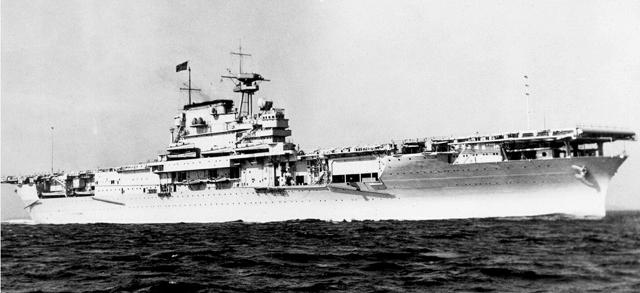
The Japanese presumed the
Yorktown to have been sunk a month earlier, at the Battle of the Coral Sea. Indeed, she had been beaten up, but the first and possibly greatest of the "miracles" of Midway had occurred in the intervening time.
Or had it?
more...
Posted by: Wonderduck at
09:16 PM
| Comments (6)
| Add Comment
Post contains 1137 words, total size 8 kb.
1
"While the US was outnumbered by the Japanese in the number of aircraft carriers present at the battle..." I think that might be a typo...
Posted by: Siergen at May 28, 2011 04:14 PM (RnayE)
2
Nope. Japanese had four carriers at Midway, US had three. Ergo, the US was outnumbered by the Japanese in the number of CVs present at the battle.
Posted by: Wonderduck at May 28, 2011 04:54 PM (n0k6M)
3
When you count the entire campaign, the disparity was even greater. There were carriers attached to the diversion force that attacked the Aleutians: Ryuujou, Junyou
There were also carriers associated with the other flotillas attacking Midway itself: Zuiho and Houshou.
Junyou was a CV; the others were CVLs. After the fourth Japanese CV was sunk, Yamamoto gave some consideration to ordering Ryuujou and Junyou to join the Midway force, to cover the landing.
But it would have taken a couple of days for them to steam that far, and the element of surprise would have been completely gone, and in the mean time the remaining American CVs (Yamamoto thought there was only one, but that was still a lot) would have been able to launch attacks on the landing force, which had been spotted by a PBY from Midway. Ultimately Yamamoto decided it was too risky.
Posted by: Steven Den Beste at May 28, 2011 05:41 PM (+rSRq)
4
As to why Yamamoto thought there was only one American carrier left, it's because the pilots who attacked Yorktown reported twice that they'd sunk it. they were wrong both times, but the Japanese command counted that as two kills, leaving only one left.
But even one American CV would have bbeen a problem, and the Midway airstrip wasn't knocked out.
Posted by: Steven Den Beste at May 28, 2011 05:45 PM (+rSRq)
5
Grr, I misread your post twice before posting. I hate to see what a mess I made of my reports at work earlier today...
Posted by: Siergen at May 28, 2011 09:46 PM (RnayE)
6
Steven, the attack on the Aleutians was no diversion. It was actually scheduled to begin on the same day as the Midway operation, but fueling problems delayed Nagumo's fleet.
You're certainly correct when you say that the
Hosho was an aircraft carrier, and it was attached to the Yamamoto's Main Body. However, if it had come down to it, she would have been worse than useless in combat. She carried eight B4Y "Jean" torpedo bombers; biplanes, slower than a Devastator, fixed landing gear... think an even more obsolete Swordfish, and you've got the picture. The
Zuiho was better equipped with 6 Zeros, 6 Claudes and 12 Kates and was part of the Invasion fleet. Neither the Main Body or the Invasion fleet were within 400 miles of Nagumo's
Kido Butai... which was part of the problem to begin with, but that's a post for another day.
Posted by: Wonderduck at May 28, 2011 11:28 PM (n0k6M)
Hide Comments
| Add Comment
May 19, 2011
The Pacific Q-Ship
In 1915, things were looking grim for the British Isles. Unrestricted submarine warfare was slowly strangling the country, cutting off the flow of supplies to the nation. Stocks of fuel, armaments, supplies and food were all at desperately low levels... the Allies were losing the Battle of the Atlantic. At that time, defenses against submarines were rudimentary at best. Sonar was non-existent, depth charges were crude and for the most part ineffective, and the homing torpedo wasn't even thought of yet. The only realistic chance that a defending ship had to sink a submarine was to catch it on the surface.
While it's hard to imagine a submarine allowing itself to be caught on the surface these days, things were different in 1915. At the time, submarines were what would be called "submersibles" today: able to descend under the waves for a short time only, while doing most of their movement on the surface. Because their underwater time was limited, a sub would "go under" only when preparing for an attack run... and not always then. The torpedoes of the time were cranky, ill-tempered beasts that were often unreliable, and always in short supply. It was quite common for a submarine to sneak up on a target, surface, then engage with a deck gun. Of course this would only work against an unarmed freighter or transport; it goes without saying that an actual warship would receive a torpedo fired from underwater.
However, even this limited method of attack was extremely effective against unarmed merchant craft... so effective that England was on the verge of starving. The obvious defense, convoying, or putting a large number of merchant vessels in one group while defending them with one or more warships, was ruled out by the ship-strapped Royal Navy. There just weren't enough warships to go around. Something had to be done, and quickly. Two innovations arose from this desperate need.
The first was the armed merchantman. More of a throwback than a true innovation, at its heart the armed merchantman was a descendant of the age of sail, when almost every East Indiaman had a good number of cannon lining its rails to fight off pirates and privateers. The generic armed merchantman of WWI-vintage would have the firepower of a destroyer or light cruiser, six 6" guns and various numbers of smaller guns as a secondary battery. Since they were built as merchant vessels, they were however fragile: little in the way of compartmentalization to prevent flooding, little if any armor (other than raw size) to prevent damage, with a slow top speed that prevented running away. Armed merchantmen were mostly for use against commerce raiders as a self-defense measure: if a warship came upon an armed merchantman, at least there was some way to fight back. However, with their guns carried on deck, they were just as likely as a battleship to attract a torpedo from a submarine.
The second innovation was the Q-ship. Take a freighter and turn it into an armed merchantman... then hide the guns inside false panels or deck structures or belowdeck. When a submarine approached, it'd see a nice big fat undefended target, surface and engage with the deck gun... at which point, the Q-boat would drop the false panels, run out the guns and with the element of surprise blow the submarine out of the water. To be sure, they could take on a surface vessel as well, but their weapons were more designed to engage fragile submarines: a hole or two would prevent a sub from diving, trapping it on the surface. Q-ships had no set armament loadout, but multiple 3" guns were common.
Despite the clever idea, Q-ships were generally ineffective against submarines in WWI, accounting for less than 10% of all kills scored. Instead, they were more of a psychological weapon, preying upon the mind of a U-boat captain. If any freighter could be heavily armed and just waiting for you to surface, the sub captain might be more reluctant to do so, and either let the freighter go or waste a precious torpedo on it.
During WWII, there was a repeat of the WWI Battle of the Atlantic, and the Q-ship concept was revived. It was even less successful than in WWI, mainly because advances in submarine technology meant that a sub could spend less time on the surface, torpedoes were much less prone to failure and in greater supply. The Royal Navy commissioned nine Q-ships in 1939, two of which were sunk on their first mission. None of them sank a U-boat, and they were quietly retired in 1941. The US Navy converted five cargo vessels to Q-ships, one of which was sunk and the other four failed to engage a submarine during their two-year run.
And then there was the USS
Anacapa.
more...
Posted by: Wonderduck at
10:09 PM
| Comments (7)
| Add Comment
Post contains 1167 words, total size 8 kb.
1
Those things are cranes, aren't they? For loading and unloading? I thought they were some sort of antenna until I saw these pictures.
Posted by: Steven Den Beste at May 20, 2011 12:04 AM (+rSRq)
2
I'd assume so, Steven. It would certainly make sense for a lumber ship to have cranes onboard.
Posted by: Wonderduck at May 20, 2011 12:08 AM (n0k6M)
3
Yes, they are cranes.
4 is a lot for such a small ship but I imagine that far upriver in the forest one might have to load very quickly to beat the tide. I imagine they stood her in good stead as an attack transport.
Posted by: Brickmuppet at May 20, 2011 08:36 AM (EJaOX)
4
...that far upriver in the forest...
The navigable rivers around here don't come anywhere near the areas where logging takes place. Logging happens up in the mountains, and though there are streams and rivers there, they're fast moving and shallow, with lots of rapids and waterfalls.
I figure that this ship was probably carrying lumber from somewhere like The Dalles down to Portland, carrying logs which had come to The Dalles by truck.
Posted by: Steven Den Beste at May 20, 2011 04:20 PM (+rSRq)
5
Would that have been the case 100 years ago, Steven? She was first commissioned in 1919 as a logging ship. She met her end in the Columbia River... the fourth largest in the nation. How far upriver could she have gone on the Columbia?
Seriously; I have no idea. I know nothing about the PacNW except for what I've seen with my own eyes (the Seattle area; I was a tourist for a week).
Posted by: Wonderduck at May 20, 2011 04:31 PM (n0k6M)
6
Yeah, it's pretty much always been that way. For one thing, a hundred years ago the river system was a lot less navigable. Before 1957 navigation of the Columbia stopped at Celilo Falls, which was flooded when the Dalles Dam was built.
There were ships above that point, but any cargo had to tranship by land to get around that waterfall because locks hadn't been built. (They were built as part of the Dalles Dam project.)
But it wouldn't have been useful for lumber purposes even so. East of there it's arid. Few trees, lots of grass, lots of sagebrush and rattlesnakes. Eastern Oregon and eastern Washington are the northern end of the Great Western Desert.
There's lots of trees in the Willamette Valley, but it's not the kind of timber that the timber industry wants (maple and birch and aspen -- good for firewood but useless for construction). What they wanted is old-growth fir, and that's up in the mountains, either the Cascade range or the Coast range, both of which are a long way away from any navigable rivers then or now.
Posted by: Steven Den Beste at May 20, 2011 06:33 PM (+rSRq)
7
It's true that the Columbia river is one of the great rivers of this continent, but it's not really like the others. When you think of a great river, you probably visualize something like the Mississippi, which is kind of like a huge, long, lake. But the Columbia drops a lot more rapidly than those kinds of rivers, and there used to be several waterfalls on it. In addition to Celilo falls, there was Cascade Falls which was covered by the lake behind Bonneville Dam in the late 1930's. And there were stretches of white water; not exactly waterfalls, but not something you'd want to muck with in a steamship, either.
Even at Portland now, the current is something like 5 knots. And because of that, the Columbia Bar is among the most treacherous waters on the planet for navigation.
One of the many unusual things about the Columbia is that it doesn't meander a lot. It can't, really. Where a river like the Mississippi is running through areas of soil, the Columbia channel runs through rock. It passes through the Cascade mountains, with volcanic cliffs on both sides, and then cuts through the Coast range. Meandering is pretty much impossible. And the channel was seriously scoured out by the Missoula Floods.
Posted by: Steven Den Beste at May 20, 2011 06:50 PM (+rSRq)
Hide Comments
| Add Comment
May 18, 2011
Name This Mystery Ship V
By popular demand, the "Name This Mystery Ship" contest is back! Here's the rules: no cheating by using photo-matching programs or things like that. Otherwise? Free game. The winner gets a post on a topic of his or her own choosing (within limits: no pr0n, religion or politics). If it looks like nobody is going to get it, I may decide to post a hint or two.
Here's the mystery ship:
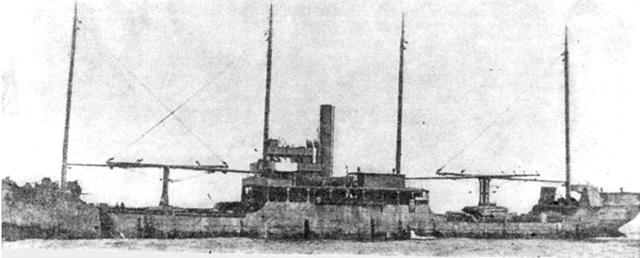
Good luck to you!
Posted by: Wonderduck at
06:16 PM
| Comments (10)
| Add Comment
Post contains 80 words, total size 1 kb.
1
To my land-lubber eyes, the rigging looks like some sort of radio gear. I searched for either a radio-navigation beacon ship, or perhaps an intelligence vessel performing radio direction finding/intercepts. Unfortunately, I could not find any vessels which both performed those missions and resembled your photo...

Posted by: Siergen at May 18, 2011 08:44 PM (ole2J)
Posted by: Wonderduck at May 18, 2011 09:00 PM (n0k6M)
3
Can duck's bill actually produce the sound "Bwah-ha-ha-ha-ha"?
Posted by: Siergen at May 18, 2011 09:12 PM (ole2J)
4
My first guess was a SIGINT ship, or maybe a RADAR picket. But I can't come up with a matching profile. The hunt continues...
Posted by: David at May 18, 2011 09:15 PM (Kn54v)
Posted by: Brickmuppet at May 18, 2011 09:27 PM (EJaOX)
6
Oops. USS Anacapa, (I figured it was a Q ship)
Posted by: Brickmuppet at May 18, 2011 09:30 PM (EJaOX)
7
Darn, now that Brickmuppet gave the name, I found it right away. For some reason I figured you wouldn't choose a Q-ship again...
Posted by: Siergen at May 18, 2011 09:44 PM (ole2J)
Posted by: Brickmuppet at May 18, 2011 10:08 PM (EJaOX)
9
@Siergen: ...again? I haven't done a Q-ship before.
@Brickmuppet: I'm not going to ask how you knew this one.
There's a good story behind the
Anacapa, which I'll tell tomorrow (oooh,
teaser).
Posted by: Wonderduck at May 18, 2011 10:53 PM (n0k6M)
10
You haven't? I could've sworn you had...
Posted by: Siergen at May 19, 2011 12:16 AM (ole2J)
Hide Comments
| Add Comment
March 30, 2011
Iowa's Bathtub
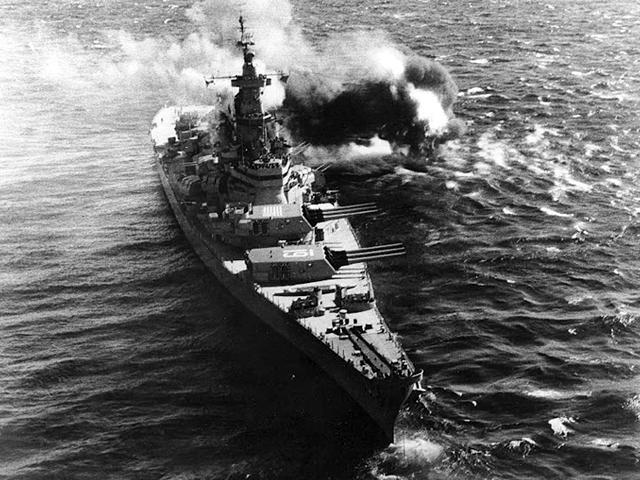
The USS
Iowa was the namesake for what was arguably the best class of battleships ever built. Launched in 1942, she was commissioned in 1943. Displacing 45000 tons, her engine rooms could still move her through the water at a blistering 33kts. Her main armor belt was 12" thick, while her three main turrets were armored to nearly 20" in thickness. Those turrets carried three 16"/50cal rifles each, and each of those guns could fire a 2700lb shell over 23 miles. Twenty 5"/38cal guns formed her secondary battery, and could be used for both anti-aircraft or anti-surface work. Four of the mammoth warships were built.
But only one had a bathtub.
Late in 1943, the heads of state for the three major Allied countries, Joseph Stalin, Winston Churchill and Franklin D Roosevelt, were to meet in Tehran for a strategy conference. The US Navy choose the USS
Iowa to take President Roosevelt on the first leg of the journey to Iran, crossing the Atlantic Ocean. But there was a small snag. President Roosevelt had developed an illness in 1921, at the time diagnosed as polio, that had paralyzed him from the waist down. He could only walk by swinging his legs laboriously via a twist of his torso, and leg braces and crutches were mandatory. FDR was also pretty much incapable of standing without assistance from one or two individuals. This ruled out his use of a shower, at the time the only form of bathing available on US warships. As the trip would take quite some time, something had to be installed for his use. That something was Iowa's Bathtub.
Who knew?
Posted by: Wonderduck at
08:02 PM
| Comments (8)
| Add Comment
Post contains 275 words, total size 2 kb.
1
Wait a minute--"at the time diagnosed as polio"? What was it, if it wasn't polio?
Posted by: Ed Hering at March 30, 2011 08:41 PM (t82kY)
2
Wait...did you photoshop in the duck?
Posted by: Brickmuppet at March 30, 2011 09:08 PM (EJaOX)
3
Ed, apparently
Guillain-Barre syndrome is the
current frontrunner. Take that for what it's worth... without a test of FDR's spinal fluid, we won't get a solid answer, and his spinal fluid is in something of short supply these days.
Muppet, I didn't. The picture was taken sometime in 1980, so FDR did not have a duckie in the tub with him.
I will say that "
Iowa's Duck" has nearly taken over first place on my "WANTWANTWANT" list from Yuno's Duckie.
Posted by: Wonderduck at March 30, 2011 09:22 PM (W8Men)
4
Assuming that the toy boat is scale model of the Iowa, the full-sized duck must be immense! It might even be the oft-prophecised Uber-Duck, Harbinger of the A-quack-alypse...
Posted by: Siergen at March 31, 2011 04:40 PM (YA1UC)
5
So, is the tub still there?
Normally, I wouldn't think so...but it *was* a Presidential Tub.
Posted by: Ben at March 31, 2011 04:40 PM (gze3w)
6
It was there in 1980 when that picture was taken. Can't think of any reason they'd have removed it since then.
Posted by: Steven Den Beste at March 31, 2011 07:01 PM (+rSRq)
7
Looks like there's been a coup here... (ahem)
Posted by: Steven Den Beste at April 01, 2011 01:08 AM (+rSRq)
8
Late information has crossed my desk; as of the
Iowa's recommissioning in 1985, the tub was still there.
Posted by: Wonderduck at October 02, 2011 10:32 PM (o45Mg)
Hide Comments
| Add Comment
March 16, 2011
Midway Tragedy
Roughly halfway between the west coast of America and Japan, there lays a small atoll consisting of two significant islands and a handful of smaller ones, mostly surrounded by a low-lying reef. Called "Midway" for obvious reasons, it was first a location for guano mining. Later, Pan Am used the atoll as a stopover point for their "China Clipper" service. As World War II approached, the US military recognized it as having an important location for the defense of the west coast. Barracks, runways, gun emplacements, a seaplane base, and even a submarine base appeared, seemingly overnight.
Of course, we remember Midway as the namesake location of one of the most important battles of any sort in history. One aspect of Midway atoll that seemingly every history of the Battle remarks upon are the ubiquitous avian residents, the Laysan Albatross.
Better known as the Gooney Bird for their goofy, clumsy appearance on land, nearly a million of these birds live on Midway today, and there's no reason to think any fewer were there during WWII. Gooneys are known to have extremely long lives, with the oldest known to be over 60 years old, and possibly older. It's quite possible that some Gooneys alive today were present on Midway during the battle.
Lost among the tragic news reports coming out of Japan in the wake of the magnitude 9.0 earthquake and huge tsunami that followed it, were bulletins from Midway atoll. Sand Island, the largest of the islands that make up Midway, was 20% covered by water from the tsunami's five foot tall waves, while Eastern Island had been 60% covered. Spit Islet, the largest of the minor land masses that make up the atoll, was completely inundated. As a result of this, over a thousand adult Gooney birds were killed, and many thousands of flightless chicks were drowned as well. "
We may see just a slight decline in breeding birds next year, next year
and the year after that," said Barry Stieglitz, project leader for the Hawaiian and Pacific Islands National Wildlife Refuges. "
There will be a gap in the breeding
population when these birds that would have grown up this year, would
have matured and started breeding for the first time."
Posted by: Wonderduck at
09:46 PM
| Comments (2)
| Add Comment
Post contains 374 words, total size 3 kb.
1
I've never seen a picture of the (avian variety) Gooney Bird before. Hope the populations recover quickly.
Posted by: Pixy Misa at March 17, 2011 08:57 PM (2yngH)
2
They've got disturbingly human eyes. If I weren't told that these were photographs, I'd think they were stills from a CGI movie like
Madagascar.
Posted by: Mitch H. at March 18, 2011 12:35 PM (jwKxK)
Hide Comments
| Add Comment
March 15, 2011
Genesis Of An Aircraft Carrier
In 1905, the Imperial Japanese Navy (IJN) showed the world that is was at least the equal of any Western navy by its complete domination at the
Battle of Tsushima. In this climax to the Russo-Japanese War, the Japanese battle fleet, commanded by Admiral Togo, annihilated the Russian Second Pacific Squadron at the cost of three small torpedo boats.
By 1906 though, the Japanese fleet was made obsolete by the appearance of HMS
Dreadnought in the British Royal Navy. Realizing that evolving technology had laid their fleet to waste (and terrified by that fact), the IJN made plans for a new and improved fleet of ships. Called the "Eight-Eight Fleet", it was to be based around eight new
Dreadnought-style battleships and eight cruisers. Designed to be capable of going toe-to-toe with the US Navy, even at this early date thought to be Japan's most likely foe, this battleline was considered the only way the nation of Japan could be made safe. Though the country had been practically bankrupted by its war with the Russians, the first batch of ships was approved in 1911.
Events on the other side of the world again worked against the IJN's plans. While Japan had sided with the Allies in World War I, for all intents and purposes she had little to do with the European theater of war. Instead, she had little spats with far-flung German possessions in the Pacific. Meanwhile, the war in the Atlantic led to massive improvements in naval technologies for the combatants there. Suddenly, the IJN again found themselves with seemingly obsolescent ships while their rivals had honed their fleets against the whetstone of war.
The decision was made to scrap the first Eight-Eight fleet plans and start a second. This second fleet was to be built around a nucleus of the newest vessels of the first, two completed battleships of the
Nagato-class, two
Tosa-class battleships that were in the process of being built, and four
Amagi-class battlecruisers that were in various stages of construction. They were to be joined by four battleships of an unnamed class that was to carry 18" guns, and four "fast battleships" to accompany the battlecruisers.
The
Amagi-class was to tip the scales at over 41000 tons, be capable of 30kts, and carry ten 16" guns on a hull some 826 feet long. As with all battlecruisers, the
Amagis were not particularly well-armored; they were designed to be able to outgun anything they could outrun (cruisers of all sizes and destroyers), and outrun anything that outgunned them (battleships, mostly). While in retrospect it's clear that the battlecruiser concept was deeply flawed, the thinking of the time was that speed, not armor plating, would be a battlecruiser's best defense.
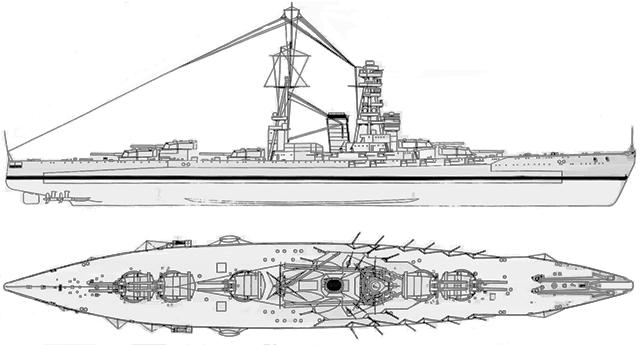
Tosa-class battleship
The
Amagi's heavier teammate on the battleline, the
Tosa-class battleship, was paradoxically smaller than the battlecruiser in most ways. Coming in at just under 40000 tons and 760 feet long, they were to cruise at just over 26 knots. Armed with ten 16" rifles of the same type carried by the battlecruisers, their secondary battery of twenty 5" guns compared favorably to that carried by the
Amagi. As with most battleships, the
Tosa's armor was to be its strong point. In short, the
Tosas were to slug it out with opponents while the
Amagis danced in and out of the battle.
In 1922, the IJN's plans again had to be scrapped when Japan became a signatory to the
Washington Naval Treaty. This attempt to curtail the growing naval arms race ongoing between Britain, America, Japan, France and Italy placed an upper limit on the size of any ship built of 35000 tons. All work on the four battlecruisers and two battleships came to a halt, in preparation for scrapping. With the stroke of a pen, both the
Amagi-class and the
Tosa-class, like the
British N3 and G3 designs, had been invalidated.
Or almost so. The Treaty placed an upper limit on the size of aircraft carriers of 27000 tons. However, a provision of the treaty, insisted upon by both the Americans and the Japanese, allowed for the conversion of two ships of a maximum weight of 33000 tons each to aircraft carriers. The US Navy selected two
Lexington-class battlecruisers for conversion. The IJN chose two of their
Amagis, the namesake of the class and the
Akagi, to be subjects for their conversions. The remaining battlecruisers were broken up and scrapped.
And then nature stepped in.
more...
Posted by: Wonderduck at
12:40 AM
| Comments (2)
| Add Comment
Post contains 1528 words, total size 12 kb.
1
Another sweet article, Duck.
When are you going to cover CL55?
Posted by: The Old Man at March 15, 2011 10:58 AM (TcNy+)
2
Thanks for the great article! And since it was an article that I "won" in one of your ship identification contests, does this mean it's time for another?
Posted by: Siergen at March 15, 2011 04:54 PM (Gqqsw)
Hide Comments
| Add Comment
March 04, 2011
The Littlest Aircraft Carriers
In the 100 years that navies have taken airplanes to sea, there have been some truly
creative methods employed to get an organic aircraft capability onto ships. Barges towed behind destroyers. Launching platforms on the turrets of battleships. Explosive catapults on the bows of merchant ships. Submarines with floatplanes. Merchantmen with a rudimentary flight deck laid over their cargo areas. The list could go on forever, but none of them were really a success.
During the Allied invasion of Sicily, there was a need for artillery spotting airplanes. The usual plane used, the L-4 Grasshopper (better known in civilian use as the famous Piper Cub), didn't have the range to actually fly to Sicily from Allied bases, and aircraft carriers decks were too valuable to ferry them there. Having them transported in a knocked-down state was possible, but it was time-consuming to have to put them back together. Knowing all this, a US Army pilot named Captain Brenton Devol, suggested a solution: put a flight deck on a
LST. And lo, was the tiniest aircraft carrier created.
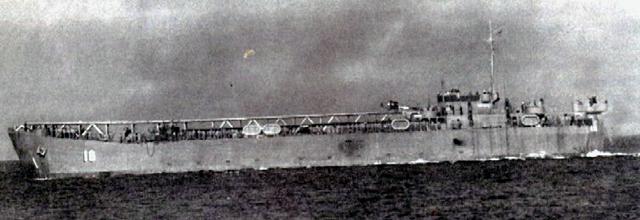 LST-386
 was fitted with a flight deck made of timber and pierced metal runway mats. It measured 216 feet long by 12 feet wide, and it took just over 36 hours to build. It could carry four Grasshoppers, plus its normal load of cargo and troops in her tank deck.
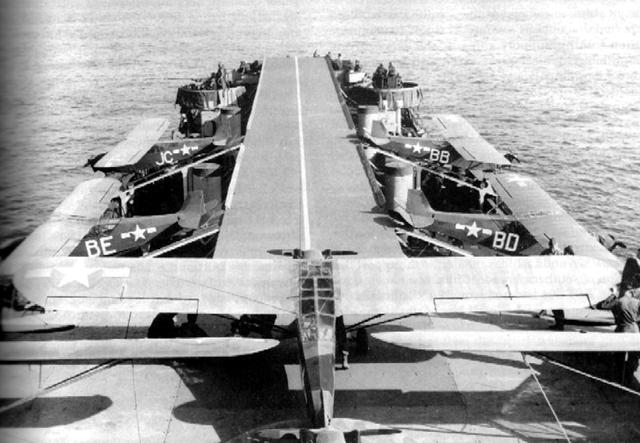
Sign #14 that pilots are insane.
The conversion was so successful that five or six other LSTs were fitted with their own flight decks. As time went on, the design was refined to allow nine Grasshoppers to be carried. Four of them, shown above, were carried on minuscule ramps, while the other five were on a platform just ahead of the bridge. The LST would go as fast as she could into the wind, usually winding up with a 20kt breeze to aid the L-4s into the air. The lightweight plane would fairly skip into the sky with that amount of help. Accidents were not unheard of, but all in all the LSTCV was a successful and useful design.
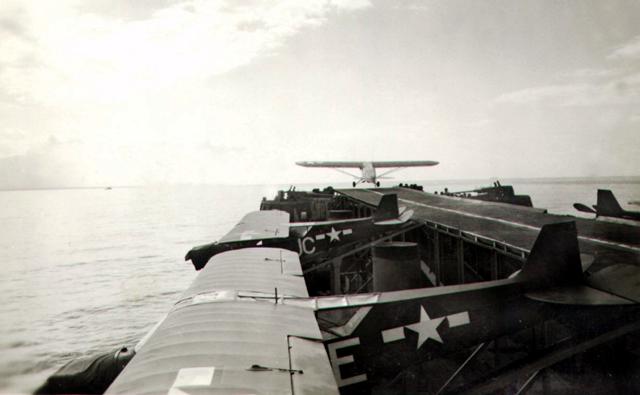
However, these LST conversions could not
be considered
true aircraft carriers. There was no provision for recovering the L-4s after launch; the planes would have to land behind friendly lines after takeoff. Considering the short-field capabilities of the Piper Cub, one could imagine a scenario where the LST would steam backwards while a white-knuckled pilot tried to land on the narrow pitching deck. It
could work, but it seems unlikely.
But out in the Pacific theatre, something different was invented... something that was allowed a LST to become a true aircraft carrier. This something was called the Brodie Device.
more...
Posted by: Wonderduck at
11:54 PM
| Comments (5)
| Add Comment
Post contains 799 words, total size 6 kb.
1
I don't know how i first found your internet site but you fucking rock, i love reading these stories, any time you want to come to Normandy give a shout i live there
Posted by: Thomas at March 05, 2011 08:14 PM (2tkjS)
2
There was an amazing amount of improvisation done by people near the front who had problems to solve. There was the way that the B-25 Mitchell was converted from a high level bomber to a tree-top strafer by "Pappy Gunn" in Australia, for use in New Guinea. That one was so successful that engineers from North American Aviation made the perilous trip to Australia to look at the modified units, and then went back to the US and started building strafer versions in the factory.
There were also "Hobart's Funnies".
This trick with the LST is right in character, and I really believe that it worked well. But the first pilot to try to land with that Brodie device has to been certifiable...
Posted by: Steven Den Beste at March 06, 2011 01:05 AM (+rSRq)
3
I remembered another case of field modification: the steel teeth that got welded to the fronts of tanks in Normandy to deal with the hedge-rows.
Posted by: Steven Den Beste at March 06, 2011 01:36 AM (+rSRq)
4
The LST proved to be a
very modifiable
design. Other than the LSTCV, some modifications I can think of off
the top of my head include the Hospital version, rocket barrage ships,
and anti-aircraft LST that was used off of Okinawa to supplement the
radar picket destroyers. If someone told me they made a version that carried nothing but ice-cream makers, I'd believe it.
Funny you should mention the B-25... I was just reading a book that had a big section on it. The Strafer Mitchells had one shortcoming that they never entirely managed to fix in the field. The extra weight from the nose machineguns screwed up the plane's center of gravity, so they never quite flew right. It was easy for the pilot to compensate, but the plane wasn't the same. The "official" Strafers fixed that.
Posted by: Wonderduck at March 06, 2011 02:06 AM (W8Men)
5
Proud to say that Brenton A Devol is my grandfather and he is the most STUDLY human being I have ever had the good fortune of gracing my presence with. Smart, quick witted, innovative (obviously from this article) and a true gentleman.
Thanks for this site! Freaken awesome as I look for more info. on him on this Veterans Day (here in the US).
Posted by: Charles at November 11, 2011 05:21 PM (yw3E5)
Hide Comments
| Add Comment
January 17, 2011
CV-1
In 1918, the Royal Navy commissioned the world's first ship to be easily recognizable as an aircraft carrier, the HMS
Argus. In 1922, the Imperial Japanese Navy commissioned the first ever ship designed and built as an aircraft carrier, the
Hosho. In between, the US Navy sent to sea the first of an unbroken line of carriers that led directly to today's nuclear-powered supercarriers.
But on the face of it, the American carrier had a very odd beginning.
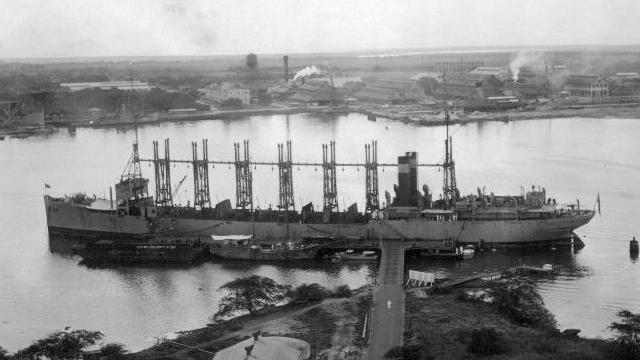
The USS
Jupiter (AC-3) joined the fleet in 1913 as the first electric-drive ship in the US Navy. A collier, her job was to provide underway replenishment to the fleet. This task led to her most distinctive feature, the vertical towers, called kingposts, amidships. These were structural supports for coaling booms, which would be lowered when a ship was alongside. Coal would then be sent down the booms to the decks of the receiving vessel.
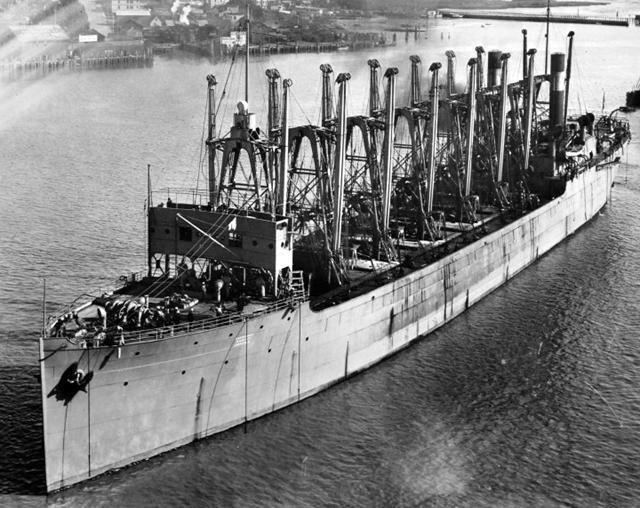
These kingposts proved to be one of the reasons she was selected to become the basis for the first US aircraft carrier.
more...
Posted by: Wonderduck at
12:21 PM
| Comments (5)
| Add Comment
Post contains 1006 words, total size 8 kb.
1
What was the first purpose-built carrier in the world? Was it Lexington (CV-2)? Or some other nation?
Posted by: Steven Den Beste at January 17, 2011 04:50 PM (+rSRq)
2
IJN Hosho was the first ship designed from the keel up as a carrier to be completed. HMS Hermes was probably the first designed, but was completed later.
I should mention that there is some minor debate on this because both ships has convoluted development histories and changed so much in the design process that here is some doubt as to when one can say they were "designed".
First takeoff from a ship was done by the USN, as was the first landing on a ship.
As to the invention of the carrier as an operational concept....That's the UK all the way. They developed the aircraft carrier in WW1 via a series of conversions of fast ferries, liners, battleships being built for export and a crazy uncategorizable THING that made much more sense when they put a flight deck on it.
Posted by: Brickmuppet at January 17, 2011 05:53 PM (EJaOX)
3
Eh, not so much debate as all that. It's generally accepted that the
Hermes was the first designed, the
Hosho first built. If you use the all-big-gun battleship as the yardstick, then the
Hosho is the first purpose-built carrier.
See, the HMS
Dreadnought was the first battleship to use an all big gun armament... or, at least, the first to be completed. The Japanese Navy had designed the
Satsuma before the British ship, but because there was a gun shortage, the
Dreadnought was completed first. From then on, ships with the all-big-gun layout were known as "dreadnoughts" instead of "satsumas."
Occidental bias? Never heard of it...
Posted by: Wonderduck at January 17, 2011 09:06 PM (W8Men)
4
But I thought that the
Dreadnought's claim to fame rested not only on her big guns, but also on her steam turbine engines which gave her great speed. It was the combination of the two in one vessel which rendered all existing warships (including the
Satsuma) obsolete.
Posted by: Siergen at January 17, 2011 10:07 PM (Gqqsw)
5
Nope, solely the realm of the guns. The turbines were a bonus, but it was the uniform main battery (of 12" guns) that made the
Dreadnought a dreadnought.
Posted by: Wonderduck at January 17, 2011 10:24 PM (W8Men)
Hide Comments
| Add Comment
January 16, 2011
The Seaplane Tender That Changed The World
After that headline, you're probably rolling your eyes... what seaplane tender changed the world?
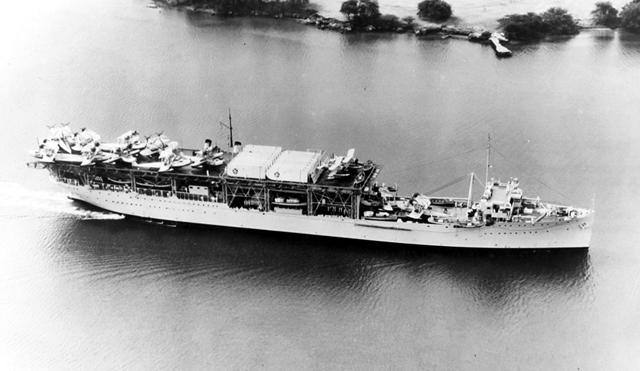
That one... and I'm working on a ship profile on it. I intended to have it up tonight, but it's not happening. It will be up sometime Monday, as I've got the day off, so look forward to it!
(ps - no, this isn't a "name that ship" contest, I just wanted to put a teaser picture up, though if you want to take a shot, go ahead)
Posted by: Wonderduck at
08:47 PM
| Comments (4)
| Add Comment
Post contains 89 words, total size 1 kb.
Posted by: Brickmuppet at January 16, 2011 09:24 PM (EJaOX)
2
That's not the Langley. The Langley was a converted collier and it had a flight deck extending its entire length. (
See picture here.)
Posted by: Steven Den Beste at January 17, 2011 02:03 AM (+rSRq)
3
Oh, rats. I scrolled further down and there was another picture. I stand corrected.
Posted by: Steven Den Beste at January 17, 2011 02:04 AM (+rSRq)
4
I almost fell for the same trap as Steven did, I went to wikipedia, so the first pictures and said to myself "nope, not the Langley." But I then thought, "well, if it's not the Langley, what else could it could it be?" So I read further, and saw the exact picture Wonderduck has posted above.
The wikipedia article on the ship was fairly terse, I'll be interested to see what our host has to say on the subject.
Posted by: David at January 17, 2011 11:10 AM (rj+nH)
Hide Comments
| Add Comment
January 03, 2011
The Forgotten Hero Ship
In my own personal shorthand, there is a category I call 'hero ships.' These vessels, for one reason or another, just stick in the mind as incredibly important... even if they really weren't in the grand scheme of things. Sometimes it's just because they have a cool name, sometimes it's because they seemed to be in the midst of all the action, sometimes it's because they were particularly influential. Ships like USS
Enterprise, or HMS
Ark Royal (the greatest name for a ship ever). The IJN
Yamato is a 'hero ship,' even though it didn't do much in WWII. So are the
Bismarck and the HMS
Hood, fated to be forever joined on history. The doomed USS
Indianapolis and USS
Arizona. There are probably dozens of others in my head, ships that anybody with any knowledge of WWII have heard of.
Then there's the ship we're discussing here. Imagine if you will a vessel that was present at the following battles: the Doolittle raid; Midway; the attacks against the Solomons; Guadalcanal; New Georgia; Wake Island; the Gilbert Islands; the Marshall Islands; Truk; the Marianas battles; Luzon; the naval raids on the Japanese home islands; Iwo Jima; Okinawa; Tokyo Bay. She also just missed the Coral Sea.
And yet, nobody considers her a 'hero ship'... and they really should. For without her and her sisters, the US would have had a much harder time of it in the Pacific War.
more...
Posted by: Wonderduck at
10:07 PM
| Comments (7)
| Add Comment
Post contains 711 words, total size 6 kb.
1
And any day during which I learn something new and interesting cannot have been a wasted day. Neat stuff, this.
Posted by: GreyDuck at January 03, 2011 11:43 PM (7lMXI)
2
I admit that when I saw your list of battles I guessed you were talking about Saratoga.
Posted by: Steven Den Beste at January 04, 2011 12:04 AM (+rSRq)
3
My first thought was the Saratoga, too. But knowing Wonderduck, I figured he'd write about something less well known, such as a seaplane tender like the Tangier. Of course it was something else. Nice post.
Posted by: Vaucanson's Duck at January 04, 2011 01:01 PM (XVJDy)
4
Well done, as usual. Thanks for continuing your articles regarding WW2 ships - you give me a viewpoint I haven't considered. But I told you that before....
Posted by: The Old Man at January 04, 2011 01:42 PM (+LRPE)
5
Thanks, Duck! Items like this are why I keep coming back.
A validation of the old maxim - logistics wins wars.
Posted by: UtahMan at January 05, 2011 05:14 PM (p1tb6)
6
"Amateurs study tactics; professionals study logistics."
-General Omar Bradley (allegedly)
Posted by: Wonderduck at January 05, 2011 07:23 PM (JvPfH)
7
"G-dammit, boys, they're gettin away!"
-signalman on the
Fanshaw Bay, scrappiest escort carrier in the Pacific Fleet, as Kurita's task force retired from Leyte Gulf
It's not true that Kurita lost the war in an afternoon - the Philippines were not a crucial theater of battle. But never did Japan come so close to winning its decisive battle than they did that day. And nothing stood between Japan's last great naval task force and the annihilation of MacArthur's forces at Leyte, except for the converted merchantmen of Taffy 3... which must have rode low in the water on account of the brass balls sported by every sailor in the group. It's one thing to win an elaborate fencing match of fleet versus fleet, but an eighteen-inch-gun battleship versus escort carriers? That's some David vs. Goliath there.
Which just goes to show. Logistics are fine and good, but logistics is fighting too, especially in a naval war...
Posted by: Avatar_exADV at January 06, 2011 02:29 AM (mRjOr)
Hide Comments
| Add Comment
November 23, 2010
The Misfit Battleships
When one thinks of battleships, what leaps to mind? The gleaming
Iowas, usually. Others would think of the hulking
Yamato-class, still the largest battlewagons ever built. Or perhaps the menacing
Bismarck and
Tirpitz, pride of the Kriegsmarine would hold primacy over all. If you have a sense of history, classes like the
Nevada/
Pennsylvania, with their cage masts and one of which, the
Arizona,
is now one of the US military's most hallowed sites. Or the first of them all, the
Dreadnought.
And then there's me. I'm a weirdo, because my favorite battleship class is one that few people know or (historically) care about. You see, I'm a fan of the
Nelsons.
I can hear you now: "The whichnow?" These:
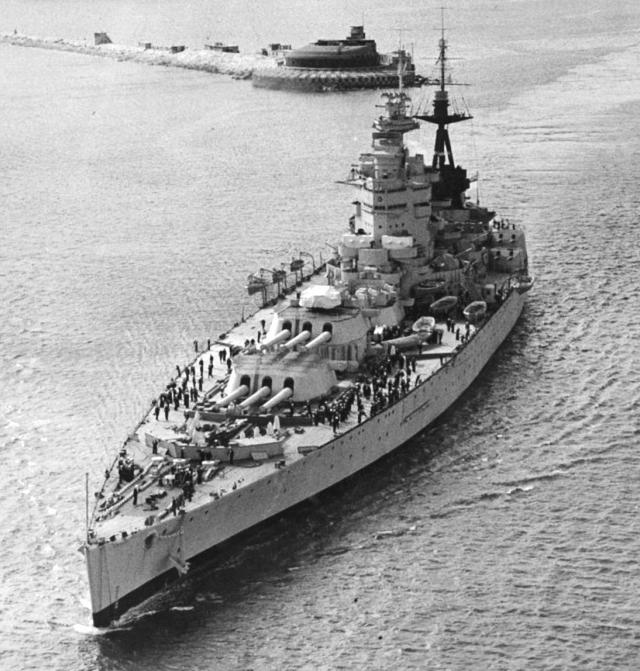
The sharper-eyed amongst you have already noticed the obvious difference.
more...
Posted by: Wonderduck at
10:23 PM
| Comments (2)
| Add Comment
Post contains 1199 words, total size 9 kb.
1
Dang, got me. I didn't spot that 3rd turret in the first photo. I realize they'll never build battleships again despite the wishes of some of the old boys in the US Marine Corp, but sometimes I play a mental fantasy about how and what it would take to build a modern equivalent for shore bombardment.
Posted by: toadold at November 24, 2010 12:57 AM (aErmb)
Posted by: Ben at November 24, 2010 07:15 PM (gze3w)
Hide Comments
| Add Comment
202kb generated in CPU 0.2605, elapsed 0.3989 seconds.
63 queries taking 0.3382 seconds, 332 records returned.
Powered by Minx 1.1.6c-pink.