December 07, 2009
68 Years
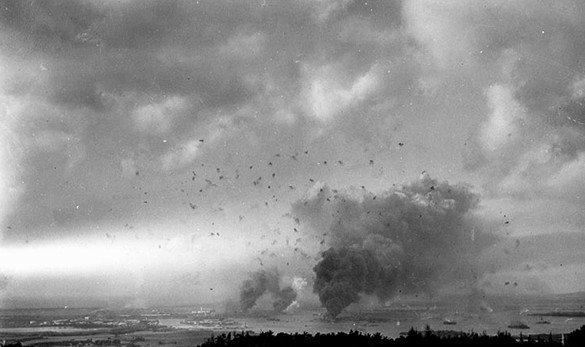
Pearl Harbor, 12/7/1941
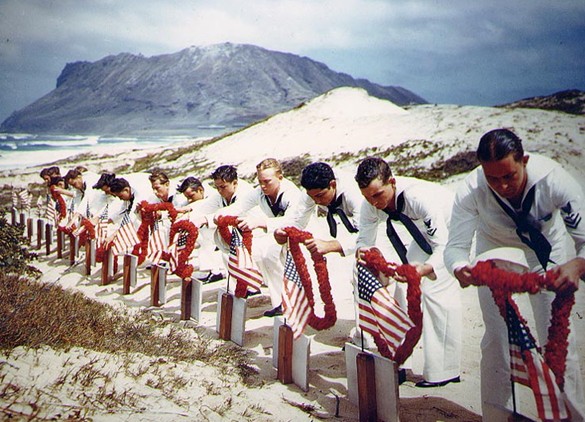
Ceremony for those killed at NAS Kaneohe, Memorial Day 1942.
Posted by: Wonderduck at
09:34 AM
| Comments (1)
| Add Comment
Post contains 15 words, total size 1 kb.
1
Microsoft's Bing had a picture of the Arizona Memorial as its backdrop today.
Google's front page didn't commemorate anything. Just plain vanilla.
Posted by: Steven Den Beste at December 07, 2009 07:53 PM (+rSRq)
Hide Comments
| Add Comment
November 30, 2009
Dive Bomber
Back in the early days of dive bombing, the British Air Ministry attempted to answer the question "what IS a dive bombing attack?" In their definition, which was generally accepted by the various air forces, when the aircraft drops its bombs while descending at an angle of 20 degrees or less, it was executing a shallow glide bombing attack. From 20 to 60 degrees, it was a steep glide bombing run.
However it was only when the pilot guided his craft into a plummeting descent of between 60 and 90 (also known as 'straight down') degrees that he was performing that most accurate, deadly and dangerous manuever, a dive bombing attack. It was dive bombing that blew open the way for Germany's blitzkrieg across Europe. It was dive bombing that helped pummel Pearl Harbor's facilities and airbases. It was dive bombing that killed
HMS Hermes, the first aircraft carrier to be sunk by aircraft. It was dive bombing that sank four Japanese aircraft carriers at Midway. It was (mostly) dive bombing that shut off the flow of supplies to the Japanese soldiers at Guadalcanal. One could go so far as to argue that dive bombing won the naval war in the Pacific.
Yet it was the dive bomber that disappeared from the lineups of the various air forces almost as soon as World War II was over. Why?
*THE PLANES
For all intents and purposes, there were four major planes designated as Dive Bombers in World War II. Oddly, the worst of the bunch is the one that's best remembered and is thought of as the prototypical DB.
The
Ju87, better known as the Stuka, was used by Germany as heavy artillery. Luftwaffe liason officers were attached to Wehrmacht units as what we would now call forward air controllers for Close Air Support. The Stuka would be called in to pummel strongpoints with the type of accuracy only available to dive bombers. The Luftwaffe had better designs to chose from when the time came to begin preparing for war but the Stuka had the support of Ernst Udet, who was the Director-General of Equipment. However, it was quite slow when carrying the usual bombload of 1100lbs, maxing out at about 150mph. In comparison to the other planes on this list, it had a very short range of about 300 miles It was also quite unmanueverable and could be hacked out of the air in immense numbers by even small amounts of fighters. When escorted by fighters, however, the Stuka could be very effective. It was able to dive vertically when executing an attack, which was devastating against stationary targets. After the Battle of Britain, where the Stuka's weaknesses were brought to stark light, the plane should have been withdrawn from action. Germany had no choice but to use it throughout the war, in upgraded forms, as there was no replacement. Despite all this, it is images of the Stuka, stooping upon a target with its landing-gear-mounted sirens (called "Jericho's Trumpet" by crews) wailing, that leap to mind when the public thinks of dive bombing.
The
Aichi D3A (Allied code name 'Val'), was the primary dive bomber of the Imperial Japanese Navy for most of the Pacific War. A contemporary of the Stuka, it flew slowly enough that drag from the fixed landing gear was not considered an issue. It was rather sturdy for a Japanese warplane, yet manueverable enough to be able to hold its own against fighters when unladen. While it generally could not dive as steeply as the other planes on this list, when combined with the highly experienced pilots of the IJN it was phenomenally accurate. During the Indian Ocean raid at the beginning of 1942, Vals caught the British cruisers
Dorsetshire and
Cornwall 200 miles off of Ceylon and scored on 85% of their attacks, sinking both ships in minutes. Later, Vals participated in the attack on
HMS Hermes, scoring 40 hits from 70 planes. With a maximum speed of 240mph (less with bombload) and a maximum range of 915 miles, it was perfectly suited to naval war in the vast ranges of the Pacific Ocean. Its main weakness was that it could only carry a 551lb bombload, which was marginal against larger vessels.
The
Douglas SBD, or Dauntless as it was commonly known, was used by the US Navy and Marines throughout WWII, though it was supplanted by the SB2C Helldiver in 1944. It was never entirely replaced, however. With a top speed of 255mph and a range of 770 miles without a bomb, the Dauntless was also quite nimble, racking up quite a few kills against the Japanese Zero. Early in the war, it was common to see Dauntlesses acting as anti-torpedo-plane interceptors, though this practice stopped when the number of fighters carried by US carriers was increased. It could carry a 1000lb bomb. The Dauntless is credited with singlehandedly sinking six Japanese carriers, including four in one day at the Battle of Midway. When carrying a bombload however, the Dauntless only had a combat radius of about 200 miles or so, fairly short in the Pacific. It was also used by the Army Air Force as the A-24, but was generally unsuccessful, more from a lack of institutional enthusiasm for dive bombing than poor performance.
The
Curtiss SB2C Helldiver was the ultimate in dive bombers. Able to carry a ton of bombs (or a torpedo) in an internal bay, it could go nearly 300mph with a maximum range of 1200 miles (unladen). A big plane, it was rather unmanueverable and complex to maintain. After early teething problems were ironed out, though, it became quite a useful bomber, participating in all major actions in the later years of the war in the Pacific. It was never as popular amongst aircrews as the Dauntless, being nicknamed "Beast" or "Son of a Bitch 2nd Class", though later versions of the plane were undoubtably better in every way than the smaller SBD. Due to a lack of targets, the Helldiver didn't ring up a large kill total of ships, though they were instrumental in the sinking of the Yamato and Mushashi, the IJN superbattleships.
Other dive bombers in World War II included the British
Blackburn Skua, the Soviet
Pe-2 and
IL-2, the
Vought SB2U Vindicator, the German
Ju88 and the Japanese
Yokosuka D4Y Suisei, which was the only plane that could argue the SB2C's title as "best dive bomber."
*THE TACTICS
Dive bombing was much more than just "point yourself at the target and dive".
A dive bomber would approach a target from around 10-15000 feet altitude, dropping in shallow dive down to about 5000-7000 feet. Upon reaching the push-over point, a dive bomber would throttle back to about 50% maximum power, extend their dive brakes, and begin a steep dive down to around 1000 feet. Each plane would reach a different high speed during this dive (the Stuka would hit around 350mph, while the Dauntless would hover around 240mph). Upon reaching its release altitude (again, around 1000 feet), a pilot would retract his dive brakes, increase throttle and pull up steeply at around 5g. Again, depending on the plane and the bravery of the pilot, the altitude would bottom out around 500 feet or less as the dive bomber rapidly exited the area.
Against an immobile target, a squadron of dive bombers would approach and dive from different directions so as to confuse the defending antiaircraft guns. As always, however, coming out of the sun was usually the preferred method of attack, so as to limit the defender's visibility.
Against a ship, however, the rules were different. In a perfect setup, a squadron would dive heading upwind and in the direction of the ship's travel (heading from stern to bow, in other words). The planes would all attack from the same direction, one after the other, in line astern. A vigorously manuevering target, however, did cause some headaches for a pilot. He would have to change the attitude of his plane to follow the ship's path, all the while hanging against his seatbelt/harness.
Early in the war, particularly for the Japanese, it was nearly impossible to shoot down a dive bomber after it began its dive with anti-aircraft guns. Early gun directors could not deal with a plane moving at high speed and shedding appalling amounts of altitude in a short time, making a plunging dive bomber nearly invunerable. Indeed, during the Battle of Midway, Japanese AA managed to shoot down only one Dauntless. The best defense against a dive bomber at this time was to shoot it down during its approach, usually with a fighter.
*THE END OF A WEAPON
It was improvements in anti-aircraft fire that spelled the end of the dive bomber, however.
By the end of the war, it was practically suicidal for any dive bomber to approach an American ship. More (and better) AA guns, under radar direction, using proximity fuzes, could blow any plane out of the air at long ranges. It was bad enough for a torpedo plane, having to fly in a straight line at a relatively low speed, but at least they could stay a good distance away from their target and still release their weapon. For a dive bomber, however, which basically had to overfly its target, they were sitting ducks. By the end of the war, a Japanese naval vessel, which never carried a particularly large number of AA guns even under the best of circumstances, could expect that it would have the number of AA guns doubled or tripled from what it had carried at the beginning of the war.
And though the Axis powers never developed the proximity fuze for their AA guns, when you're putting enough bullets in the air you often didn't need them. German anti-aircraft guns were fearsome indeed, which is one of the reasons the Allies didn't use dive bombers much in Europe. Indeed, the RAF and FAA, who are often credited with creating and formalizing the concept of dive bombing, never had more than a couple of squadrons of dive bombers at any time during WWII. This despite the benefits of the type being on display against them in Poland, Belgium and France. The reason given was that it would be too costly in men and machines, and it's hard to debate the point.
Another reason for the disappearance of the dive bomber was the rise of what is now called the multi-role aircraft. The F4U Corsair, for example, could perform steep diving attacks nearly as well as the Dauntless despite the lack of dive brakes, had a longer range, and could carry a greater weight of bombs to boot. The P-47 Thunderbolt was another excellent fighter that could double as an attack plane, as was the Focke-Wulf Fw190. Using a fighter to do a bomber's job, and perhaps do it better to boot, made a lot of sense, particularly in the crowded hangar decks of an aircraft carrier.
The massacre of a squadron of dive bombers by such technology as a surface-to-air missile could easily be imagined, but by that time the dive bomber was no more.
*EPILOGUE
The dive bomber, in some ways, still lives on today. It's not hard to see modern precision guided munitions (or "smart bombs") as the direct descendant of the bombs dropped by Stukas, Dauntlesses and Vals. To continue the analogy, the air-dropped torpedo became the stand-off missile (such as the Tomahawk cruise missile or Harpoon anti-shipping weapon).
However you look at it though, today's attack pilot still needs to do the same thing as the dive bomber: put a bomb on a relatively small target with skill and precision.
This post is dedicated to Mort Price, USMC, Dauntless rear-seat gunner.
Posted by: Wonderduck at
10:39 PM
| Comments (7)
| Add Comment
Post contains 1962 words, total size 13 kb.
1
I think Il-2 could only do shallow dives. Initially its main application was anti-armor work, and it was reflected in the design. It had two long-barrel 23mm cannons that easily penetrated top and rear armor of anything up to and including Pkzf-IV, and usually carried cluster bombs PTAB.
Pe-2 was a true dive bomber, despite having 2 engines, and not being able to dive at full 90 degrees. One of the favourite tactics was "Polbin's wheel" (after Col. Polbin, its inventor), when each aircraft only released one bomb and doubled back in line. The continuous pummeling denied an effective resistance from the ground.
As for Stuka being obsolete, well, it was. But then again, Rudel! The deadliest man in an aircraft, ever.
Posted by: Pete Zaitcev at December 01, 2009 12:29 AM (/ppBw)
2
The Il-2 could do just about anything you told it to, Pete. It's one of the most remarkable planes of WWII. Ground attack, dive bombing, there's even some record of it carrying out torpedo attacks. The only thing it
couldn't do is defend itself from fighters.
So I listed it under "other".
I'm not entirely sure the Val could do a 90-degree dive, but it sure as heck was a DB... the Pe-2 surely counts as one.
Posted by: Wonderduck at December 01, 2009 12:50 AM (C32SO)
3
I think it might be worth mentioning that when it came to ship-based AA, there were three kinds. They used heavy machine guns, and 40 mm artillery, and 5" DP guns.
The first two kinds could elevate quite a lot, but the 5" guns, which were the most effective, pretty much could not. I'm not even sure the 40 mm guns could elevate 90 degrees. HMG's could, but they were useless against any target above about 2000 feet.
So one reason dive bombers did well compared to torpedo planes was that when you were coming straight down you were out of the view of the most dangerous guns that would like to shoot at you.
The F6F could also carry a 2000lb bomb, and late in the war US carriers tended to carry about three quarters Hellcats and about one quarter Avengers.
Posted by: Steven Den Beste at December 01, 2009 01:08 AM (+rSRq)
4
The 5"/38 caliber gun used throughout WWII on all US Navy combatants could elevate to +85º in Dual-Purpose mode. The 40mm Bofors L/60 could do a full 90º. The L/50 version could only do 80º, though.
The 5" didn't usually fire vertically; it's job was to smack planes out of the air before it got that close.
Posted by: Wonderduck at December 01, 2009 01:18 AM (C32SO)
5
Great article, Wonderduck. I'd never given much thought to why dive bombing disappeared after WWII - or why I heard it so rarely mentioned in European accounts aside from German Stukas.
Oh, and a suggestion for a future post: the last dive-bomber, the
Skyraider. (Didn't see much action as a dive-bomber, but that was its original reason for being.)
Posted by: UtahMan at December 01, 2009 12:49 PM (p1tb6)
6
Wow! Super post!!! I was going to pass up on it since I know nothing about dive-bombers and next-to-nothing about WWII. But I started to read it and it sucked me right in. I loved it! Now hopefully I will be able to remember what I read. I love history, but cannot retain the details about anything --- not names, dates or places! Nada! Which is why I majored in math and computer programming in college. Anyway...thanks Wonderduck!!! XOX
Posted by: Gerberette at December 01, 2009 10:54 PM (0erIh)
7
Well... Chechelashvili, for example, is credited with 2 Bf-109, 2 FW-190, 1 Ju-88 individually (which alone made him an ace - of Il-2!), and 10 more aircraft as a part of group. So it was largely down to the ability of pilot and rear gunner, some of whom were credited with a2a kills as well. In modern terms, the key with Il-2 was angles fight at the deck, but of course nobody taught Il-2 pilots how to do it.
Posted by: Pete Zaitcev at December 02, 2009 01:05 AM (/ppBw)
Hide Comments
| Add Comment
November 23, 2009
The Japanese "Saving Private Ryan"
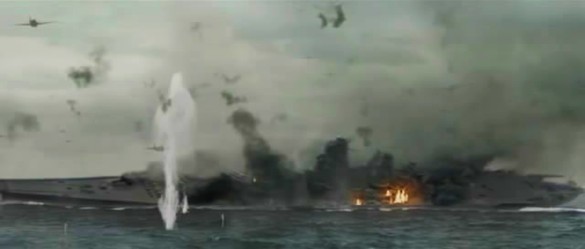
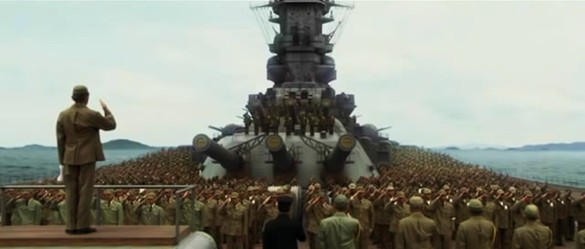
Otoko Tachi no Yamato, or "The Men of Yamato" in English, tells the story of the final sortie of that famed battleship. Not from a strategic standpoint, mind, but from that of her men. The script isn't brilliant, but you do know and care about these sailors by the time the American carrier planes begin to appear as the battleship approaches Okinawa.
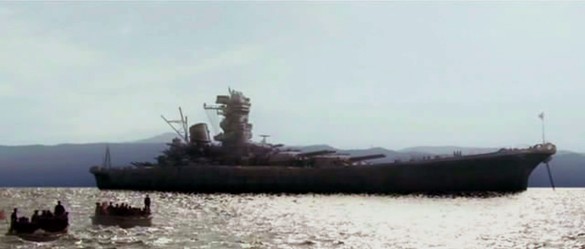
But the main character in this movie is the Yamato herself. No expense was spared in the making of this epic film, including a 1:1 scale set of the forward section of the ship, and the port side of the island area (the anti-aircraft guns in particular) that cost ¥600 million (nearly $7million).
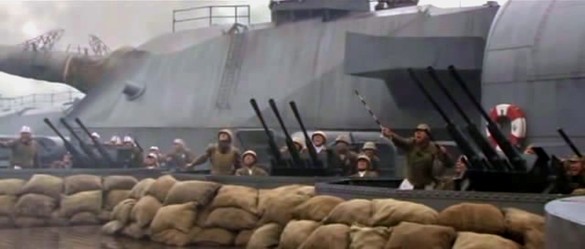
While the producers did wind up reusing a lot of the CG footage in the two major battle scenes, it's barely noticeable amidst all the chaos of war. And make no mistake, this movie pulls no punches when it comes to the combat... if you can't stand the sight of blood, this is not the movie for you.
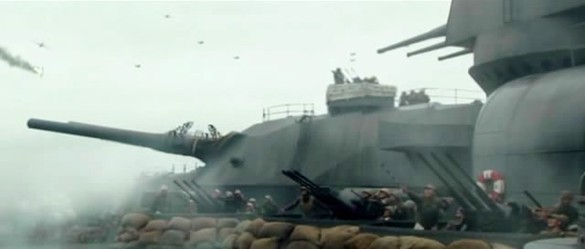
If you can stomach seeing people opened up by machine-gun rounds and the deck running red with blood, however, what you'll get is a war movie that ranks up near the top of the list. It's not as good as
Saving Private Ryan or the HBO miniseries
Band of Brothers, true, but it's lightyears ahead of, say,
Tora Tora Tora or
Midway.
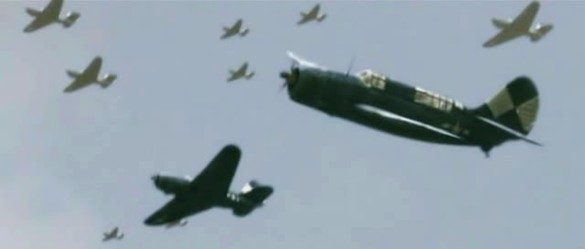
While this screencap makes it look obvious that we're looking at models or CG, in motion it's nearly flawless. The amount of detail is immense, both in the planes and in the Yamato herself.
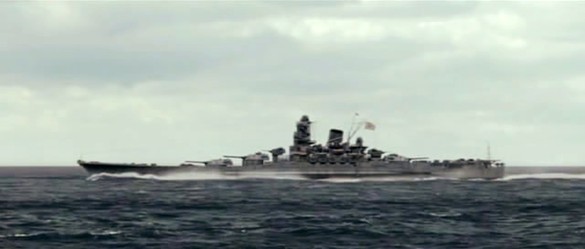
But when the final attack begins, the great ship goes to hell in a hurry. You barely notice that the whole fight is nearly 30 minutes long.
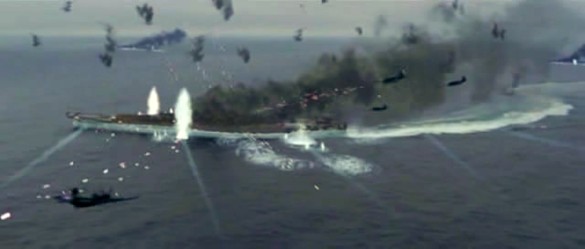
The sailors aren't supermen. There's no "one man shooting down a squadron", or even a single plane, like you might see in an American war movie. They're just there to serve the guns, and die. And die they do, in droves.
If you can find a copy of the movie, I recommend it heartily. It's well-done, historically accurate, and beautifully shot. You get the feeling that you're watching a documentary on the shipboard life of the Yamato, rather than a feature film, but it's never dull, despite the 2-1/2 hour length.
It's not perfect, but it's plenty good, and a fitting tribute to the men who crewed her.
Posted by: Wonderduck at
09:51 PM
| Comments (7)
| Add Comment
Post contains 409 words, total size 3 kb.
1
It was the ultimate kamikaze mission. It's sad to see that many good men sacrificed for essentially no gain.
There was virtually no chance of Yamato succeeding in the mission it was assigned, and even if it had succeeded it would have been a bad ending for a good ship. Their orders were to beach the ship and to use their guns to provide fire support for the infantry, for as long as fuel and ammunition lasted.
But between code breakers reading Japanese dispatch orders, and picket submarines seeing them coming, and Mark Mitscher's carriers, they had no chance of getting close to Okinawa. One afternoon of flying by a fraction of the American planes in the vicinity, and Yamato was doomed.
It was actually a dive bomber that administered the death blow, though it took a long time to make a difference. One of the very first bomb hits set off fires that were never controlled. Eventually the fires reached the magazine for number 2 turret and set off the ammunition there, causing the ship to blow in half.
Simply a waste of good men.
Those pictures look fabulous. Did you managed to acquire a DVD?
Posted by: Steven Den Beste at November 24, 2009 12:30 AM (+rSRq)
2
No, I'm afraid it's just a rip I found online. 640x272 resolution, so it's REALLY widescreen, but also really small: 2.5 hours, 1.5gb filesize.
It's never been released here, it appears.
Posted by: Wonderduck at November 24, 2009 08:24 AM (C32SO)
3
Actually, the Yamato had already capasized and sunk by the time the magazine exploded. The US Navy had learned a lot when they sank her sister Musashi at Sibuyan Sea during the Battle of Leyte Gulf (Namely, have all the torpedo bombers consistently go after one side of the ship - spreading the torpedoes on both sides just made the Japanese damage control efforts easier.). And it was later determine that magazine 1 was the one that exploded - which might not have been from the fires caused by the bombing (The primary bomb load-outs of the dive bombers and fighter-bombers from Task Force 58 was geared to knocking out the topside stations - it would have taken a properly dropped 2000 lb AP bomb to break through Yamato's deck armor.).
And the truly frightening part? Task Force 58 only used the aircraft from 2 1/2 of her 4 carrier groups to sink the Yamato and her escorts (One carrier group was conducting UNREP at the time and could not arrive back in time. Another one had most of their strike get scrambled due to awful weather.). Most of the Japanese were shocked at the sheer number of American aircraft coming at them - each time the first couple strike waves finished, the Japanese thought the Americans had shot their bolt...Right up until the next wave arrived.
I do like how they managed to get the SB2C Helldivers correct.
Anyone who does not read Japanese could do a lot worst than read A Glorious Way to Die by Russell Spurr, which covers both the Japanese and American side of the battle. It is definitely not the most authortative book, but definitely the most readable. The most emotionally powerful book available is supposed to be the translation by Richard Miniter of Requiem for Battleship Yamato, which was written by her assistant radar officer. Never read it myself, but it has an excellent reputation by those who have.
C.T.
Posted by: cxt217 at November 24, 2009 03:24 PM (QSek/)
4
You can see it starting to roll over in that second-to-last screencap, by the way. There's no clear shot of it making the final tumble in the movie; it's merely implied by the cinematography.
Posted by: Wonderduck at November 24, 2009 06:35 PM (C32SO)
5
I feel like an idiot not looking for the DVD when I went to Japan in August. Great movie, great Hisashi soundtrack. You really get some insights into the heart of Japanese culture. Especially how the characters prepare for death on what everybody knows is a pointless mission. You have to think what might have been different if those lives and so many others had not just been wasted.
Posted by: Jcarlton at November 27, 2009 06:24 PM (mKHVN)
6
I'm not sure how to really translate the title effectively; Yamato is the noun, so it's not really the men of Yamato, it's the men's Yamato. Perhaps "Our Yamato" would work, given the point of view.
The DVD is on sale for ¥2992 on Amazon Japan, and I've been meaning to put in an order soon, so I'll pick up a copy. Even at the current heart-breaking exchange rates, that's not a bad price.
It looks like the author has a lengthy non-fiction version of the story, plus two novels, the second one titled Onna-tachi no Yamato. Its cover picture and blurb make it sound like the framing story that IMDB describes for the film.
-j
Posted by: J Greely at November 28, 2009 10:50 AM (2XtN5)
7
Hey C.T.
I'm sorry to have to be the guy to tell you this, but EVERY aircraft carrier that could launch airplanes in Task Force 58 sent aircraft to try to sink the Yamato task group! EVERY ONE of the twelve aircraft carriers sent out aircraft - ALL of Task Groups 58.1 (4 carriers), 58.3 (5 carriers) and 58.4 (3 carriers).
And Russell Spurr's book is better than nothing, but it is replete with errors. If this were to be a person's only source about the attacks on the Yamato task group, then a person's knowledge would be very slanted indeed. I have listed a bunch of Mr. Spurr's errors, and can make them available if you're interested.
Yamatodebunker
Posted by: David F. Anderson at December 27, 2009 01:06 PM (2kPCR)
Hide Comments
| Add Comment
November 06, 2009
Remember That Torpedo 8 Detachment?
The first combat experience of the Grumman TBF (latter named the Avenger) came at the Battle of Midway, with a detachment of planes from Torpedo 8. We all know how that turned out: five TBFs shot down, and the sixth a flying sieve.
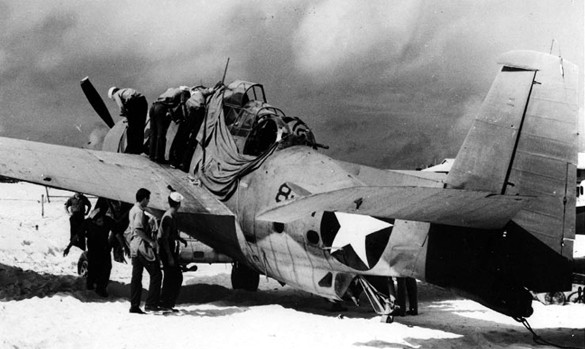
The pilot of the surviving TBF was Ensign Bert Earnest. He later went on to fight with VT-8 at Guadalcanal. He retired from the Navy as a Captain. Along the way, he earned a Purple Heart, two Air Medals, and
three Navy Crosses.
Albert K Earnest, CAPT USN (RET) passed away on October 26th at the age of 92.
May he rest in peace.
Posted by: Wonderduck at
06:23 PM
| Comments (15)
| Add Comment
Post contains 112 words, total size 1 kb.
1
Considering your interest the WW II Pacific theater, I was wondering if you could answer a question that has been nagging at me for years. I have read several books which state:
Because they had armored decks, British carriers suffered less damage in Kamikaze attacks than the wooden-decked American carriers.Although I have seen this claim in several books, I have never seen any mention of Pacific battles involving British carriers. Which battles against the Japanese (if any) involved British carriers?
Posted by: Siergen at November 08, 2009 02:47 PM (pnoBR)
2
Siergen, the Royal Navy participated in the Okinawa campaign and the carrier raids against Japan afterwards.
Their Okinawan contribution was substantial, actually. While they weren't directly involved in the battle for Okinawa, they were positioned between Formosa and Okinawa, attacking island airfields and making it difficult for the Japanese to reinforce and strike from that direction.
While it's true to an extent that armored flight decks did protect the RN CVs against kamikaze attacks, they had serious drawbacks as well. The obvious one is the limitation the armored decks placed on the size and number of planes the carriers could embark. RN CVs carried somewhere between half to 2/3rds as many aircraft as their USN counterparts, and it became very clear that the best defense against the kamikaze wasn't armor, but fighter cover. Near as I can find, the RN suffered about 75 kamikaze attacks, and had four carriers hit. The USN had to deal with about 1900 kamikaze attacks... and had four fleet carriers hit. Having a lot of fighters in the air helped protect the fleet a lot more than the armored decks did.
The other, hidden, cost of the armored flight deck became clear after the war. RN CVs
Formidable and
Illustrious were both hit by kamikazes. Post-war, both carriers suffered fires in their hangars. The
Formidable's was caused when a Corsair fell off an elevator and its guns fired. The fire was contained entirely within the hangar box, which acted like a furnace. Her hull was actually deformed by the blaze, resulting in her being scrapped. This amount of fire damage wouldn't've occurred in the non-armored USN CVs.
Illustrious' fire was a small fuel explosion that an
Essex-class CV wouldn't've noticed. The RN CV's hangar, however, contained the explosion completely, again causing deformation.
In both cases, however, damage surveys a few years later found that the kamikaze impacts caused serious hull stresses previously unexpected. The armored deck did stop them planes from getting inside the hull, yes, but it also transferred the impact damage to the hull itself.
Even if the later fires hadn't occurred, the two carriers probably would have been scrapped quickly. Even those armored carriers that didn't have fires onboard were soon scrapped post-war, and in those ships that had been hit by kamikazes, there was varying amounts of hull damage caused by impact shock.
So the armored flight deck worked to an extent, yes, but it had huge drawbacks, too.
By the way, today's
Nimitz-class CVNs are technically armored deck carriers, and in theory could suffer the exact same sort of hull damage from missile impacts. In practice, though, they're so much larger than the WWII-era RN CVs that the threat from such damage is minute: something big enough to cause hull damage to a
Nimitz via shock effect would be big enough to cause serious damage conventionally. Hull shock would be the
least of the carrier's worries at that point.
Posted by: Wonderduck at November 08, 2009 03:45 PM (4Mcos)
3
Part of the reason that the RN CVs carried fewer planes is that all the steel used in the armored flight deck weighed a hell of a lot, so the ship simply didn't have enough extra floatation to carry as many planes as a USN CV.
Of course, the only way to find these things out is to try them. And there were experiments tried by the RN that were successful. For instance, they were the ones who found a safe way to land Corsairs on CVs, so they switched over from the Hellcat sooner. (The Hellcat was a fine plane, but the Corsair was better.)
Posted by: Steven Den Beste at November 08, 2009 04:33 PM (+rSRq)
4
Thanks for the very detailed response! I wonder why the books I've read didn't cover the British involvement at all. I can understand why some authors chose to concentrate on the bloody invasions and the fire bombing of the Japanese cities at that stage of the war. However,
none of the books I've read covered British naval activities in the Pacific after their loses during the initial Japanese expansion.
Posted by: Siergen at November 09, 2009 06:17 PM (TJQ10)
5
There was also a period in 1943 where the US was down to two CVs in the Pacific, and Enterprise was urgently in need of several months in drydock. That left Saratoga the only US CV available for the Solomon area, and by that point it had become amply clear that CVs shouldn't operate alone if it could possibly be avoided.
So the British loaned us HMS Victorious to operate as part of a task force with Sara. (In radio signals, Victorious was referred to as
#USS_Robin">USS Robin.)
Posted by: Steven Den Beste at November 09, 2009 07:40 PM (+rSRq)
6
Well, that was interesting. Here's the URL I intended to link with:
#USS_Robin">http://en.wikipedia.org/wiki/HMS_Victorious_(R3 #USS_Robin
Posted by: Steven Den Beste at November 09, 2009 07:41 PM (+rSRq)
7
One more try:
http://en.wikipedia.org/wiki/HMS_Victorious_(R3
#USS_Robin
Posted by: Steven Den Beste at November 09, 2009 07:41 PM (+rSRq)
8
I give up. You'll have to search for the article yourself.
Posted by: Steven Den Beste at November 09, 2009 07:42 PM (+rSRq)
Posted by: Wonderduck at November 09, 2009 08:30 PM (4Mcos)
10
Siergen, the recent book by Max Hastings,
Retribution, gives quite a bit of coverage to the Brits at the end of WWII. Now, to be clear, he pays more attention to their activities in India, but if my memory serves there's a good bit on their naval contribution.
There's a trade version of
Retribution available, and it's well worth the $20 or so it'll cost. Oh, and ignore the WaPo review on the Amazon page: it tilts so far to the left I'm surprised it didn't cause my monitor to fall over.
Posted by: Wonderduck at November 09, 2009 08:37 PM (4Mcos)
Posted by: Siergen at November 09, 2009 09:06 PM (TJQ10)
12
Ack! I meant to type "Steven", not "Steve"...
Posted by: Siergen at November 09, 2009 09:21 PM (TJQ10)
13
Can't claim that I am, Siergen... looks interesting, though.
Posted by: Wonderduck at November 09, 2009 09:28 PM (4Mcos)
14
Churchill was pretty insistent on the British contributing in some fashion - in his history, he mentions several times that he did not want it to be said that the British accepted American help when they were under threat, but didn't reciprocate in helping defeat the Japanese.
That said, the specific contributions they made were somewhat limited - they didn't have a whole lot of naval force in the region, they kept a fleet in the Bay of Bengal, and the time between V-E and V-J didn't leave them enough to get major Atlantic fleet assets into the Pacific. (I didn't get the impression that they were vigorously planning such a move, but a lot of that was a desire not to have British fleet elements wholly dependent on an American supply train.)
Churchill had a lot of good things to say about practically everybody, but curiously, he hardly mentioned MacArthur at all. I got the impression that Churchill didn't have a whole lot of contact with him and didn't have a particularly good opinion of him - there were a couple of exchanges that you could interpret as "yes, we'd be glad to help you out, even if that means our units end up having to coordinate with MacArthur." Honestly, I don't know if there was something specific there - certainly MacArthur had a lot more contact with the Australian government than most American commanders, and since Australia was a Dominion... but no, nothing at all from that.
(Then again, Churchill had actual bad things to say about Australian politics, which cost him a couple of divisions at a time when the British couldn't afford them; it's entirely possible any transfer of antipathy would be going in the other direction! But at the same time, I don't have a lot of use for MacArthur myself - good shogun, lousy general, at least from his WW2 performance.)
Posted by: Avatar at November 09, 2009 10:24 PM (pWQz4)
15
MacArthur was actually a pretty good general, or he could be. The military conduct of the New Guinea campaign was very competent and effective; you have to give him credit for that.
MacArthur's problem was that he thought he was better than he really was. That's a pretty serious flaw in a top commander.
I think Churchill's insistence on participating in the Okinawa campaign was completely appropriate.
Posted by: Steven Den Beste at November 09, 2009 10:40 PM (+rSRq)
Hide Comments
| Add Comment
August 09, 2009
The Best Of The Jeeps
Escort, or 'Jeep', carriers, were wartime conversions of merchant hulls. In 1942, as the US "auxiliary" carrier program spun up to full gear, every available
C-3 hull, which was the preferred base design for conversion, had been earmarked for the
Bogue-class escort carrier.
The
Bogue-class was a relatively unsophisticated design, essentially slapping a flight deck on top of the hull, and changing the old main deck to a hangar. While effective, more hulls were desperately needed to escort convoys in the Atlantic and support operations in the Pacific. To overcome the shortfall, the powers-that-be tagged four
T-3 tanker hulls for conversion.
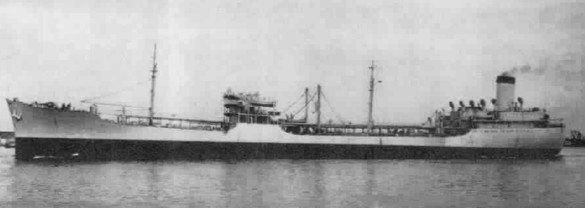
T-3 Esso Trenton before conversion to USS Sangamon
The US Navy wasn't particularly fond of this idea. The one type of ship in even shorter supply than carriers were fast fleet oilers, designed to accompany warships and provide fuel and other supplies to short-legged ships in the vast ranges of the Pacific ocean, and the T-3 filled that bill. However, the Navy wasn't given a choice, and the four ships were taken into Norfolk Navy Yard, Newport News, Puget Sound Navy Yard and Bethlehem Steel.
The resulting
Sangamon-class was considered the best of the converted Jeep carrier classes.
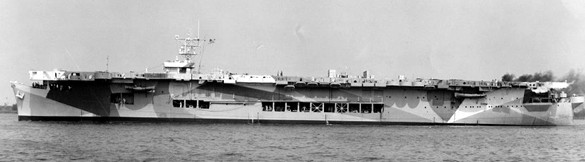
USS Santee, CVE-29
Longer, heavier and faster than the preceding
Bogue-class, and the basis for the subsequent purpose-built
Casablanca-class (which was smaller and lighter, and just 1kt faster), the
Sangamons could (and often did) carry 36 planes.
Unlike every other escort carrier class, the four
Sangamons were able to embark any carrier plane in the Navy arsenal, save for the Helldiver and the Corsair. The usual air complement was between 12-18 Wildcats and around the same number of TBF Avengers, though the
Sangamon and the
Santee occasionally carried the Dauntless dive-bomber. The
Suwannee and the
Chenango never did, for one reason or another.
They displaced 24100 tons (full load), as opposed to 16600 tons for the
Bogues. Unsurprisingly considering their tanker origins, they carried nearly three times as much fuel as well, giving them a range of 24000 nautical miles @ 15kts (the
Bogues range was just over 10000nm). They also had a huge bunkerage for airplane fuel. As a matter of fact, they could carry more fuel than a
Yorktown or
Lexington-class fleet carrier, and only a bit less than the
Essex-class, despite being about 350 feet shorter. In effect, the
Sangamon-class were self-escorting tankers.
All four began their service life in late 1942, covering the North Africa landings of
Operation Torch. Immediately following, they transferred to the Pacific. Three of the four were hit by kamikaze (the
Chenango avoided that fate, but suffered severe damage when a F6F crash-landed on her deck and smashed into planes parked forward). The class as a whole suffered three kamikaze hits, four bomb strikes, and a submarine torpedo hit, yet all four survived... again, testament to the survivability of their larger-sized tanker origins.
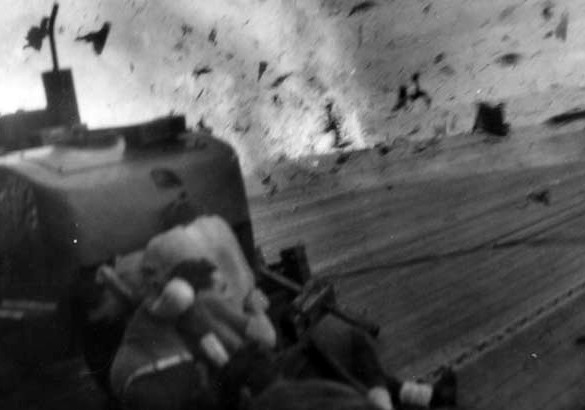
Santee takes a kamikaze hit
As with all ships in WWII, their AA guns were substantially increased from their starting armament. Unlike most others classes, however, the
Sangamons handled the near-doubling of their guns without any topweight problems, owing to their tanker origins.
The only thing that separated them from CVL status was their speed. 18kts maximum was pretty good for a transport, and excellent for an escort carrier, but much too slow to operate with the battle fleet, where 25-30kts was considered standard. That's about the only statistic that the
Sangamons were inferior to the
Independence-class CVL.
All four ships of the class survived the war, earning 41
battle stars between them. The
Chenango and
Santee continued in US Navy service as CVHEs (Carrier, Helicopter, Escort) until the late '50s. The
Suwannee was put into the mothball fleet. The
Sangamon, amusingly, was returned to commercial service in her original tanker configuration after the war, until she was scrapped in 1960.
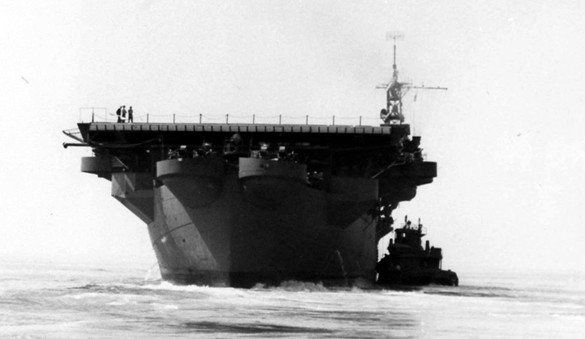
The end of Sangamons.
For ships that were considered 'expendable', not a bad history.
Posted by: Wonderduck at
02:11 PM
| Comments (9)
| Add Comment
Post contains 660 words, total size 7 kb.
1
The thought of being on a somewhat slow, thin hulled ship filled with AV gas and ordnance tends to make my nether regions pucker, and yet they survived.
Posted by: toad at August 10, 2009 12:57 AM (Pe1td)
2
War ain't safe. No ship in wartime is safe.
Posted by: Steven Den Beste at August 10, 2009 10:21 AM (+rSRq)
3
A friend of mine in Japan told me about her father, who was a doctor, shipping out on a hospital ship. It got torpedoed coming out of the harbor, and he had to swim back to shore...
I saw the Bowfin's battle flag at the memorial in Hawaii, and noticed that it had a bus on it. If they figured out how to torpedo a bus, you can't really be safe on a ship...
Posted by: Avatar_exADV at August 10, 2009 04:18 PM (pWQz4)
4
My memory and Google Fu is weak these days. There is the possibility that the Bowfin got the bus with with her deck gun. However there was an incident in which an American sub fired a torpedo at a small coastal vessel close inshore. The torpedo missed the vessel, ran up a shallow beech, and hit a train engine. I can't find the record though so I'm going to call it legend.
Posted by: toad at August 12, 2009 06:20 AM (c6lyc)
5
There was a case where a sub sent a party ashore in rubber boats at night in Japan, and set an explosive charge on a railroad track and blew up a train. The train ended up on their battle flag.
But they didn't do it with a torpedo.
Posted by: Steven Den Beste at August 12, 2009 12:07 PM (+rSRq)
6
Russians attacked coastal guns with torpedos when retaking Novorossiysk, apparently with some success, although mostly from gun crews being thrown around by the blast rather than destroying actual guns and encampments.
Posted by: Pete Zaitcev at August 12, 2009 01:03 PM (/ppBw)
7
It's certainly true that torpedoes have been used for things other than sinking ships.
They were the preferred weapon for destroying dams, for instance. Or would have been except that everyone defended against them with torpedo nets.
But I don't think I've heard of a case where someone deliberately tried to hit something well above water line by shooping a torpedo up to shore and trying to make it jump above water line. They just weren't that kind of projectile, not to mention being too damned expensive for that kind of crap.
If a sub saw a train ashore, it would be more likely to fire on it with the deck gun. I think that story is apocryphal, likely caused by someone seeing the battle flag I talked about and making up their own story about how it happened.
Posted by: Steven Den Beste at August 12, 2009 07:57 PM (+rSRq)
8
Well, OK, maybe the Russians did it. But it's not the kind of thing the Americans did.
Posted by: Steven Den Beste at August 12, 2009 07:57 PM (+rSRq)
9
Ah, found the story on Wikipedia. Evidently the torpedo was a miss, it exploded upon hitting a dock, and the bus was blown into the water. Still counts! ;p
Posted by: Avatar at August 12, 2009 11:43 PM (vGfoR)
Hide Comments
| Add Comment
June 04, 2009
What If #3: Midway... Timing Is Everything
In the previous post,
reader Toad asks:
If the American torpedo and dive bombers had managed to make a coordinated attack per doctrine how much difference would it have made if any on the number of Japanese carriers sunk and damaged?
It would, indeed, make a difference, but perhaps not the way you may be expecting.
As in life, love, baseball and comedy, the Battle of Midway is all about timing. Disrupt the timing of the American attacks, and you disrupt the outcome. Throughout the morning of June 4th, 1942, American planes ran in on
Kido Butai. At no time during the day, until the famous plunge of the Dauntlesses, were these attacks coordinated or in greater than squadron strength. Also at no time during the day, until the big attack, were American fighters effectively on the scene (there were Wildcats on the scene when VT-6 made its run, but they were high above the fight waiting for a radio call on a different frequency from a different squadron).
The easiest way to describe the effect of all these seperate attacks had on the Japanese fleet is to borrow a phrase from land combat:
suppressive fire. The carriers were too busy "keeping their heads down" and tossing the occasional grenade (or Zeros, in the case) at their attackers from behind cover to launch their own attack on the US carriers.
The sequence of events went like this:
Shortly before 6am, the Japanese carriers were spotted by Midway-based PBYs.
*Around 620am, the Japanese strike on Midway Island began.
*At 7am, TF16 (
Enterprise,
Hornet) began launching their strike against the Japanese.
*Between 705am and 730am, the VT-8 detachment flying from Midway and a handful of B-26s carrying topedoes attack the Japanese carriers. During this time, Admiral Nagumo, commander of
Kido Butai, orders that his reserve force of carrier planes be rearmed for land attack.
*Around 745am, Tone #4, the infamous late scout plane, discovers and reports the presence of American carriers. Nagumo reverses his rearming order.
*At 755am, two unrelated attacks on the Japanese carriers come in. First, a flight of B-17s arrive overhead. At the same time, a green squadron of Dauntless dive bombers from Midway, led by Major Lofton Henderson, begin a glide bombing attack. This attack is dealt with sternly, and is over by 815am or so.
*At 8am, TF17 (
Yorktown), which had been in charge of scouting for the morning, launches its planes.
*At 805am, the Midway strike planes return to
Kido Butai and wait for the American attacks to be driven off.
*Around 820am, a second group of dive bombers from Midway, this time
SB2U Vindicators, attacks and is beaten off.
*Around 835am, the SB2U and B-17 attacks come to an end.
*Immediately thereafter, recovery of the Midway strike force begins.
*Around 910am, the last planes from the strike force touch down.
*At 915am, VT-8 attacks. By 935am, all of the torpedo bombers are shot down.
*At 940am, VT-6 attacks. This attack is over by 1010am.
*At 1010am, VT-3 is spotted.
*At 1020am, VB-3 and VB-6 attack
Kido Butai.
*By 1030am, the
Soryu,
Kaga and
Akagi are mortally wounded.
*Around 1040am, VT-3's survivors make their torpedo attacks and leave the field.
From this timeline, it can be seen that the Japanese carriers had no time to even
prepare to launch an attack on the American CVs. The only open stretch available to them was between 835am and 910am, the time when the Midway strike force was being recovered. They could have spotted and launched an attack during this stretch of time (even though the re-rearming of the reserve planes wasn't yet complete), but only at the risk of losing many of the Midway strike planes to fuel depravation or pilot injuries. Japanese doctrine at the time did not allow for, say,
Hiryu and
Kaga to launch an attack while
Soryu and
Akagi recovered planes. Doctrine called for massed airpower using large numbers of planes in a balanced, coordinated attack. This would swamp the target's defenses and allow for maximum damage to be inflicted while minimizing casualties. There was never any thought to leaving the Midway strike dangling, because that's not how the Japanese carriers worked.
So, what would have happened if a coordinated American strike had been launched and all the attackers arrived on target at the same time?
The answer, as mentioned before, comes down to
timing.
more...
Posted by: Wonderduck at
10:44 PM
| Comments (3)
| Add Comment
Post contains 1570 words, total size 12 kb.
1
Also IIRC the Japanese carriers were behind the curve on ship board fire fighting techniques and equipment. When the bombs ignited the ordnance and fuel of the aircraft, aviation gas fuel lines on the carriers were subsequently ruptured. Again IIRC they had no way to flood or purge with CO2. The disaster cascaded.
Posted by: toad at June 04, 2009 11:12 PM (WmNXR)
2
Well, they did have a way to CO
2-flood the hangar decks, involving metal curtains that would divide each into three areas. The areas could then be flooded with CO
2. Unfortunately for the
Kaga and the
Soryu, based on where they were hit, bomb fragments almost certainly shredded the curtains, preventing the areas from being flooded.
The
Akagi was a different story. Her lone hit probably didn't damage the curtains, but it probably did blow her center elevator all the way down. The wreckage, and probably bomb fragments, almost certainly would have destroyed her CO
2 tanks. Oops.
Posted by: Wonderduck at June 04, 2009 11:22 PM (hlGBx)
3
While the American attack could be called a piece meal commitment of forces it did result in a non-piece meal defeat of the Japanese.
Maybe Bismark was right, "God looks after drunks, children, and the United States of America."
Posted by: toad at June 04, 2009 11:26 PM (WmNXR)
Hide Comments
| Add Comment
A Miraculous Day, A Tragic Day
June 4th, 1942.
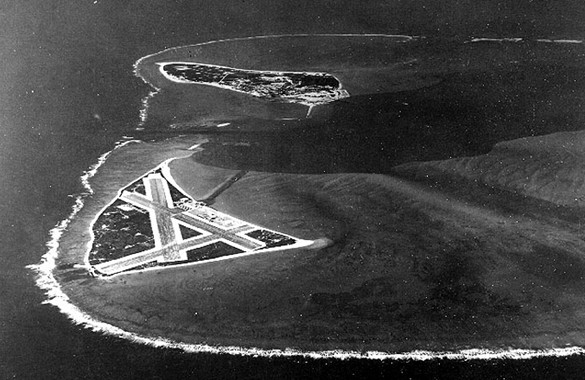
Midway Island.
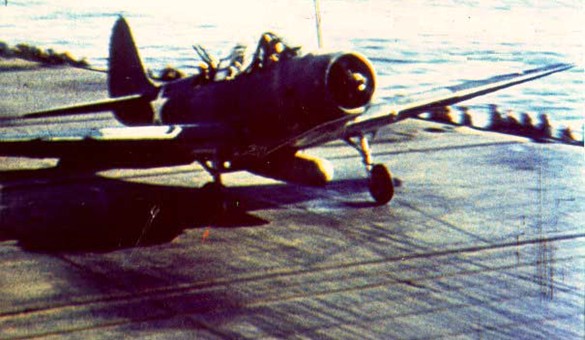
John Waldron, Commander of Torpedo 8, takes off from USS
Hornet around 7am.
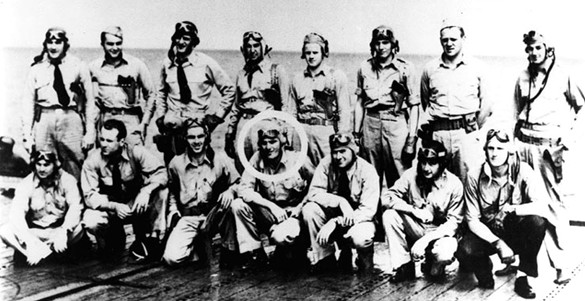
Waldron's Torpedo 8 attacked the Japanese fleet at 920am. By 940am, all of the men in this picture save for Ensign George Gay (circled) were dead.
Their loss, along with the savaging of Torpedo 6 off the
Enterprise and Torpedo 3 from the
Yorktown, a total of 36 out of 41 TBD Devastators launched, prevented the four carriers of the Japanese force from launching their own airstrike. Then the Dauntless dive bombers of the fleet arrived... and the rest is history.
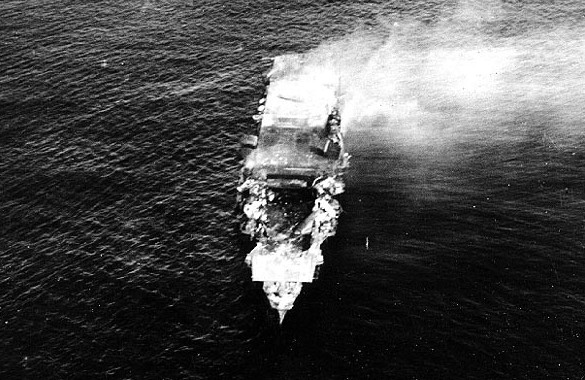
Japanese carrier
Hiryu, pummled by multiple bomb hits,
burns later in the day. She would sink shortly after this picture was taken.
The USN did not escape unscathed, however. The
Yorktown, hastily repaired after the Coral Sea, took multiple hits and went dead in the water.
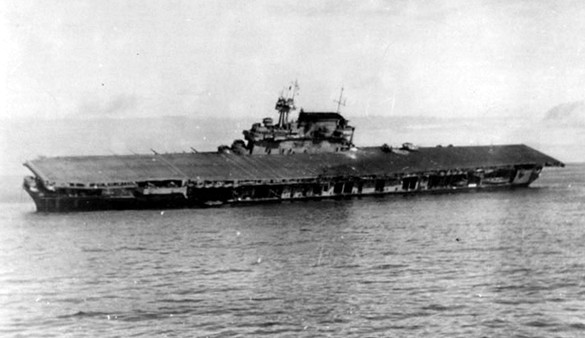
On June 7th, after being torpedoed by a submarine, she went down.
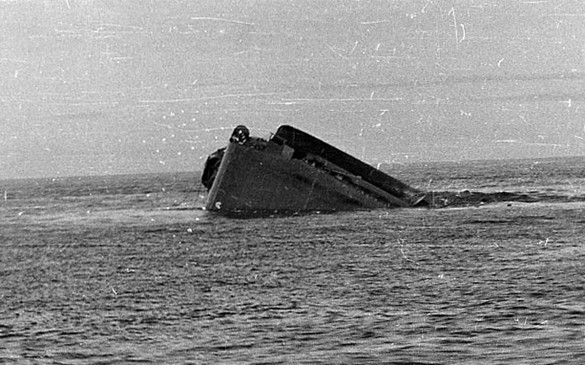 The Battle of Midway
, that "miraculous victory", was over.
The Japanese would not win another strategic victory for the rest of the war.
Posted by: Wonderduck at
08:53 AM
| Comments (5)
| Add Comment
Post contains 186 words, total size 2 kb.
1
Well I've moved and can't find the dang book,(or a host of other stuff)or remember the title, but it had an analysis of Japanese moves and motives leading up to the battle of Midway. One of the kickers that led to the Japanese charging toward Midway was the Doolittle Raid. Apparently Yamamoto felt that he had personally let the Emperor down by not preventing the Americans from getting close enough to launch the raid. Also the Japanese were still contemptuous of the Americans despite of what happened in the Coral Sea. Anyway that battle is fascinating because of all the ifa, coulda, shoulda, woulda, points in it.
Examples: There were people on the Japanese side that believed that it was time to change the codes just to be safe but were put off, "We don't have time for that now."
If the American torpedo and dive bombers had managed to make a coordinated attack per doctrine how much difference would it have made if any on the number of Japanese carriers sunk and damaged?
Posted by: toad at June 04, 2009 11:56 AM (WmNXR)
2
All the Japanese carriers were sunk. Kind of hard to do any better than that, donchathink?
Posted by: Steven Den Beste at June 04, 2009 01:15 PM (+rSRq)
3
The story of the torpedo planes at Midway always makes me sad. Brave, brave men flying obsolete planes, carrying defective torpedoes, making a hopeless attack and getting butchered.
The only reason their sacrifice wasn't a waste was because of sheer chance: they pulled the Japanese fighter cover down to the surface, leaving the sky empty when the dive bombers arrived.
And for Ensign Gay, he had the satisfaction of seeing three of the Japanese carriers get hit, and thus knew that his mates hadn't died in a losing battle.
Posted by: Steven Den Beste at June 04, 2009 03:47 PM (+rSRq)
4
Toad, I think I'll have to make a full post specifically to answer your final question.
Steven, your comment about "pulling the Zeros down" is the commonly held belief, but it's incorrect. The time gap between VT-6's attack (VT-8 had already been hacked out of the sky) and the arrival of the Dauntlesses from the
Yorktown and
Enterprise was nearly 20 minutes, according to the available information.
That's more than enough time for a Zero to get back up to an altitude where they could deal with a dive bombing attack.
No, the sacrifice of VT-8 and VT-6 served a different purpose: it kept
Kido Butai cycling CAP fighters off and on the carriers, and prevented the counter-attack from ever getting spotted on deck.
But what about VT-3? More about them later.
Posted by: Wonderduck at June 04, 2009 06:39 PM (hlGBx)
5
Midway is the perfect demonstration of the military aphorism that in war both sides make mistakes, but victory goes to the side which makes the fewest and least important mistakes.
Posted by: Steven Den Beste at June 04, 2009 09:17 PM (+rSRq)
Hide Comments
| Add Comment
February 08, 2009
What If...? #2
Outwardly, Warrant Officer Takeo Koyani, pilot of the G4M, looked calm and capable. On the inside, however, he was cursing everybody involved on sending him on this stupid mission. "Fly Admiral Yamamoto on an inspection tour of the Solomons," they had said. "It'll be easy, and the morale boost will be enormous." And so it had, these past few days. Then that airstrip commander at Rabaul had warned of ambushes coming from Guadalcanal, and yet here he was, flying towards Ballale island near Bouganville... in the direction of Starvation Island itself... in a damned "One-shot Lighter." Still, here he was, and the flight had been uneventful so far. Buka was nearby, and some additional Zeros would be lifting off right about... now... to provide additional cover. Then he'd be... well, not safe exactly, but he'd feel a lot better.
Then the tailgunner shouted a warning. With a curse, Koyani pushed the nose of the G4M down, picking up speed to get closer to Buka as fast as possible. Tracers shot past the cockpit, but he heard the unmistakable sounds of bullets whipping through the fuselage. Dammit, where was his escort? A solid whump drew his attention to the left wing, where he saw a huge plume of smoke pouring from the engine. Suddenly, the G4M snap-rolled that direction. Koyani frantically struggled to level the bomber out, an American P-38 flashed by, the jungle below looked very green. "We're going to crash, brace yourself," Koyani yelled as he hauled back on the stick. Dammit, why hadn't he been picked for fighters? Why the hell was he here right now anyway?
Some miles away, an IJN minesweeper cruised in the Solomon Sea. The brief aerial struggle had been in clear view, and the captain radioed back to Rabaul that two G4Ms had been shot down by Lightnings. That task done, he turned as the man next to him spoke quietly. "No wonder we lost at Midway. They've been reading our mail." The captain nodded. "Take me back to Rabaul, Captain. I've got a lot of work to do, and the inspection can wait."
As the minesweeper came about, Admiral Isoruku Yamamoto strode from the bridge and began calling for his aides.
more...
Posted by: Wonderduck at
10:37 AM
| Comments (4)
| Add Comment
Post contains 1212 words, total size 9 kb.
1
Genda was never prosecuted, even though he was the main one who planned Pearl Harbor. After the war he was instrumental in organizing the JASDF.
So it's completely plausible to me that Yamamoto might have been let off lightly, and maybe even not prosecuted at all, had he lived.
Posted by: Steven Den Beste at February 09, 2009 01:18 AM (+rSRq)
2
My favorite "World War II
What If?" regards Japan's decision to attack the US in the first place. As I understand it, the territories Japan wanted to seize for their resources did not include any held by the US. What if the Japanese diplomats had told the US on December 7th that they were attacking British, French, and Dutch territories in the Pacific and Asia to aid their Axis allies, and to warn the US to maintain their neutrality in that conflict?
Would Roosevelt been able to rally the American people to attack the Japanese solely to protect European colonies?
While deciding to
not attack the "weak-willed" US seems out of character for the Tojo government, they had already signed a non-aggression pact with the USSR, even though they had defeated them previously in the Russo-Japanese War. If the US held no territories that Japan wanted, "what if" they had
not attacked Pearl Harbor on December 7th?
Posted by: Siergen at February 09, 2009 06:39 PM (syMpe)
3
Someone asked me about that one, back in the day. (It's the second of the three what-if's in that post.)
I don't buy it as a plausible alternative.
Posted by: Steven Den Beste at February 09, 2009 06:55 PM (+rSRq)
4
Keep in mind that the objective of the Japanese fleet in Leyte Gulf was not to "win the war in a day"; they were not operating under the illusion that they could win such a decisive victory as to render further US offensive action untenable.
What they were trying to do, and what they tried to do later on with suicide strikes, was convince the US that an invasion of the Japanese home islands was too costly, and that a negotiated peace treaty would be preferable. And a decisive victory that crushed the transport fleet at Leyte might have done it; not only would the loss of lives have been appalling, but later revelations that the success was partially (mostly?) due to US incompetence would have been a big blow to morale. The world would indeed have wondered, hm?
But then again, probably not... It wouldn't have even set back the date of the end of the war, given that it was prompted by atomic attack and the occupation of the Philippines had very little (i.e. no) affect on actions against the Japanese mainland. We might have nuked Kyoto, maybe...
Posted by: Avatar_exADV at February 09, 2009 10:51 PM (pWQz4)
Hide Comments
| Add Comment
January 25, 2009
The Sole Survivor.
On December 7th, 1941, the strongest navy in the world was undoubtably the
Nihon Kaigun of Japan. Foremost in this powerhouse were the fleet's 10 aircraft carriers. Carrying the best, most experienced pilots, flying the best fighter and torpedo bomber and a dive bomber that was very nearly the equal of the best, this striking force ran roughshod over the Pacific Ocean.
By the end of the war, however, all of the carriers in the fleet at the beginning had been sent to the bottom of the ocean by the "Big Blue Blanket" of the US Navy. All, that is, except for one... the Sole Survivor. Ironically, it was the smallest, slowest, oldest, least capable of Japan's flattops, the
Hosho.
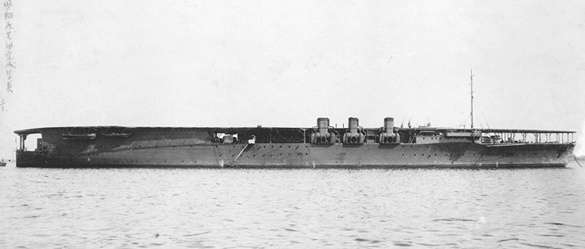
The
Hosho was also the first ship ever built from the keel up as an aircraft carrier, commissioned on December 27th, 1922, 13 months before the HMS
Hermes, the first ship designed as a CV, took to the water.
As the first carrier in the Japanese navy, it was influential in many ways, serving as a testbed for experimental methods that later became standard operational procedures for the fleet. Experience gained from the
Hosho's construction and service influenced the conversion of the
Kaga and
Akagi, and led directly to the design of the
Ryujo.
By the time of Pearl Harbor, however, the
Hosho was only just barely able to operate with the rest of the fleet. She was too small and slow to be able to handle the modern Zero, Kate and Val planes, and was only just able to fly the
A5M Claude off her deck in the best of situations (fresh headwinds with a relatively calm sea). As this combination was rare at best, and the Claude was obsolete as a whole and rapidly retired, this quickly left the
Hosho without a fighter it could carry. During the Battle of Midway, where she gave the battleships of Yamamoto's Main Body a tiny organic air capability, the
Hosho was carrying eight
B4Y Jean torpedo bombers.
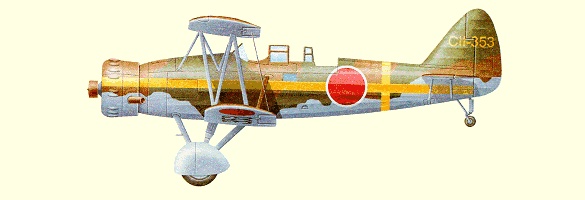
It was one of these planes that took the
famous picture of the burning Hiryu after she had been pummeled by Dauntless bombers at Midway.
After Midway, the Japanese fleet was desperate for carrier decks. Despite this, the
Hosho was removed from active duty as a combatant on June 20th, 1942. She was then used exclusively for landing exercises and carrier training in the Inland Sea of Japan. She very nearly escaped the war unharmed.
On March 19th, 1945, while operating near the battleship
Yamato in the Inland Sea, the
Hosho was attacked by seven planes. She suffered either a small bomb or a rocket hit that punched a few small holes in her flight deck, losing six crewmen in the process. The war revisited the
Hosho on July 24th, 1945, when she was attacked in harbor on July 24th, 1945, and she reportedly took one hit for scant damage.
After the war ended, she was used as a troop carrier to bring Japanese soldiers home from Wotje and Jaluit. Struck from the list in 1946, she was finally broken up for scrap on May 1st, 1947.
Hosho, the Sole Survior, was no more.
Posted by: Wonderduck at
10:43 PM
| Comments (1)
| Add Comment
Post contains 533 words, total size 4 kb.
January 03, 2009
A Dawn Like Thunder
Readers of The Pond know that I have a thing for the Pacific War, and even moreso for the
Battle of Midway. The study of that period is one of my avid hobbies, and is what lead me to my fondness of Japan in general and eventually anime in particular (though in a fairly roundabout way). I know quite a bit about the strategies used by both sides in the conflict, and could talk tactics with confidence as well.
With
a few exceptions however, the one thing I don't have much knowlege about is the people involved. Oh, I don't mean the Halseys and Nagumos, but the Chucks and Morts and Joes and Mitsuos and Hidekis... what about them?
While I was doing my Christmas shopping at a local bookstore, I stumbled on a new release that seemed to have been aimed directly at my bump of curiosity.
A Dawn Like Thunder: The True Story of Torpedo Squadron 8, by Robert J. Mrazek tells the stories of the men made famous by the Battle of Midway, the only squadron flying off the USS
Hornet to make contact with the enemy on that day in June, 1942... and which was almost entirely wiped out as it made its run on the Japanese carriers. All the squadron's Devastators torpedo bombers were shot down, and only one man, George Gay, survived.
But that wasn't the whole squadron. Historians of the battle will remember that the first six
Avengers in US Navy service were flying from Midway's single runway after a hurried deployment from Pearl Harbor just before the battle. They, too, were part of Torpedo 8, a detachment left behind when the
Hornet sailed. Further, another group of VT-8 pilots and crewmen, including the squadron XO, remained behind at Pearl waiting for the rest of the Avengers to arrive.
Later, VT-8 wound up flying from the USS
Saratoga until it was torpedoed. Many of her squadrons wound up at Espiritu Santo, and some of them wound up going to Guadalcanal as part of the Cactus Air Force. VT-8 was one of those. The second half of the book covers that period of time, and the many, many trials the squadron suffered through. Indeed, VT-8 suffered the highest casualties amongst naval squadrons at both Midway and Guadalcanal. At Midway, 45 of 48 officers and men serving in Torpedo 8 were killed. At Guadalcanal, seven of the remaining members were killed and another eight wounded.
It also wound up one of the most decorated squadrons in Navy history, if not the most decorated in US service, period. It was the only squadron to receive two Presidental Unit Citations from FDR. Its 35 pilots earned 39
Navy Crosses before it was decommissioned after Guadalcanal.
A Dawn Like Thunder is written almost entirely from interviews conducted with the few members of VT-8 still living, and from letters and memoirs by those who've passed away. We meet men like Swede Larson, the squadron XO who took command of the squadron after Midway. We learn that as a leader, he was a martinet who wasn't afraid to belittle his men, issued promotions not on how they performed but if he liked them or not. Twice, men under his command were pushed so far that they pulled their sidearms on him. He was also a courageous pilot (though one who refused to admit mistakes). We meet Bert Earnest, the pilot of the single Avenger to make it back to Midway, though so shot full of holes that it never flew again. He then went on to survive Guadalcanal, and WWII as a whole. We meet Chief Petty Officer James Hammond, who won a Silver Star at Guadalcanal in large part because he built three 'Frankenstein Avengers', piecing scraps of many planes together to make one (barely flyable) bomber. This at a time when the Cactus Air Force was down to a bare handful of planes. The lineup of pilots and crew goes on, but you never feel like anybody is getting short shrift. The wives and girlfriends of some of the men even get their nods.
Robert Mrazek has done a fine job of tying all his research together and turning it into a coherent and readable story. The small number of inaccuracies (Midway was described as having two airfields in 1942, when there was only one, for example) are easily overlooked, and don't detract from the superb job he's done telling the human story of Torpedo 8. Highly recommended!
Mrazek and many of the men he wrote about are members of the
Battle of Midway Roundtable, an organization that's been in existence since 1997. I'm proud to be a member myself. It's free to join, and if you're interested in the Battle of Midway or the Pacific War, you owe it to yourself to become a member.
Posted by: Wonderduck at
10:50 PM
| Comments (3)
| Add Comment
Post contains 812 words, total size 5 kb.
1
There are breaks, good and bad luck, in every battle and every war. But the way so many critical things broke in favor of the Americans in the Battle of Midway has led me to consider the possibility of meddling by time travelers. In particular, the fact that the only Japanese scout plane to be launched late was the one that found Yorktown, but there are others as well.
Posted by: Steven Den Beste at January 04, 2009 02:13 PM (+rSRq)
2
...the fact that the only Japanese scout plane to be launched late was the one that found Yorktown...Wait, it gets better. If the
Tone's scout plane had launched on time, it wouldn't've found the
Yorktown's group until it was on the way back to base. Upshot? Probably wouldn't've lost the
Yorktown, as the Japanese second strike would have been launched against Midway.
Wait, it gets even better than that: the
Tone's scout plane cut his outbound leg short. Nobody knows why... but we DO know it wasn't because he saw the
Yorktown group, considering where he made the turn and where the
Yorktown was at that time. So if the scout plane hadn't've made the turn when he did, it would'nt've found the
Yorktown until much later, and perhaps never. Upshot?
Yorktown probably lives.
Luck cuts both ways.
Posted by: Wonderduck at January 04, 2009 03:14 PM (sh9fy)
3
You're right that luck cuts both ways, and it's a truism that in the end the side that makes the fewest big mistakes nearly always wins. Nimitz rightly deserves major credit for the victory because he was able to leverage his advantages and his luck, and minimize the Japanese advantages and luck, and was a savvy enough poker player to be willing to go "all in" when he thought he had a chance of a major victory.
But it didn't have to result in a major victory for the Americans. There were a hell of a lot of ways it could have gone very, very badly. (As, of course, you know full well.)
Posted by: Steven Den Beste at January 04, 2009 04:24 PM (+rSRq)
Hide Comments
| Add Comment
August 21, 2008
Flight Deck Round-Downs... Why?
The early days of aircraft carrier design saw a lot of different concepts that eventually went by the wayside. Such "innovations" as multiple flight decks (so airplanes could launch directly from their hangars), transverse-mounted catapults that launched planes perpendicular to the direction of travel (ditto), longitudinal arrestor wires, arrestor gear at both bow and stern (so if one end of the flight deck had a hole in it, the ship could steam in the other direction and launch planes from the undamaged end), carriers without islands, the list goes on and on. All of these elements made sense, however, and one can see why an Admiralty could think they were good ideas at the time.
One design feature of some early carriers, however, has always struck me as being particularly pointless, with no redeeming features whatsoever: the flight deck round-down.
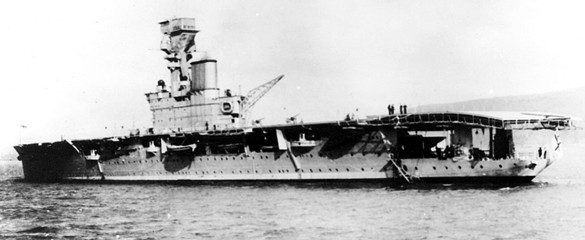
HMS Hermes
As can be seen in the above picture, a round-down is a sharply sloping portion of the aft end of a flight deck, a location particularly unsuitable to topography of any sort.
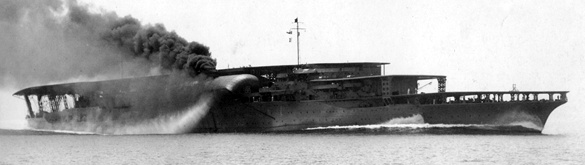
IJN Akagi, circa 1927-'35. Note the "fly-off" decks, right, round-down left.
In the book
Shattered Sword, it's mentioned that the
Akagi's round-down is so pronounced that it, in effect, shortens her flight deck, as planes cannot be spotted there without having them roll off into the sea.
So why are they there at all? Throughout all my readings through the years, the only reason I've seen is that they were thought to be aerodynamically helpful for landing planes, perhaps by creating an are of calm air behind the ship.
But even if that were so, doesn't it seem that it'd be a rather ill-positioned lee for an aircraft attempting to land, not to mention small? Further, they also look like a fairly hostile place to try and land upon in the first place. Imagine: you touch down on the round-down, crest the "hill", and then? You're thrown back into the air, much like today's "ski-ramp" carrier decks would do.
Do any of you, my readers, have an idea? I'm completely flummoxed here!
Posted by: Wonderduck at
11:12 PM
| Comments (4)
| Add Comment
Post contains 350 words, total size 3 kb.
1
I wonder if they thought of it as a way to make the initial contact just a bit more forgiving. If you came in just a bit too low, then if the flight deck was level you'd run into it, but with that dip you might bounce off and still have a chance of catching the arrestor cable.
I don't think it would work, but I wonder if that's what they were thinking?
Posted by: Steven Den Beste at August 21, 2008 11:22 PM (+rSRq)
2
The variation in forms of early aircraft carriers mirrors the variation in forms of early combat aircraft two decades before. The thing is that we see the mature aircaft, and the mature carrier, and know what they look like, but the people back then didn't.
Obviously, what we're seeing is the result of their experimentation and evaluation, to determine what works and what doesn't. For instance, it always gets me just a little to see WWII carriers without angled flight decks. It just seems to obvious that a carrier should have such a thing, yet it wasn't until the end of WWII before anyone (the Brits) even thought of such a thing.
Posted by: Steven Den Beste at August 22, 2008 11:24 AM (+rSRq)
3
I remember reading a book about Ark Royal iii (the WW2 one), which said the flight deck's was deigned to give better air flow, therefore helping take off. (British naval aircrst in the inter war years being... antiquated to say the least). Not sure about landing though,
The later Illustrious class had a similar shaped flight deck, later more powerful aircraft didn't need the assistance and at least one (Indomitable?) had the bow and stern rebuilt post war.
Posted by: Andy Janes at August 22, 2008 03:32 PM (xVeNB)
4
I believe it was to accommodate the original longitudinal arrestor wires. Once the now standard transverse arrestor wires were implemented, the rounding was no longer needed. They didn't build carriers with it any more, but they didn't spend the money to flatten it out either.
Posted by: Paul Fitch at February 05, 2013 01:09 PM (M/vyn)
Hide Comments
| Add Comment
August 16, 2008
An Unfortunate Encounter
I'd like to relate to my readers something that happened to me earlier today, something that can only be described as confusing, perplexed and, ultimately, sad.
This morning, I went grocery shopping at a local store that has a fairly decent "international foods" section. You know the type: Mexican staples, Indian chutneys and the like. There's also a wide selection of Asian foodstuffs, including Japanese things like soba, 10 different types of soy sauce, some microwaveable beef bowls (awful), a couple of different flavors of Pocky, instant miso, sushi fixings, yadda yadda...
I was browsing through the section, trying to decide if I wanted to get a cheap packet of instant miso (I did, eventually) along with the Pocky and some hot sauce (good to add to chili) when an elderly man said to me "you shouldn't buy that (crap)." I gave him a surprised look and asked, intelligently, "what?"
He repeated his assertion, adding "it's made by the Nips."
By now, my eyebrows had long left my forehead and headed for the stratosphere. Like an idiot, though, I asked him what's wrong with getting Japanese food. It's awfully tasty, after all. He visibly became angry with me as he said (I'm paraphrasing here) "I fought them in the Philippines, they shot me and killed some of my friends, I hate those damn Japs and I will until the day I die."
I want you to imagine my state of mind at this moment: standing in front of me was a man I automatically honor, a WWII vet, and one who fought in the Pacific theatre no less, an area of history I'm fascinated in. At the same time, though, he's trashing an entire race of people (including some that I'd call casual friends: Duck U has an exchange program with a Japanese college, so there's always around 5-10 students from there attending) for events that happened over sixty years ago, and a culture that I enjoy learning about to boot.
To say that I was confused and saddened just then would be accurate. I would have loved to have spoken with him about his experiences if he would have let me, but at the same time his attitude (and don't get me wrong, I understand where it comes from: if you're not going to like someone or something, seeing your friends killed and being shot yourself is a pretty good reason) was distasteful at best.
Fortunately, he didn't recognize the baseball cap I was wearing (the
Hanshin Tigers, brought back from Japan by a Duck U student for me). After heaping some more abuse on "the Nips" and scorn on me, he stalked off (as best he could, using a cane and an old person's shuffle) muttering under his breath.
I'm still disturbed by the whole thing. I think of
Brickmuppet, who's touristing in Japan right now, and wonder if there's old members of the Imperial Japanese Army who might want to chew him out, or skewer him with a bayonet if they could get away with it, just for being American. I think of my DVD rack, filled with anime, and my end-table, covered with pockyboxes... and one of my bookcases, stuffed with history books about the Pacific war.
And I wonder which of us has the right of it: the elderly man who fought and bled for our country, who's attitudes are over a half-century out of date? Or myself, who has the more modern attitudes, but who respects the actions of the other man.
In this multi-culti, politically correct world, are the experiences of the old soldier scornworthy? I'm glad I don't feel the way he does, but is he wrong to feel that way?
Posted by: Wonderduck at
08:29 PM
| Comments (7)
| Add Comment
Post contains 622 words, total size 4 kb.
1
It's understandable why he should feel that way, though many old soldiers do not.
I'm glad you didn't try to argue with him; that would have been wrong.
And it's OK for us to like the Japanese. The war was a long time ago.
Posted by: Steven Den Beste at August 16, 2008 08:43 PM (+rSRq)
2
I guess there really is no "right" here. My dad fought in Europe (came ashore 3 days after D-Day) and fought all the way through (including in the Ardennes during the Bulge) until about two weeks before V-E, when he was hit by shrapnel and ended up in a British hospital. Just like the man you encountered, he lost friends and was wounded. He didn't seem to harbor any particular hatred towards the Germans. I suppose it's something we can never understand, so its best to just let it lie.
My dad's unit was one of the ones that liberated Mauthausen... if he had been there, he might have felt the same towards the Germans that the man did towards the Japanese. Hell, I'd probably feel the same way.
Posted by: Evil Otto at August 16, 2008 09:15 PM (tYvh+)
3
Steven, the last thing I would have done is argue with him.
Otto, everything I've ever read indicates that the Germans were "just like us" in WWII. How many immigrants from the Old Country served in the Army, after all? Or lived on your street? The Japanese, though, were looked down upon to start with, then as backstabbing sneak-attackers after Pearl Harbor. There weren't internment camps for German-Americans, but there sure were for Japanese. They were (and, I suppose, still are in some ways) too different.
Which is why I'm fond of the Japanese culture: it's
different! In another world, maybe I'd be fascinated by (say) the Indian culture, or Egyptian, or whatever... *shrug*
But add in the stress and horrors of war to the "different", and one can see how hatred can occur.
Posted by: Wonderduck at August 16, 2008 10:35 PM (AW3EJ)
4
In response to "but is he wrong to feel that way?" I feel the answer is no. He's entitled to feel any way he wants. People are who they are and they take from life what they choose. But always remember that we are entitled to agree, disagree, become motivated, be disappointed, etc with/by the thoughts and behaviors of others. He will never change and I find it sad, but what would be sadder is if you allow his bitterness to affect your life. You each have the right to live your lives as you see fit. His issues are his. Don't let them become yours.
Posted by: The Librarian at August 17, 2008 02:44 AM (lMPdx)
5
We tend to forget that history was and is personal, that all those good and bad experiences happened to someone.
My boss is half-Japanese. I've had the pleasure of meeting her mother, who fits the perfect stereotype of the little old Japanese lady. Her mother's family still lives in Japan. Her father is a veteran who was stationed in Japan after the war. I've never felt comfortable asking, but I'm sure there's a story there.
I wouldn't be surprised if there's a veteran of World War 2 somewhere, probably of Jewish or Eastern European ancestry, that fought alongside one of the Nisei units in Europe, that admires the Japanese but can't look at a German car without feeling a similar hatred.
Posted by: Civilis at August 17, 2008 05:01 AM (Y1ZWN)
6
I don't think he's wrong to feel that way at all. He's got a good reason for his feelings and he's entitled to them.
That's the way of it, though, and his time will eventually pass. Japan and the US are friendly now, and in some ways we would both suffer greatly from ending that friendship.
Of course, I'm a big Japan-o-phile too. I'm sure my Dad (who was in boot camp about the time they vaporized Hiroshima) was mystified that I could be so interested in Japanese culture and stuff.
Posted by: Ed at August 17, 2008 06:15 AM (XJZSD)
7
I think that if I had time to compose an answer, I'd offer him my hand and say, "Thank you for helping make it possible for future generations to not hate the Japanese people."
In reality, I don't think my synapses would start firing until about ten minutes after he left. I could manage the thank you, but that's about it.
-j
Posted by: J Greely at August 22, 2008 06:48 PM (2XtN5)
Hide Comments
| Add Comment
June 09, 2008
T-Bird Sunday
So as has been previously related, the weather around The Pond on Sunday was pretty miserable. Until around 1230pm, there were thunderstorms and high winds which caused no end of havoc, which prevented the Duckford AirFest from doing anything at all.
But the storms blew away, and with a four hour window before the next ones were supposed to happen, AirFest threw the schedule out the window and went for broke: how many teams can we get in the air in a limited amount of time?
The answer was "most of them." The Pond was alive with the roars of jet engines and the growls of prop planes for a good while, but the prevailing winds were such that none of the actual planes came anywhere near Pond Central.
330pm. The Thunderbirds could be clearly heard taking off in the distance. I couldn't take my usual position off in the field behind Pond Central, since there were small rivers running through it, rivers that only form when it rains really hard, so I had to hope that I'd be able to get a pic or two from Pond Balcony.
Yup.
I had to adjust the contrast on this, but otherwise, it's as it came out of the camera.
Not bad, but I like this one better:
Different pass from them, same nice tight formation. Less zoom, too.
The Thunderbirds didn't come into view for the rest of the performance. Drat. Never saw the two solos, either. Double-drat. The diamond is amazing to see, holding that ridiculously tight formation as they blitz by at high speed, low altitude.
Oh, and the Snowbirds? They were at the Canadian Grand Prix. Good reason not to be here!
Posted by: Wonderduck at
11:14 PM
| No Comments
| Add Comment
Post contains 286 words, total size 2 kb.
June 07, 2008
Thunderbirds Are GO!
Yes, this is the best I could do today...
Today was a weird weather day for the Duckford AirFest. Sudden downpours, hot, muggy, and very windy played hob with the schedule. Out of the shot, about ten or 15 miles in the direction of travel, was a VERY ugly looking storm front, which was headed towards The Pond at a good clip.
In fact, it was such an ugly looking storm, that the Thunderbirds ended their (roughly hour-long) program after about 20 minutes. Good thing, too: about five minutes after they landed, just as I made it back to Pond Central, it became as night and the rain began to bucket down.
Even before that, though, I pretty much knew that I wasn't going to get any pictures
as interesting as last year's. The Thunderbirds' F-16 is smaller than the F/A-18 flown by the Blue Angels, seemed to be flying higher than last year's show, and the mostly white colorscheme did nothing to make them stand out against the low-ish clouds. Hopefully Sunday will be a nicer day (the weather forecast doesn't look promising, though) and let me take some better pics.
Posted by: Wonderduck at
03:43 PM
| Comments (6)
| Add Comment
Post contains 195 words, total size 1 kb.
1
Was that the same storm front which laid down ten inches of rain in some parts of Indiana? (Probably not the same front, but maybe the same storm system, blown up from the Gulf.)
Posted by: Steven Den Beste at June 07, 2008 11:03 PM (+rSRq)
2
Yup, and tornadoes in the Chicago area, too. It's been an ugly couple of days around here, weather-wise.
Posted by: Wonderduck at June 08, 2008 12:47 AM (AW3EJ)
3
And here I was, complaining about drizzle.
Posted by: Steven Den Beste at June 08, 2008 12:53 AM (+rSRq)
4
Small world, I was at the Biggin Hill airshow yesterday, whihc was also overcast and threatening rain (though thankfully it stayed dry)
Am still disapointed the Vulcan didn't make it, also the Red Arrows weren't there this year either- and lets face it they are the best display team in the world, even if they only have tiddly little training jets 
Andy
Posted by: Andy Janes at June 08, 2008 05:42 AM (xVeNB)
5
As I type this, it's 11am on Sunday. The AirFest program for today was supposed to start at 1030am. I've not heard sound one from the airport yet, probably because it's raining quite steadily out there. I have a feeling I might not get a chance to improve on the above picture today.
Andy, I know I'd love to see a Vulcan! There's a B-52 over at the "static display" part of the AirFest, and I would have enjoyed seeing that beastie land. The Duckford Airport isn't able to handle jumbos without removing the lights and other things along the sides of the runway they're using.
And I'd really like to see the Red Arrows in person.
Posted by: Wonderduck at June 08, 2008 10:07 AM (AW3EJ)
6
I heard someone at the Vulcan to the Sky tent saying they were supposed to be doing a test flight on Monday, and hopefully doing some airshows later in the summer. This was the second event I've been to where theyt were supposed to be flying it, and cancelled at the last minute.
I went to the Mildenhall (US Base in East Anglia) Air show years ago and they had a B-1B: that was a sight to remember! Would like to see a B-52 too, or a B-2 (though think thats unlikely)
Andy
Posted by: Andy Janes at June 08, 2008 01:55 PM (+aSSY)
Hide Comments
| Add Comment
January 23, 2008
What If...?
It was a brilliantly sunny day that Sunday morning, seemingly not a cloud in the sky. People made their way to church, or did laundry, played golf or slept in. Out in the harbor, motorboats took men from one point to another, seemingly at random.
A few miles out to sea, a metal behemoth sailed towards the harbor. On its flat wooden deck, a white painted number "6" gleamed in the Pacific sun. The Enterprise was coming home. The time: 710am. The date: December 7th, 1941.
The term "first order counterfactual" refers to the changing of one detail of a recorded event, and seeing where that change takes you. In the world of "alternative history," such as Harry Turtledove's writings, a first order counterfactual may be something as simple as the Confederate Lost Orders not falling out of an officer's jacket, leading to the United States being divided permanently.
742am. A huge flight of Japanese fighters and attack planes approach Pearl Harbor. Captain Mitsuo Fuchida, gazing out of the cockpit of his Nakajima B5N, has just keyed his radio to life. "Tora tora tora!"
Back on board the Akagi, the flagship of the attacking Japanese fleet, static whispers through the speakers of the radio room. Then, unexpectedly, Fuchida speaks again. "There's a carrier in the harbor!"
In the actual events of history, the
Enterprise had been on a mission to Wake Island, delivering fighters to the garrison located there. Scheduled to return to Pearl Harbor on December 6th, she was running late... and thereby missed out on being the main target of the December 7th attacks.
more...
Posted by: Wonderduck at
12:03 AM
| Comments (28)
| Add Comment
Post contains 1050 words, total size 8 kb.
1
All else being equal, though, the atomic bomb was ready in August of 1945, so that would have still led to a relatively quick end.
A carrier battle group, steaming in formation, would have been a sweet target for a 20kt nuclear weapon. One bomb per CBG and Japan would have found itself without a navy in relatively short order. The limiting factor would then be how quickly the US could make atom bombs.
...which, if I recall Rhodes (
Making of the Atomic Bomb) correctly, meant about 1-2 bombs per month in 1945-46.
Posted by: Ed Hering at January 23, 2008 02:09 AM (4/tk8)
2
Not quite that straightforward. The bomb was carried by a B-29 launched from Tinian. That was extreme range for B-29's. If the bomb was ready in August 1945, but there were no B-29 bases within range of the home islands, then what do you use it on? The idea of using it on enemy fleets is naive; they move and are hard to find for a long range bomber flying in from a base many hours away. B-29's were not a tactical weapon.
On the other hand, I'm not sure I believe the loss of the Enterprise on the first day would have had quite the catastrophic consequences described here.
Honestly, losing Halsey would have been more critical, but it's not certain he'd die in such an attack.
Posted by: Steven Den Beste at January 23, 2008 06:02 AM (+rSRq)
Posted by: Mitch H. at January 23, 2008 07:20 AM (iTVQj)
4
Sorry about that.
What I meant to say is that although I'm really not an expert on the Pacific war, the "Lost Orders" counterfactual is a guarantee to pull me out of my cave and rant a bit.
Firstly, the famous lost orders were the *sixth* set of operational orders lost by either side in the late summer of 1862. The fluidity of the Rapidan-to-Pennsylvania operations meant that various divisional and army headquarters got overrun or otherwise compromised on a regular basis. Both Stuart and Pope's staff were scattered and overrun on separate occasions, both times losing their paperwork to the other side's benefit.
Secondly, it's been recently argued that the Union advance was actually *slowed* by the discovery, as it occasioned an additional iteration of McClellan's OODA loop, and perhaps cost him an extra six to eight hours as he paused to figure out what the discovery meant - and more importantly, whether it was real or a trick. He had already put his scratch force on the move - this is how they found the lost orders in the first place - and because of Stuart & the cavalry's poor showing in screening against this advance, he would have caught the Confederates scattered and unprepared regardless of the intel bonanza.
A far more interesting what-if is a situation where McClellan is *not* in control of the Union forces around Washington at the time of the Potomac crossings. The tenuousness of McClellan's authority in making the advance into western Maryland is often understated. A situation where Stanton & Halleck get crosswise with McClellan & put him under arrest for something untoward said by one of his hot-head subordinates like Fitz Porter or Franklin in the heat of the moment, post-Second-Bull-Run - I could see a situation where command chaos in Washington could have resulted in an indecisive fall campaign.
The key in the September 1862 campaign was what led up to the capture of DH Hill's superfluous operational orders in Frederick, not the contents of those orders. It was the fact that there *were* Union infantry in Frederick rummaging for cigars through the clutter of an abandoned Rebel camp, and not cooling their heels in front of the Washington defenses.
Posted by: Mitch H. at January 23, 2008 07:37 AM (iTVQj)
5
Steven, that's the joy of counterfactuals: there's no way to be sure what would happen. I do feel secure in claiming that there'd be no attack on Midway without the Doolittle Raid, however, and without basically abandoning the lines of communication with Australia, there just wasn't a carrier available to escort the Hornet.
No battle of Midway, no four Japanese carriers sunk in one day. No destruction of Kido Butai and the Japanese continue to outnumber the US in the only manner that matters in the Pacific until sometime in 1943.
Yes, the A-bombs would be available in August '45, no question. Would the US have an airfield near enough to Japan that a B-29 could use by then? If you posit a year's delay in the arc of the Pacific War, Tinian wouldn't be
invaded until August of 1945, let alone have the busiest airfield in the world.
It's all speculation, of course, and I don't claim to be able to read tea leaves... but the contents of this post have been bugging me for a couple of days, and I finally got a couple-three hours to put it on 'paper'.
Mitch, would any of those previous 'lost orders' be the plans for an entire season's campaign, like THE lost orders were? Please note that I honestly don't know; the Civil War has never interested me enough to study such details. Weak, I know, but what can I do?
Posted by: Wonderduck at January 23, 2008 08:09 AM (AW3EJ)
6
Oh, and Ed? A nuke the size and yield of the ones used against Japan may not be as effective against a fleet as you might think. Take a look at
Operation Crossroads Able. 23kt, 500ft airburst above an anchored fleet. The bomb exploded about 2000ft off-target (the center of the anchored formation)... and this was on a STATIONARY target, not a moving fleet.
The result? Five ships of the target fleet sunk: two APAs, two DDs, and a CL. The
Saratoga (CV-3) was more-or-less undamaged, though we know her electronics would have been zorched and any exposed planes would likely have been blown away.
So unless the US got lucky and dropped the bomb right above a Japanese carrier, it's not sure that it would have completely killed it. If it was dropped dead-center in the usual Japanese carrier formation, they'd be damaged, but probably not sunk.
It wasn't until Crossroads Baker that the
Sara was sunk, and that was an underwater burst, which carry more shock power than airbursts.
Posted by: Wonderduck at January 23, 2008 09:04 AM (AW3EJ)
7
Good points all. Still, I wouldn't want to be in a carrier battle group when someone set off a nuke nearby. That would ruin my day, whether the ship sank or not. Electronic machinery in 1945 was "nuke hardened" simply by virtue of not being all that intricate; it could stand more radiation than people could. Even a near miss with a nuke would cause a lot of Japanese sailors to get sick and die, and if you got enough of them, it would effectively kill the CBG until it could be remanned.
The B-29's range is the real limiting factor here, IMHO. The Pacific is a big ocean and the thing's combat range of 3,250 miles is not that great.
And, of course, you couldn't get a satellite image to show you where the ships were.
Still, while my initial thoughts might be overly optimistic, I think the nuclear bomb option would make pretty quick hash out of the Japanese effort in the Pacific in 1945.
Posted by: Ed Hering at January 23, 2008 09:33 AM (4/tk8)
8
Ed:
You wrote:
Even a near miss with a nuke would cause a lot of Japanese sailors to
get sick and die, and if you got enough of them, it would effectively
kill the CBG until it could be remanned.
True. The thing is, the Japanese
couldn't have remanned very quickly, if at all, because they lacked the skilled manpower. In prewar Japanese society, mechanical skill and technological experience--the prerequisites for a trained air department--were relatively rare. If Japan had had the ships to replace the four carriers lost at Midway a week after the fleet returned home, they wouldn't have had the air department personnel to crew them with. (There's a long discussion of this point in the recent Midway book
Shattered Sword, which I highly recommend.)
On the other hand, Americans had mechanical skill and technological experience in abundance. It's been said that in every deuce-and-a-half full of American infantry--the ones left over after all the skilled gearheads were siphoned off by the Navy and Air Corps--there were at least two or three guys who could fix the truck if it broke down.
Posted by: Mike at January 23, 2008 11:39 AM (6gdkP)
9
Few ships have ever been as pivotal as the Enterprise. The scenario that Wonderduck outlines is actually qute likely IMHO. Enterprise was for a time the ONLY CV in the Pacific. Without her there is no aircover during that crucial time.
WD is also right that the capture of Tinian is what made the Atom Bombing possible.
Even if Midawy is fought, keep in mind that historically, Midway was an incredibally close run thing with 2.5 American CVs...With just 1 fully operational carrier plus,Yorktown the American long odds become quite dismaying. Also, Hornet was fairly ineffective in that most important battle, the kills were largely made by the planes from Enterprise and Yorktown. Take Enterprise out of the equation and the Japanese almost certainly win.
Without having half their air crew killed at a stroke, the IJN does not suffer from the acute experience shortage they did historically, they can afford to rotate some veterans for training and the smaller holes in their order of battle could probabnly be filled even given their slow training procedures.
If, due to the reasons Wonderduck gives the Japanese ignore Midway, then they likely concentrate on the Indian Ocean and actually execute the planned joint operation with Germany on Madagasgar. With 2-4 german heavies, (the "twins" plus a pocket BB or 2) plus a few detached IJN carriers the Indian ocean becomes an axis lake, leaving more than enough IJN assets to deal with the US for a time. The ANZAC convoys are swept from the seas, India almost certainly falls to revolution, insurgency and invasion, the Suez is threatened from the EAST and it is likely that an amphibiouys assault would be made to ensure that the vital minerals from South Africa go to the Axis.
IJN aircrews are even less deplested in this scenario.
Straying farther from the path, close cooperation with the IJN might convince the Germans to finish Graf Zeppellin and Peter Strasser which could complicate the Home fleets problem even more.
All in all a bad thing.
Thank you for that ray of sunshine Wonderduck.
Posted by: brickmuppet at January 23, 2008 09:06 PM (V5zw/)
10
Muppet, it gets worse. Assuming the war doesn't end in 1945 as it does, the USA wouldn't be in position to tell the Soviets to stay away from an invasion of Hokkaido.
Japan may very well have ended up like Berlin in the Cold War.
Posted by: Wonderduck at January 23, 2008 09:15 PM (UdB9M)
11
This assumes things go as well for the USSR as they did historically....if recious minerals are obtained by the Germans in abundance they would not be out of fuel. Chromium for their jet engines would have made a big difference in a bad way and if the middle east fell....the pressure on the USSR would have been very great indeed.
Yeesh...
Posted by: brickmuppet at January 23, 2008 09:21 PM (V5zw/)
Posted by: Steven Den Beste at January 23, 2008 09:59 PM (+rSRq)
13
Here's an interesting nugget - what would happen if Adm. Kurita hadn't blown it at Leyte Gulf? That's the only point where the "decisive battle" doctrine the Japanese were using to force the US to negotiate a peace could possibly have worked...
Posted by: Avatar at January 23, 2008 10:39 PM (LMDdY)
14
Steven sez (in #12): "
And as to the question of when Tinian gets taken, to be used as a B-29
base, if it isn't in time for August 1945, then the first atom bomb
would have been dropped by a B-29 flying from a base in China."
Not a chance. The chance that the plane carrying the bomb would have a malfunction and crash-land someplace the Japanese could get their hands on it wouldn't be taken under ANY circumstances. We barely let our
friends know what was going on with the bomb, after all. The flight from Tinian, on the other hand, was completely over water... perfect for jettisoning the bomb where nobody untoward could get their hands on it.
The logistical problems with flying B-29s from China are well-documented as well. Throw in the added headaches of trying to get the various pieces of the bomb to the Chinese base, and it seems even less likely.
"
Also, nothing about this scenario affects the new Navy scheduled to start coming off the blocks late 1943."
Granted, and mentioned in the body of the post. The first Essex came into the field in mid-'43, by the end of the year there were four.
And the submarine war could have been effected by the loss of the Enterprise. In 1942, the US moved a large number of subs to Australia. If Japan made their move towards Australia, that could have put a serious crimp in the sub campaign.
Nothing could have saved the day for Japan, really... just prolonged the bleeding.
Posted by: Wonderduck at January 23, 2008 11:11 PM (AW3EJ)
15
(From a lecture I had years ago at Air War College) This itself may be counterintuituive, but Pearl Harbor was actually a blessing for the US Navy. The Navy was still dominated by battleship admirals; Navy doctrine still favored the "decisive engagement" of capital ships slugging it out.
Pearl Harbor took the battleships off the table, leaving only the carriers as our remaining tools. Luckily for the Navy, the naval aviators had long been experimenting and thinking about using carriers for more than scouting and fleet defense (which was their assumed normal role). Thus, the Navy was forced to adapt to carrier-centric battle, which, thanks to the forward thinking of it naval aviators, was not as wrenching as it might otherwise have been.
Had the Enterprise been in Pearl during the attack, there arguably would have been no carrier force to turn to, and the battleship admirals might still have prevailed. A counter-attack might have waitied until enough battleships were on line. Then, an American battleship fleet (with carriers only in their usual scouting role) might have sailed out, seeking to "cross the T" with the Japanese Navy, only to get pulverised by Japanese carriers. Thus, the US Navy might have been delayed even longer in switching to carrier strategy, and the Pacific war might have thus lasted even longer.
Another lesson from Pearl Harbor: prior to the attack, US Navy ships had only a modest number of anti-aircraft guns sprinkled on the decks. After Pearl, all ships bristled with AAA guns of all calibers. Battleships became floating AAA batteries, and in an ironic twist, were assigned to help defend carriers when they weren't supporting Marine landings.
Posted by: Bob1 at January 23, 2008 11:15 PM (o4Y4V)
16
One thing about the internet is that frequently somebody else has already done the analysis we want. In this case it is the wonderful page on the Nihon Kaigun:
http://www.combinedfleet.com/economic.htm
The only way japan could have avoided losing the war was to never start it. The imbalance was that great. Also after the actions at the beginning of the war the Kido Butai was limited by logistics. The Japanese never developed a forward refueling strategy and this severely limited their operational flexibility. For instance the Kido Butai could not operate off the US coast as Enterprise and Hornet could operate off the coast of Japan even early in the war. Loss of the Enterprise would probably mean that Wasp would be transferred to the Pacific earlier to replace her. Replacing Halsey would probably have been more difficult but I imagine that Nimitz would have found somebody, probably sooner rather than later.
Posted by: J Carlton at January 23, 2008 11:26 PM (1WtAL)
17
Please note that the link J Carlton gave is authored by Tully and Parshall, the writers of "
Shattered Sword", one of the best history books out there, and in many ways, the genesis of this post.
The Combined Fleet website is fantastic, by the way.
Posted by: Wonderduck at January 24, 2008 12:26 AM (AW3EJ)
18
Wonderduck,
here's Dimitri Rotov's FAQ on the lost orders. I was overstating things a bit, it was the fifth set of lost orders in a month, not the sixth.
As for the loss of the
Enterprise, I surprised that no-one's made the obvious linkage: the American prioritization of the European theatres over the Pacific. In a context where the airpower assets were that badly unbalanced and the Pacific coast & Australia were effectively exposed, I can't see King agreeing to the historic compromise which gave priority to the war against the Germans and Italians. At the least, I'd guess that the North African and Med campaigns would have been shelved, and any diversion of resources from the Battle of the Atlantic might have been the last straw for the build-up in Britain.
Without the
Enterprise, Guadalcanal wasn't happening, which probably would have resulted in the total loss of New Guinea. With resources as thin as they would have been without the
Enterprise, would they have exposed the
Lexington and
Yorktown in the Coral Sea? Mightn't we have seen a re-trial of the Battle of Midway with an intact
Yorktown and the
Lexington in place of the lost
Enterprise while the Australians get pinned into the Indian Ocean by a barrier of fortified bases across New Guinea and the Solomons?
I can't see an actual Australian front, if only because the Japanese Army just didn't have the resources to pour into
another continental campaign.
Posted by: Mitch H. at January 24, 2008 08:19 AM (iTVQj)
19
I love this stuff...
It seems amazing in retrospect, that Japan would have started a
conflict against such odds that even given near-perfect military
successes, that it could not have won unless we were convinced to stop
fighting. Yet, such things are often not defined by rationality,
no matter how much men in suits sitting around tables may think
otherwise. Not to de-rail the thread to modern times, but I
suspect such an attack today would have a greater chance of success
than it did then.
One of my favorite counterfactuals was actually posited by Rev. Sensing
(http://www.donaldsensing.com/2003_10_01_archive.html#106729189888046907).
What if WWI had ended early with a German victory? What if Moltke
had not stripped troops from the western front prematurely, and had
pressed the plan to its original design?
The world might have been a much better place. Given what we see
today, I think that you could make the claim that maybe Western
Civilization was mortally wounded in those trenches.
Posted by: Big D at January 24, 2008 11:12 AM (JJ4vV)
20
Mitch points out one affect this might have had on the War in Europe, ie not transferring the bulk of material there at first That would have tremendous ripple effects for the European theater even if it otherwise proceeded as it did historically.
However, history is a malicious pachinko machine and things might not.
Given a successful Madagascar operation (and there is no reason to believe that Scharhorst, Gneisenau Prinz Eugen and select elements of Kido Butai could not have conquered the Indian Ocean) then the European front looks VERY different. Suez is threatened, this threatens Egypt from the EAST. The North Africa campaign suddenly looks different. IF Suez falls (and is useable) then Germany and Italy have DIRECT access to tremendous resources like the chromium and other minerals from Africa (say...Namibian cryolite). Burma and possibly India falling (bad) Even if Suez holds out or is rendered impassible, Madagascar is a staging area that allows, say 30 I boats to be added to the Battle of the Atlantic during the dark days of '42. The Japanese submariners and kit were actually pretty good, they were handicapped by doctrine....doctrine which would not apply if they were TAD with their German allies.
It gets worse...there is the specter of (unlikely, but possible) two IJN CV's added to the North Atlantic blockade to assist the German cruisers in scattering the convoys for their wolf packs. Remember PQ17? Imagine that 20 times over. Additionally, the "Twins" would make fine complements to the Kongo class in the Pacific, screening the IJN carriers.
The European Theater is going to be way harder for the allies
even if the US agrees to Churchill's plea. Turkey probably turns to the Axis. (suck!)
This reduces the logistical chain on the German Panzers in the USSR. (suckity suck!)
Without Midway an important US submarine refueling/repair base is off the table. The effect of a successful blockade of OZ has already been mentioned.
The submarine campaign is harder and less effective until, perhaps '44.
Things would begin to turn around '43-44 but more slowly...possibly accelerating as the intrinsic racism in the upper levels of the two main Axis powers begins to unravel their alliance.
It is still a mess. The US is not building against Japan, but Japan, and a Germany un hobbled by strategic materiel shortages. The Eastern front might be rather different.
If things went this far south before turning around, does FDR even WIN in '44?
If he does not, then Dewey will likely find the State Department riddled with commie spies...and get rid of them.
Thus No Atom bomb secrets to the Russians. No sell out at Yalta.
If the USSR DOES survive as the USSR, then Eastern Europe doesn't fall behind the Iron curtain.
Hiss is in prison or gets a well deserved bullet in the head and so he doesn't get to keep putting Nagasaki on the nuke list, so all those allied prisoners (and the citizens of Nagasaki) don't die. (With no Hiss, Kyoto and Nara would not have been on the nuke list either.)
Perhaps the Cold War never really gets started. The benefits of that are incalculable.
However, that silver lining is tarnished by the fact that
millions more die in WW2 proper. The Holocaust lasts longer killing several million more Jews. With a year or two of breathing room, perhaps the CCP gets hit by the Japanese rather than ignored. Or perhaps Chang Kai Sheck is finished off as here is no Burma road to supply him. If Mao and he CCP
are destroyed, then perhaps tens of millions actually live...a net gain that would never be appreciated as the horrors perpetrated by that evil regime never come to pass.
WW2 could have been immensely longer and more costly, some of the more exotic German weapons might have made it to service. Would NY or DC have been hit by a dirty bomb?
How many readers of this post would never have been born if the war had accounted for millions more people?
Would there be, in the early years of the 21st century a duckbilled blogger who would post some spectacularly speculative revisionist post concerning some US carrier (an ignomimious footnote in history) and what might have happened if only she had been a bit late on what was historically her last voyage...to Pearl Harbor?
Posted by: Brickmuppet at January 24, 2008 01:25 PM (W6Ekm)
21
I love this thread SO very much... this post has generated more comments than any other in the history of The Pond!
Big D, it's interesting you should mention the good Rev's post, because I was just reading a very similar article in the book "What If? 2"... the writer of that one basically says "Germany wins WWI, the world becomes a very happy place full of rye bread and rainbows."
Brickmuppet, for good or evil, it's almost a guarantee that yours truly would NOT be here if the war carried on for another year or two. My paternal grandfather was in one of the divisions slated to be the first wave in Operation Olympic (the invasion of Japan proper). He was a platoon leader as well, so it seems somewhat unlikely that he'd come out of the campaign unharmed.
If Grampa Mallard never made it off the beaches, my father (who was born in 1947, I believe) would never have been hatched... thereby depriving the world of the Wonderduck.
Posted by: Wonderduck at January 24, 2008 06:00 PM (AW3EJ)
22
Neat... I've got the original "What If", and it has some rather
interesting scenarios (like US losing Midway and having to advance
along a northern route from Dutch Harbor).
I've really wanted to see the Rev's one wargamed out more... I can see
a chance that Lenin would find fertile ground without ever leaving
Paris, thus resulting in (possibly) yet another French attempt at
empire, but it's sorta iffy--France is in a much weaker position
geopolitically by 1900 than it is in 1800, and doesn't have the wits
and luck of Napoleon in his early days to bail them out. In
addition, in any kind of Red/White battle, there's a chance the Brits
and/or Germans would intervene against Lenin in the first place.
OTOH, The Great Game would still be in full swing come 1918. Who
knows what mischief they could have come up with (it'd be hard to top
reality, though)?
Here's a cute idea... with no WWI, Britannia rules the waves with no
loss of a generation, and remains our greatest rival. We end up
siding with Japan *against* England around 1940 in an all-out naval war
(this would require Japan to make concessions like "no raping,
pillaging, or mass murder", of course).
Posted by: Big D at January 24, 2008 08:03 PM (JJ4vV)
23
I can't imagine a "northern route" scenario playing out. I mean, what, you're gonna base planes out of Dutch Harbor? You're gonna put your logistics in Dutch Harbor? Forget lack of facilities, it's actually a worse choice than tropical jungle as far as climate, and that's -hard-.
I'm not even sure a US loss at Midway would have been that significant. Oh, sure, screws up the operations pattern for everything following. But while the US certainly took territory and defeated Japanese garrisons, it's entirely plausible that the war could have been won exclusively with logistics warfare, and the destruction of the Japanese carriers and pilots at Midway isn't a major contributor to that aspect of the war. If anything, lack of offensive fleet action would probably have spurred the US to a greater submarine effort...
Then again, the US didn't KNOW that at the time - while we can sit back on historical records of overpowering material warfare, there was a little more urgency felt by the actual participants.
In the end, though, nothing affects the timing for Manhattan, and it's not like there's any way to defend against it. (Well, aside from shooting down the bomber, good luck.) I don't know how you can plausibly rewrite WW2 and get around a quick end after Trinity...
Posted by: Avatar at January 25, 2008 03:07 AM (LMDdY)
24
I don't know how you can plausibly rewrite WW2 and get around a quick end after Trinity...
You can't get the bomber in range.
Of course, if China falls due to a lack of the Burma road then the first nation to have nukes used on them is Germany. Given ramping up of production on the nukes by the time Tinian or Iwo Jima are occupied there might be an attempt to have multiple Japanese cities hit by nukes simoultaneoulsly...though it is unlikely that even 5 simultaneous atomic attacks on Japanese cities would have cost as many lives as the firebombings did.
OTOH if the war goes into 46'-47perhaps the Japanese are so starved by the submarine offensive that they just give up. IIRC the USN felt that was the most likely scenario and opposed the firebombing for that reason.
Posted by: Ken Talton at January 25, 2008 01:33 PM (V5zw/)
25
ISTR that we had to ship massive amounts of food into Japan in the
winter of '45 just to keep people from starving. A strong
blockade (which could have been done largely with submarine-deployed
mines, if it had to be) could have really messed with them.
I can't see the war cabinet surrendering, since a good chunk of them
wanted to fight to the death IRL; but, I don't think it's impossible
that starving citizens might not have revolted. That would have
been an ugly way to end the war, though--millions dead from starvation,
and parts of the military continuing to fight.
Posted by: Big D at January 25, 2008 03:21 PM (JJ4vV)
26
It should probably be pointed out that Nimitz's performance in the first six months of the war was considered miraculous -- and so it was. By 9 months after Pearl Harbor he'd stopped the Japanese advance and gone on the offensive himself.
That wasn't expected, and it wasn't according to plan. The expectation at the beginning of the war was that it would probably take until 1947 to beat Japan. Germany was rightly seen as the worse opponent, which had to be taken out soonest, so the situation in the Pacific was expected to stagnate for several years before enough production could be spared for anything like a major offensive there.
Loss of the Enterprise and a failure to win at Midway would have been approximately according to plan. If things could have been stabilized with Australia and New Zealand still secure, and Hawaii safe, that was about all the plan really required.
As it turned out, Nimitz did far better than anyone had any right to expect, and this actually made life harder for top command because he, and even more so MacArthur, kept clamoring for more resources to be able to follow up on those early successes.
Posted by: Steven Den Beste at January 25, 2008 03:40 PM (+rSRq)
27
I just bought and read "Shattered Sword." Wow. It change my opinion of Nagumo and Yamamoto. I had always assumed that it was Nagumo's dithering that lost the battle of Midway. But according to the book Nagumo was doomed by poor defensive doctrine, ie dispersing CAP duties to all the carriers rather than having one carrier assigned to that function, poor ship designs with the worst elements of all carriers built in(wooden flight decks and enclosed hangers), underemphasized damage control training and the continuous ineffective attacks keeping the second strike off Nagumo's decks and in the hangers where the strike made the perfect kindling. Yamamoto's politiking and infighting with the general staff for Midway as the target, the IJN general staff not having a strategic plan, diffusing the carrier force for secondary objectives(Coral Sea), the ignored warnings of the before action war games all contributed to the disaster. The biggest problem was six months of being on the offensive against targets that could not defend themselves against carrier attacks never forced the IJN to develop effective defenses until it was over.
Posted by: J Carlton at January 25, 2008 09:07 PM (1WtAL)
28
J, you might be interested in my post from last June, "
Midway Myths Debunked." I draw a lot of it from
Shattered Sword, which I got the day it was released.
I've read it, oh, six times since then...
Posted by: Wonderduck at January 25, 2008 11:49 PM (AW3EJ)
Hide Comments
| Add Comment
June 05, 2007
Midway Myths Debunked
Today, June 5th, is the 65th anniversary of one of the biggest victories in US Naval history, the Battle of Midway. LGF
links to a post on the battle that, while well-written, brings out the usual myths of
"The Miracle At Midway".
The story of Midway is well-known by now, thanks to numerous books and one feature film. Most of these books, and the movie, were mostly (if not entirely) based on American sources and a perishingly few translated Japanese "I was there" accounts that were never checked for accuracy.
Now that more researchers are able to read the raw Japanese data, such as the official War history of Japan (the Senshi Sosho), it's clear that much of what we "know" of the battle of Midway needs to be reevaluated.
Let's go over some of those myths, shall we?
1) "The near total destruction of the first wave of U.S. pilots and crew on board the "low and slow†torpedo bombers was not in vain; it alone made possible the exact conditions that allowed 50 U.S. dive bombers to send the Japanese armada to the bottom of the ocean minutes later."
2) "Four sitting duck Japanese carriers, without their protective shield of Zero fighter planes, with scores if not hundreds of Japanese planes sitting on the carrier decks, strewn with ordnance, fuel and crew..."
3) "The combined Japanese Alaskan and Midway forces, including those in support role, involved 200 ships, including 8 carriers, 11 battleships, 22 cruisers, 65 destroyers, 21 submarines and approximately 700 aircraft."
4)"A small Japanese carrier group first launched an attack on Alaska, intended to draw the U.S. Fleet out of Pearl..."
5)"The US Navy - outnumbered in carriers, ships, technology, planes and pilots - had achieved the greatest naval victory in modern history."
I'll discuss all of these below... read on, won't you?
more...
Posted by: Wonderduck at
05:45 PM
| Comments (12)
| Add Comment
Post contains 2502 words, total size 17 kb.
1
When I saw the title of the post, I said to myself, "I'll bet he's read
Shattered Sword." One of the best nonfiction books I've ever read, BTW.
Posted by: Mike at June 05, 2007 10:36 PM (gJDlA)
2
Meh, a lot of this is just contrarian hair-splitting. Almost every battle won by the inferior force is fought by nearly-even elements at the point of contact, and most feature local superiorities of force by the victory. It's rather the point, achieving superior concentration of force, isn't it? Look at Jackson's May 1862 Valley campaign - he was outnumbered decisively at every moment of the campaign if you total up the theatre resources, but he enjoyed significant numerical advantages in every single tactical battle.
I'm not much on naval history - if the four ships of the Carrier Force only carried ~250 planes, and the other three fleets in the theatre only had four light carriers between them, how do we get to a total force of 700 planes? Is that number just bullshit?
As for techological imbalances, was radar a tactical factor in Midway? I seem to remember from the few books I read on the battle that everybody was flailing around with line-of-sight flying boats. I'll grant you superior damage-control & carrier design, but the torpedo imbalance cancels that out, and the worthlessness of the torpedo planes & the period superiority of the Zero seem to be rather important elements which bear out the myth.
Your other myths seem to be more akin to misperceptions & mis-statements than actual errors - the torpedo plane runs *did* expose the carriers to the dive bombers when it mattered, the repeated American attacks *did* keep the Japanese carriers from mustering a decisive attack on the American fleet, the Aleutians force *was* an attempt at concentration-in-time.
There are much more controversial & mis-understood battles out there - you ever want to see fur fly, bring up Shiloh/Pittsburg Landing. Or Perrysville/Chaplin Hills. Or Stones River/Murfreesboro. Or even Antietam/Sharpsburg. Hell, they can't even agree on the names, let alone which side won, or how!
As decisive battles go, Midway was pretty danged decisive, although naval battles tend to be somewhat more decisive than land engagements in general.
Posted by: Mitch H. at June 06, 2007 12:49 AM (iTVQj)
3
Mitch, if you take the maximum number of planes the eight Japanese carriers could theoretically carry, and add in the seaplanes carried by the Midway Assault force, you come within sighting distance of 700. Closer than that, I can't get, so I don't
know where the number 700 came from. But that's the same rationale that says that the US faced "8 carriers, 11 battleships, 22 cruisers, 65 destroyers" at Midway.
You say
"Almost every battle won by the inferior force is fought by nearly-even elements at the point of contact, and most feature local superiorities of force by the victory."
Here's the thing: IT DIDN'T HAVE TO BE THAT WAY. The Japanese fleet specifically and knowingly threw away their advantage in ships and planes, and
didn't care. They WANTED to have it that way.
Was radar a tactical factor at Midway? Not a huge one, I'll grant you, but it WAS there, and the US used it to vector their CAP around much better than the Japanese could ever hope for.
Gotta go to work, more later.
Posted by: Wonderduck at June 06, 2007 01:14 AM (2nDll)
4
The Pacific Theater geek in me is thoroughly pleased. Well done, fellow waterfowl!
Posted by: GreyDuck at June 06, 2007 01:47 AM (2Yvi7)
5
"...the repeated American attacks *did* keep the Japanese carriers from mustering a decisive attack on the American fleet."
Yes, quite true. However, that's not what the original article said, and the many many books on the subject don't say that either. They simply say that the death of the various Torpedo squadrons 'drew down the Zeros', and that's NOT what happened.
"...the Aleutians force *was* an attempt at concentration-in-time."
I'm afraid that's entirely incorrect.
Concentration would be putting everything in the same place. The Aleutians force was the exact OPPOSITE of concentration. Those two carrier decks, if put in with
Kaga, Akagi, et al, could... perhaps WOULD... have made Midway a completely different event.
Posted by: Wonderduck at June 06, 2007 02:31 PM (A5s0y)
6
"Concentration in time" is a goofy strategic concept you run into a lot in discussion of the American Civil War. The idea is to put as many of your elements in motion at the same time, so as to overwhelm a numerically inferior enemy with threats & hopefully provoke an ill-timed reaction such that the force in motion is unavailable at the crisis, being in transit. The classic example is Halleck's attempt at concentration-in-time by coordinating operations between Grant, Burnside, and Rosecrans in December 1862, which supposedly worked because a large division was en transit from Bragg's army in Tennessee to Mississippi instead of pitching in with the rest of Bragg's troops at Stone's River.
The fact that none of the December 1862 operations were what you'd want to call particularly successful (they included Fredericksburg, Grant's first failure against Vicksburg and the bloody tactical see-saw in front of Murfreesboro) didn't divert Union commanders from repeatedly trying for the same thing - concentration in time. The ugly mess in Virginia in May 1864 was yet another swing at the concept.
Concentration-in-time is usually employed by a numerically superior force in a logistically problematic theatre. If it's theoretically easier & cheaper to move three forces of 40k along three separate axes than one lumbering, starving mass of 120k along a single axis, then you'll have somebody pushing for concentration-in-time. That obviously wouldn't apply in the Midway example... hmm.
So if the Aleutians diversion wasn't a concentration-in-time effort or a true feint, what was it? Clearly, the Japanese would want to engage the American naval force away from the ground bases at Midway or Honolulu - engage his fractions with your mass, not vice-versa. I know the Japanese didn't realize that the
Yorktown was in theatre, they'd already had a recent demonstration in the Coral Sea that American carrier groups weren't pushovers even *without* the support of a nearby airbase or string of airbases.
Posted by: Mitch H. at June 07, 2007 04:43 AM (iTVQj)
7
I always took Midway to be a "Turning Point in World History" in that it is probably the clearest of the second world war battles in which victory is won through information supremacy rather than industrial supremacy, something which holds true even though the sides were much closer to being equal than is often acknowledged. The Battle of Britain is probably the first example, although one that is not as well defined as a battle. As modern warfare is much more warfare of informational supremacy rather than warfare of industrial supremacy, Midway does represent the start of an important trend. World War 2 may be seen as the last of the wars of industrial supremacy and the first of the wars of informational supremacy.
The tendency to romanticize great moments in history is something that will always be with us, for good and for ill.
Posted by: Civilis at June 07, 2007 09:57 AM (rgi1K)
8
The last account I read on Midway was in Keenan's book on intelligence - he used it as an argument that even thorough and precise intelligence was often unhelpful in the actual combat encounter.
Did the Japanese suffer from a lack of concentration of forces? Absolutely - like you said, a few of those light carriers might have turned the tide, or at least prevented the kind of fatal damage to the Japanese fleet carriers that made the engagement decisive.
A lot of the reason -why- the Japanese had done so, however, was a fundamental miscalculation of which elements constituted the strength of the fleet. It's easy for us to say "duh, the carriers are more important than everything else put together" - we're looking back at the issue through the lens of history, especially the history of the Pacific Theater, where carriers came into their leading role.
The Japanese admirals, though, -simply did not appreciate that fact-. What Midway was designed to do was provoke a "decisive battle" with the American fleet, and to the Japanese, that meant the American battleships. If you look at their fleet deployment as putting the big battleships in front, and deploying the carriers to cover the battleships like some kind of long-range artillery... of course it didn't work, especially as we knew that they were doing things that way, but it was definitely a conventional way of looking at a fleet engagement.
The Japanese knew that carriers were important, but still believed in their battleships, right up until the end; the US went from the same opinion to using battleships for "harbor defense" in port. ;p There were also big differences in aviator training and replacement programs, so that the US naval aviation experience survived some pretty heavy losses during the war, while the Japanese reserve of (very) skilled pilots was utterly exhausted even before the carriers and planes ran dry.
Posted by: Avatar at June 07, 2007 11:02 AM (s42Qj)
9
"So if the Aleutians diversion wasn't a concentration-in-time effort or a true feint, what was it?"
A seperate operation altogether. Particularly after the Doolittle raid, the Japanese were very paranoid about attacks on the Home Islands. They feared that air attacks could be launched from the Aleutians against Japan, so moved to prevent that from ever happening.
The "funny" thing is that they had little concept of the weather up there, and how miserable it was to fly in; the US had pretty much given up on staging bombers out of there.
The Aleutians were also a compromise. Pre-Doolittle, the Army were opposed to the Midway operation (remember, the Japanese military was very stratified; the Army and Navy often refused to work together). Post-Doolittle, the Army said that they'd support the Midway landings if the Navy would agree to the Aleutians operation. It was a scheduling quirk that had both kicking off at the same time.
Posted by: Wonderduck at June 07, 2007 02:11 PM (2nDll)
10
"In such things as radar, anti-aircraft weaponry and fire control, and particularly damage control aboard carriers, the US had an overwhelming advantage. For example, according to Senshi Shoho, the Akagi suffered only one bomb hit and two near misses during the climactic attack, yet this was enough to set her ablaze fatally."
In part. There were several factors involved, however:
- It wasn't until after Coral Sea and Midway that the Navy deployed improved firefighting equipment on its ships. Before this the US and Japanese were essentially equal in the firefighting departments.
- The Franklin survived because (a) it was a tougher, more modern Essex class carrier and (b) the foam-emitting firefighting equipment used was a generation more advanced than that of the older carriers.
- One of the principle reasons Japan went to war was to gain control of the vast oil reserves in the Dutch East Indies. W/O those reserves they would not have been able to attack Midway. The most attractive features of these fields were their purity and quality - they required almost no refining to be used as bunker oil. Unfortunately, the Japanese didn't glom onto the "almost required almost no refining" part and took it straight out of the ground and into their fuel bunkers. "Almost" means that there were free radicals and volatiles still in the oil, making it highly volatile and likely to explode. Commercial-grade refined oil, in comparison, is much harder to ignite accidentally. The oil in Japanese fuel bunkers tended to explode when hit, making their ships powder kegs just waiting to be lit off.
- The principle advantage of the US fleet at Midway was that they had cracked the Japanese naval code and knew what the enemy was up to. They knew the enemy plan of attack and how best to counter it. The Japanese on their part had very poor intel on the US Fleet. They thought Yorktown was crippled and would be out of action for at least 6 months. They thought Nimitz would sortee the Pacific fleet to defend the Aleutians, when he had no intention of doing so even if he hand't known the Japanese's prime target was Midway.
Posted by: Orion at June 12, 2007 05:02 AM (xGZ+b)
11
"It wasn't until after Coral Sea and Midway that the Navy deployed improved firefighting equipment on its ships. Before this the US and Japanese were essentially equal in the firefighting departments."
Almost correct. The US had instituted one firefighting technique that almost certainly saved the Yorktown during it's first Midway bombing, that of draining the aircraft fuel lines and filling them with carbon dioxide.
The
Lexington, sunk at Coral Sea, eventually died due to a massive explosion, caused by fuel vapors 'cooking off'. The
Yorktown's damage control specialist knew this and suggested to the Captain that clearing the lines and filling them with an inert gas would prevent this, and indeed, it did. It wasn't until the torpedo attacks from both Kates and submarine that the carrier was given up for dead.
"They thought Yorktown was crippled and would be out of action for at least 6 months."
Actually, the Japanese thought the
Yorktown was dead, sunk at Coral Sea. Minor point, but there nonetheless.
"They thought Nimitz would sortee the Pacific fleet to defend the Aleutians..."
Not so. The Aleutians attack was scheduled to occur on the same day as the Midway attack. It was only due to the Midway fleet's inability to sail on time (refueling problems) that the Aleutians attack occurred 24 hours before Midway. (please see debunking #4 in the main post for more details)
Posted by: Wonderduck at June 12, 2007 09:51 AM (h/YdH)
12
Midway's influence extended far beyond the Pacific as it radiated into North Africa, into Normandy and into the Russian front. Even for the Pacific your reasonment assumes the Japense do nothing and just let the USN buildup.
Midway allowed Roosevelt to set a policy of Germany first (even with the Midway victory the Democrats paid a heavy price for it at the midterm electioons): D-Day came very close to be a failure and the German defences would have been far stronger in 1945, without Midway it would have been probably impossible for Roosevelt to lend to the British the Sherman tanks who won the Battle of El Alamein, without Midway operation Torch would have been impossible since the carriers who covered it would have had to be assigned to the Pacific. Operation Torch pinned in the Mediterranean crucial assets who, at least for the air ones, could have been used to strengthen Von Manstein's attempt to relieve the Sixth Army trapped at Stalingrad, also when the Germans tried to supply the Sixth Army only half of their transport planes were available, the other half was supplying the forces who had been sent to oppose Torch. Finally, Hitler had assumed that the Japanese would keep the Americans busy for a couple years, Midway altered his plans and in a little known but first magnitude unforced error he transferred several elite units to the West at a time the Sixth Army could have taken Stalingrad on the run had it had just one or two additional divisions. Of course, we know that there was no way the Allies could do more than a large scale raid in 1942 but nevertheless Midway was one of the main factors in why Hitler sent those divisions to France instead of to the Sixth Army. In 1943 when faced with the option of staying in the defensive Hitkler embarked in the ill-fated offensive at Kursk because he believed Germany needed to knock out the USSR in order to be able to turn West and face the Allied landings.
The other point is that you assume that had the Americans lost at Midway it would have been just a matter of the IGN having four more cariers in 1944 and the Americans two less. But a victorious IJN could have conquered Hawai or least make it it thus depriving the USN of a crucial base and severely curtailing its ability to operate against them. The Japanse would have been able to put an air base at Guadalcanal and cut the communications between Americans and Australia. They could have conquered New Caledonia thus depriving the Allies of half the world production of Nickel, a metal used in stainless steel and many alloys. But most importantly there is a definite possibility that the USN would have not had the leisure to build and train the impressive force who mopped the floor with the IJN in 1944, instead it is very possible as soon as out of the shipyards new US carriers would have been to be sent piecemeal to put out the fires set by the IJN and be destroyed in battles were they would have been outnumbered.
Despite my critics about your conclusions over the importance of Midway I have to say that I thoroughly enjoyed your article. In fact I have spent several days trying to find it after coming on it a couple years ago but failing to bookmark it. That is why I datred to post a reply four years after the initial post.
Posted by: JFM at July 11, 2011 07:23 AM (avBnI)
Hide Comments
| Add Comment
197kb generated in CPU 0.2497, elapsed 0.3166 seconds.
58 queries taking 0.2626 seconds, 301 records returned.
Powered by Minx 1.1.6c-pink.